
3PL Logistics: What a Third-Party Logistics Provider Actually Bills
A 3PL executes your logistics, but who checks what it bills you? See what a 3PL does, and why 3PL-run freight audit has a built-in conflict of interest.
.webp)
August 26, 2026
•
9
mins
A third-party logistics (3PL) provider handles the physical work of getting freight moved: warehousing, fulfillment, and transportation, on your behalf. What most enterprises don't examine closely enough is who validates the invoices a 3PL sends back for that work, because in a lot of arrangements, the answer is the 3PL itself.
Key Takeaways
- A 3PL (third-party logistics provider) executes logistics operations on your behalf: warehousing, order fulfillment, and freight transportation, so you don't have to run that infrastructure yourself.
- 3PLs typically bill through a mix of storage fees, per-order fulfillment charges, and freight costs, either their own contracted rates or passthrough carrier billing.
- A common but underexamined setup: many 3PLs bundle freight audit in as a value-added service, meaning the 3PL is checking the accuracy of invoices it either issued or arranged.
- That arrangement has a structural conflict of interest. The incentive to find and recover an error is close to zero when the party doing the auditing is also the party being audited.
- Independent audit, with no financial relationship to the carrier or 3PL, checks that billing the way it would get checked if a neutral third party had never entered the picture at all.
What is a 3PL (third-party logistics provider)?
A 3PL (third-party logistics provider) is a company that handles logistics operations on behalf of a shipper: warehousing, inventory management, order fulfillment, and freight transportation.
Instead of building and running that infrastructure internally, an enterprise contracts a 3PL to execute it, often at a scale or cost point the enterprise couldn't match on its own.
3PLs range from asset-based providers (they own trucks and warehouses) to non-asset-based providers (they broker capacity from carriers and third parties) to hybrid models that mix both.
For a side-by-side comparison of platforms built to audit 3PL and 4PL billing, see our guide to 3PL and 4PL audit software.
What does a 3PL actually do day to day?
A 3PL runs the physical execution layer of your supply chain. That typically includes receiving and storing inventory, picking and packing orders, arranging or executing transportation, and managing returns. Many 3PLs also offer value-added services on top: freight audit, rate negotiation, EDI/API integration with your systems, and reporting.
That bundling is where the arrangement gets more complicated than it looks. A 3PL that stores your inventory and also negotiates your freight rates and also audits the resulting invoices is performing three roles that, in a cleaner setup, would check each other.
{{blue-cta}}
How does a 3PL bill you, and who checks it?
A 3PL typically bills through some combination of storage fees (per pallet or per square foot), per-order fulfillment fees, and freight costs, either its own contracted carrier rates passed through, or a marked-up rate it sets itself.
The freight portion is usually the largest and the most variable, since it moves with fuel prices, accessorial charges, and lane-specific pricing.
The audit question matters most on that freight line. When a 3PL bundles freight audit in as part of its service, and it commonly does, the invoices under review are either the 3PL's own bill or a carrier bill the 3PL itself negotiated and arranged. The incentive to catch and recover an error in that setup is structurally close to zero.
This arrangement is common enough at mid-market enterprises that it's rarely questioned. The highest-spend categories, dedicated lane and FTL freight, are frequently the ones getting no independent review at all.
Does bringing in a 3PL remove the need for independent audit?
No. If anything, a 3PL relationship makes independent audit more necessary, not less. A 3PL that also audits its own freight billing has no structural incentive to flag an overcharge it created or arranged. Enterprises that assume "the 3PL handles that" often discover, once they run an independent check, that dedicated fleet and FTL spend, their highest-dollar categories, had never actually been validated against a contracted rate.
A high-growth sports nutrition company running $33 million in annual freight spend ran into exactly this. Its LTL carrier also performed the LTL freight audit, meaning the auditor was auditing its own invoices. The FTL side ($15 million) had zero independent review at all, invoices were approved on a reasonableness check rather than a rate match. After moving to independent AI audit across both LTL and FTL, the company recovered $495,000 to $825,000 annually (1.5% to 2.5% of spend) and compressed its invoice cycle from over 30 days to under 3.
What should you ask a 3PL about how your invoices get audited?
- Who performs the freight audit on our account, and are they financially connected to the carrier or rate we're being billed? If the answer is "we do it in-house as part of the service," that's the conflict, not a reassurance.
- What percentage of our invoices get checked at the line-item level, versus a summary or reasonableness check? A summary check against budget isn't the same as validating each accessorial and rate line.
- Which spend categories are excluded from the audit entirely? Dedicated fleet and FTL lanes are commonly the ones that fall outside a 3PL's bundled audit process.
- Would the 3PL support an independent audit layer running in parallel? A 3PL confident in its own billing accuracy shouldn't object to a neutral check.
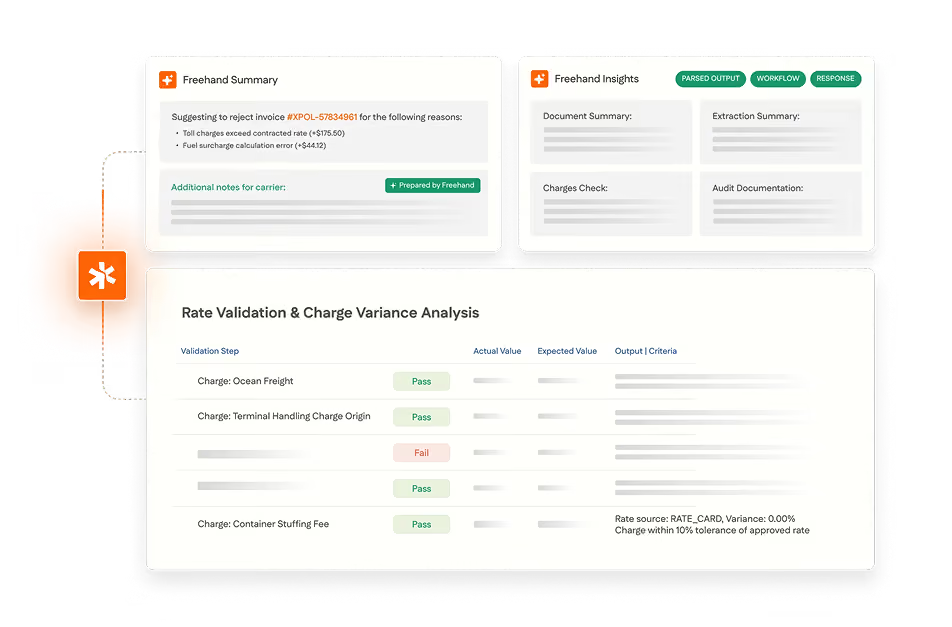
Freehand's invoice audit agent runs independently of any carrier or 3PL relationship, checking 100% of invoice lines against contracted rates rather than a sample, so the audit isn't performed by the party with an incentive to skip it. When it confirms an overcharge, the Dispute Management Agent files the claim directly with the carrier, not back through the 3PL that arranged the invoice in the first place.
A 3PL relationship solves the execution problem: getting freight moved without building that infrastructure yourself. It doesn't solve the audit problem, and in a lot of arrangements, the way freight audit gets bundled in actually recreates it. Knowing where your 3PL's billing sits, and who's actually checking it, is the difference between assuming your freight spend is validated and knowing it is.
{{brown-cta}}
Frequently Asked Questions
What is a 3PL in logistics?
A 3PL (third-party logistics provider) is a company that handles logistics operations, warehousing, fulfillment, and freight transportation, on behalf of a shipper, so the shipper doesn't have to run that infrastructure internally.
What's the difference between a 3PL and a freight broker?
A freight broker arranges transportation by matching shippers with carriers. A 3PL typically offers a broader set of services, warehousing and fulfillment on top of transportation, though many 3PLs also broker freight as part of that offering.
What's the difference between a 3PL and a 4PL?
A 3PL executes logistics work directly. A 4PL manages and coordinates a network of 3PLs and carriers on a strategic level, without necessarily executing the physical work itself. See our full breakdown in 4PL logistics.
Why would a 3PL auditing its own invoices be a problem?
Because the incentive to find and recover a billing error is structurally close to zero when the party doing the audit is also the party that issued or arranged the invoice. Independent audit removes that conflict by having no financial relationship to the carrier or 3PL being checked.
Does using a 3PL mean freight billing is automatically validated?
No. Many 3PLs bundle freight audit in as a service, but that audit is often a summary-level check, not a line-item validation against contracted rates, and it frequently excludes the highest-spend categories like dedicated fleet and FTL.
An Audit With No Stake in Your 3PL's Invoice.
Freehand checks 100% of your 3PL-arranged freight charges against contracted rates, independent of the 3PL relationship, and files disputes directly with the carrier.
The Company That Billed You Is Auditing the Bill.
When a 3PL bundles freight audit into its own service, the incentive to catch its own overcharge is close to zero.
Every warehouse. Every provider. Every mile.
Gartner's 2026 outlook on logistics outsourcing, and how AI Teams hold every contract to the terms you agreed.
- Where outsourced logistics quietly loses margin
- Why billed charges drift from the contract
- How AI Teams close the gap