

4PL Logistics: What It Means and What Still Needs Auditing
A 4PL manages your 3PLs and network, but it doesn't remove the invoice audit problem. See how 4PL differs from 3PL and where billing still needs checking.
.webp)
August 17, 2026
•
6
mins

A 4PL (fourth-party logistics provider) manages your logistics network on your behalf. It coordinates the 3PLs, carriers, and technology involved, instead of executing shipments itself. Handing that work to a 4PL doesn't remove the invoice audit problem. It usually multiplies it.
Key Takeaways
- A 4PL manages and coordinates your 3PLs, carriers, and logistics network on a strategic level, while a 3PL executes the physical work: warehousing, fulfillment, and transportation.
- 4PLs often act as a control tower, consolidating data and vendor relationships into a single point of contact.
- A 4PL relationship still generates invoices, both the 4PL's own management fee and passthrough billing from the 3PLs and carriers it coordinates, and none of that billing audits itself.
- Enterprises with a 4PL in place often assume the 4PL is validating that passthrough billing; in practice, that validation is frequently summary-level, not line-level.
- Freehand's invoice audit agent checks every 3PL and 4PL invoice line against contracted rates, at 100% coverage, and its Dispute Management Agent files and tracks claims when a discrepancy is confirmed.
What is a 4PL, and how is it different from a 3PL?
A 4PL (fourth-party logistics provider) oversees your logistics network. It coordinates the 3PLs, carriers, and technology that make it run, at a strategic level, not a hands-on one.
A 3PL executes: it warehouses inventory, fulfills orders, and moves freight. A 4PL directs: it plans the network, picks the 3PLs and carriers within it, and often serves as your single point of contact.
The practical difference is control. With a 3PL, your team still makes the key vendor and network decisions. With a 4PL, much of that decision-making shifts to the 4PL itself. That's why 4PL relationships tend to show up at enterprises with complex, multi-region networks that are hard to manage directly.
For a closer look at what a 3PL itself bills and who checks it, see our guide to 3PL logistics. For a side-by-side comparison of platforms that audit 3PL and 4PL billing, see our guide to 3PL and 4PL audit software.
What does a 4PL actually do day to day?
A 4PL typically runs as a control tower. It pulls shipment data, vendor performance, and billing from every 3PL and carrier in your network into one interface and one point of contact. That includes picking and managing the 3PLs and carriers, running network optimization and KPI reporting, and coordinating the technology stack behind it.
This centralizes a fragmented network, which is genuinely valuable. But it also means the billing coming out of a 4PL relationship has more layers than a single carrier invoice. It can include the 4PL's own management fee, plus passthrough charges from every 3PL and carrier it oversees.
{{blue-cta}}
Does using a 4PL remove the need to audit invoices?
No. A 4PL relationship doesn't eliminate invoice risk. It adds a layer to it. Every 3PL and carrier the 4PL manages still bills for its own services, and the 4PL's own fee sits on top. Enterprises often assume the 4PL is auditing this billing for them. In practice, that oversight is usually a summary-level check against a budget, not a line-level check against every rate, accessorial, and service charge.
How do you audit invoices that flow through a 4PL relationship?
Auditing 4PL-managed billing means checking every line, from every underlying 3PL and carrier, against the contracted rate schedule. That's different from reconciling the 4PL's summary invoice against a budget. It includes storage fees, handling charges, value-added services, and accessorials from each provider, plus the 4PL's own management fee against its service agreement.
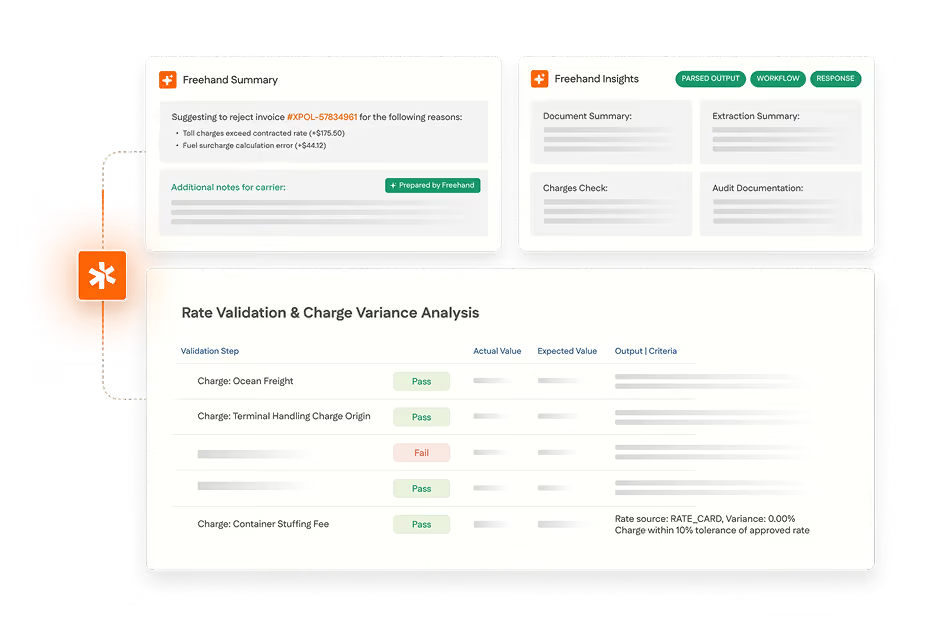
Freehand's invoice audit agent validates every line item on every 3PL and 4PL invoice against your contracted rate schedule, at 100% coverage instead of a sample. When a discrepancy is confirmed, the Dispute Management Agent files a structured claim with the provider, tracks resolution status, and escalates unresolved disputes. That's easy to lose track of manually across a network with multiple providers billing on different cycles.
{{brown-cta}}
Frequently Asked Questions
What is 4PL in logistics?
A 4PL (fourth-party logistics provider) manages a company's logistics network on its behalf. It coordinates the 3PLs, carriers, and technology involved, at a strategic level, not a hands-on one.
What's the difference between 3PL and 4PL?
A 3PL does the physical work: warehousing, fulfillment, and transportation. A 4PL oversees multiple 3PLs and carriers for you, often acting as a control tower and single point of contact.
Does a 4PL replace the need for invoice auditing?
No. It adds a billing layer instead of removing one. You get the 4PL's own management fee, plus passthrough invoices from every 3PL and carrier it manages. None of that audits itself.
Why would a company use a 4PL instead of managing 3PLs directly?
A 4PL centralizes a complex, multi-region network into one point of contact. That's useful once managing multiple 3PLs and carriers directly gets too hard to coordinate in-house.
Who audits a 4PL's passthrough billing?
That's often a gap. Many enterprises assume the 4PL checks its own network's billing for them. In practice, that check is usually summary-level, not a line-by-line audit against the contracted rate.
Every Layer Checked, Not Just the Summary.
Freehand validates each 3PL and carrier invoice inside your 4PL network against contracted rates, at 100% coverage, and flags rate drift the summary line would never show.
One 4PL Invoice Hides Three Billing Layers.
The management fee, passthrough 3PL and carrier charges, and rate drift across the network all move through the same summary line, unchecked at the line-item level.
Every warehouse. Every provider. Every mile.
Gartner's 2026 outlook on logistics outsourcing, and how AI Teams hold every contract to the terms you agreed.
- Where outsourced logistics quietly loses margin
- Why billed charges drift from the contract
- How AI Teams close the gap