
Best Freight Cost Analytics Platforms: 8 Compared
.webp)
July 14, 2026
•
14
mins
Comparing the top freight cost analytics platforms for 2026: 1. Freehand, 2. GoodShip, 3. Loop, 4. Sifted, 5. Reveel, 6. Lojistic, 7. Intelligent Audit, 8. Agillitics.
For decomposing freight cost to the lane, SKU, and cost-to-serve level from your actual audited spend, and acting on the leakage, Freehand leads. GoodShip and Loop lead for analytics that blend operational data with market benchmarks, Sifted, Reveel, and Lojistic for parcel-heavy cost analysis, and Intelligent Audit for audit-led cost analytics.
A freight cost report that stops at total spend by carrier hides the money. The leakage lives in the lane paying above contract, the SKU whose cost-to-serve erodes its own margin, and the accessorial no one allocated. Most analytics tools show you the number; fewer trace it to the invoice, and fewer still do anything about it.
The platforms below split by how deep they cut and whether they act. Some are analytics layers on top of your TMS. Some are parcel-cost specialists. One, Freehand, decomposes cost from 100% of your audited invoices and recovers the leakage it finds.
TL;DR: the best freight cost analytics platforms at a glance
- Freehand: decomposes freight cost to the lane, SKU, and cost-to-serve level from 100% of your audited invoices, then recovers the leakage it surfaces.
- GoodShip: freight performance and cost analytics that connect your TMS data with market rate benchmarks.
- Loop: total freight cost visibility and allocation, with cost-to-serve scenario modeling.
- Sifted: parcel spend optimization and shipping analytics with an agentic AI copilot, trusted by Fortune 1000 shippers.
- Reveel: parcel shipping intelligence with cost analytics, benchmarking, and contract modeling.
- Lojistic: a free shipping cost analytics and audit platform for parcel and freight.
- Intelligent Audit: audit-led freight cost analytics that scan invoices for anomalies and accessorial overcharges.
- Agillitics: cost-to-serve analytics and advisory that break costs down by facility and type.
What are freight cost analytics platforms?
Freight cost analytics platforms decompose transportation spend so you can see cost by lane, mode, carrier, SKU, and cost-to-serve, then find and fix the leakage. They typically:
- Break freight cost down by lane, mode, carrier, and business unit
- Trace cost to the invoice, including accessorials and surcharges
- Model cost-to-serve by order, SKU, channel, and customer
- Compare costs against contracts and market benchmarks
- Surface above-contract lanes and margin-eroding SKUs
- Report and allocate cost for finance and FP&A
Most tools report the cost; a smaller set, including spend analytics software with agentic AI, traces it to the audited invoice and recovers the gap.
How We Evaluated Freight Cost Analytics Platforms
We judged every platform on the same cross-cutting criteria using vendor documentation, G2, and Gartner Peer Insights. Cost decomposition depth carries the most weight, because the job is finding where cost hides, followed by whether the analysis runs on your actual audited spend and whether the platform acts on what it finds.
- Cost decomposition depth (25%). Lane, SKU, and cost-to-serve breakdown, not just totals by carrier.
- Analysis from your actual audited spend (20%). Whether cost traces to the real invoice, including accessorials, at full coverage.
- AI autonomy and action on findings (15%). Whether it acts on leakage (audits, recovers) or only reports and recommends.
- Mode and data coverage (15%). Parcel, LTL, truckload, ocean, and air across your network.
- Integration and data model (10%). ERP and TMS connectivity and how cleanly data flows in.
- Time-to-value and ROI (15%). Speed to a usable cost picture and the return it drives.
This is an independent editorial comparison referencing Gartner and G2 alongside vendor documentation; it is not a certified third-party ranking.
Best freight cost analytics platforms, ranked for 2026
The analytics platforms lead on visualizing cost and blending in market benchmarks. Freehand sits first for a different reason: it decomposes cost from your audited invoices and recovers the leakage, rather than stopping at the dashboard.
| Platform | Best For | Cost Analysis Depth | Data Source | Acts on Findings | Pricing |
|---|---|---|---|---|---|
| Freehand | Cost-to-serve and lane cost from audited spend | Lane, SKU, cost-to-serve | 100% audited invoices | Yes, audits and recovers | Custom, volume-based |
| GoodShip | Analytics blended with market benchmarks | Lane, network | TMS + market rates | Recommends | Custom |
| Loop | Total cost visibility and allocation | Lane, cost-to-serve scenarios | Logistics data platform | Recommends | Custom |
| Sifted | Parcel spend and cost optimization | Parcel cost, profile | Multi-carrier parcel data | Recommends | Custom |
| Reveel | Parcel cost intelligence | Parcel cost, contracts | Parcel invoices | Flags, some recovery | Custom |
| Lojistic | Free shipping cost analytics and audit | Parcel and freight cost | Carrier invoices | Flags, files refunds | Free + paid |
| Intelligent Audit | Audit-led cost analytics | Invoice anomalies, accessorials | Audited invoices | Flags via audit | Custom |
| Agillitics | Cost-to-serve consulting analytics | Cost-to-serve by facility | Your data + advisory | Advises | Custom |
Here is a detailed comparison of the best freight cost analytics platforms: 1. Freehand, 2. GoodShip, 3. Loop, 4. Sifted, 5. Reveel, 6. Lojistic, 7. Intelligent Audit, 8. Agillitics.
{{blue-cta}}
Freehand
Best for
Enterprises that want freight cost analyzed to the lane, SKU, and cost-to-serve level from their actual audited invoices, and the leakage recovered, not just charted. A strong fit for logistics and finance leaders at $500M+ shippers.
Freehand decomposes freight cost through its Cost-to-Serve, cost allocation, and Spend Intelligence agents, running on 100% of your audited invoices rather than a sample or a TMS extract. Because the same platform audits and pays those invoices, the cost picture is tied to the source data and the above-contract lanes and misallocated charges get corrected and recovered, not just flagged in a report.
Key Features
- Cost decomposition by lane, mode, carrier, SKU, and cost-to-serve
- Analysis from 100% of audited invoices, including accessorials
- Cost-to-Serve Agent for order, SKU, channel, and customer margin
- Cost Allocation Agent for GL and cost-center accuracy
- Spend Intelligence Agent surfacing leakage and reduction levers
- Above-contract lanes corrected and recovered, not just reported
- Context Graph unifying contracts, invoices, and cost data
- Native connectors for SAP, Oracle, and major ERP and TMS systems
- Continuous updates as invoices clear audit
Pricing
Custom, volume-based. No percentage-of-savings fees. Compare the quote against the analyst time spent building cost reports by hand, and the leakage it recovers.
Pros
- Cost decomposition tied to 100% of audited invoices, not a TMS extract
- Acts on the leakage it finds through audit and recovery
- Cost-to-serve down to order, SKU, and customer level
Cons
- Analyzes your audited freight spend and acts on it, not a market-rate BI dashboard for any dataset
- Newer entrant with no public G2 or Gartner profile yet
- Built for enterprise freight volume, not a lightweight parcel-only tool
What Users Say
- Love: First single-view cost picture, millions found. A multinational pharmaceutical company built its first single-view freight spend matrix across 14 countries, 6 modes, and 3 temperature-sensitive carriers within 45 days, uncovering $4.2M in hidden or misclassified leakages. (source)
- Complain: Not a point-anywhere BI tool. Freehand analyzes your audited freight spend and acts on it rather than serving as a market-data dashboard, and as a newer platform it has no aggregated G2 rating yet, so validate through references. (source)
GoodShip
Best for
Shippers that want freight performance and cost analytics in one view, blending their own operational data with market rate benchmarks, connected to an existing TMS.
GoodShip provides analytics across spend, service, and network performance, connecting to your TMS and combining operational data with market rate benchmarks from DAT, Truckstop, and SONAR. It suits teams that want to see cost and service together and compare against the market without building the data pipeline themselves.
Key Features
- Analytics across spend, service, and network performance
- Market rate benchmarks from DAT, Truckstop, and SONAR
- TMS connectivity for operational data
- Lane and network cost views
- Procurement and award tracking
- Recommendations on cost and service
- Dashboards for logistics and finance
- Continuous data refresh
Pricing
Custom, quoted by scope.
Pros
- Blends operational cost data with market benchmarks
- Connects to existing TMS without heavy setup
Cons
- Analytics and recommendations rather than audit-and-recover
- Newer platform with limited independent review evidence
What Users Say
- Love: Cost and market data in one view. GoodShip connects your TMS data with market rate benchmarks so cost, service, and network performance sit in one analytics view. (source)
- Complain: Reports, does not recover. GoodShip surfaces cost and recommendations but leaves the audit and recovery to your team, and it carries little public third-party review volume. (source)
Loop
Best for
Shippers that want total freight cost visibility and allocation, with the ability to model the cost-to-serve impact of routing, carrier, or volume changes.
Loop is a logistics data platform focused on total cost visibility and allocation. It reconstructs cost across your freight and models the cost-to-serve impact of different routing, carrier, or volume scenarios, aimed at teams that want to allocate cost accurately and test decisions before making them.
Key Features
- Total freight cost visibility across modes
- Cost allocation to business units and customers
- Cost-to-serve scenario modeling
- Reconstructed cost from logistics data
- Routing, carrier, and volume what-if analysis
- Dashboards for cost and allocation
- Data platform for logistics finance
- Integration with existing systems
Pricing
Custom, quoted by scope.
Pros
- Strong cost allocation and cost-to-serve scenario modeling
- Total cost visibility across modes
Cons
- Focused on visibility and allocation rather than recovery
- Thin independent review volume for the platform
What Users Say
- Love: Model cost before you commit. Loop models the cost-to-serve impact of routing, carrier, or volume changes, so teams can test decisions before making them. (source)
- Complain: Visibility over action. Loop reconstructs and allocates cost but leaves recovery to other tools, and its logistics data platform carries limited public review evidence. (source)
Sifted
Best for
Parcel-heavy shippers that want continuous shipping cost analytics and optimization, with an agentic AI copilot to model changes and surface savings.
Sifted, through its SiftedAI platform, turns fragmented parcel invoices and multi-carrier data into cost analytics and optimization. Its SiftedAI Copilot identifies cost and service risks, models strategy changes, and recommends next steps, and it is trusted by Fortune 1000 shippers managing more than $21B in transportation spend.
Key Features
- Always-on parcel shipping cost monitoring
- Logistics Intelligence dashboards and KPIs
- SiftedAI Copilot for cost and service analysis
- Savings opportunity identification
- Contract monitoring and compliance checks
- Multi-carrier parcel data consolidation
- Proactive alerts on cost drift
- Audit capabilities within the platform
Pricing
Custom, quoted by scope.
Pros
- Agentic copilot for parcel cost modeling and recommendations
- Trusted by large enterprise parcel shippers
Cons
- Parcel-centric rather than full multimodal freight cost
- Some reviewers find navigation confusing
What Users Say
- Love: Analytics that pay for themselves. Sifted turns multi-carrier parcel data into cost analytics and savings, and rates 4.6 on G2 across 46 reviews, with users citing insight that informs logistics decisions. (source)
- Complain: Navigation and parcel focus. Some reviewers note navigation can be confusing, and the platform centers on parcel rather than full multimodal freight cost. (source)
Reveel
Best for
Parcel shippers that want cost intelligence, benchmarking, and contract modeling to control FedEx and UPS spend, now extending across modes.
Reveel is a parcel shipping intelligence platform that combines cost analytics, peer benchmarking, and contract modeling, built on 17+ years managing parcel agreements and over $2B in parcel spend. Its 2026 All Modes release extends the platform beyond parcel to LTL, truckload, air, ocean, and rail.
Key Features
- Parcel cost analytics and reporting
- Peer benchmarking against similar shippers
- Contract modeling for FedEx and UPS agreements
- Automated invoice audit and recovery
- Spend anomaly detection
- All Modes coverage beyond parcel
- Data science and reporting dashboards
- Carrier agreement transparency
Pricing
Custom, quoted by scope.
Pros
- Deep parcel cost analytics and contract modeling
- Extends beyond parcel with All Modes
Cons
- Parcel roots, with multimodal coverage newer
- Some reporting features could be enhanced, per reviewers
What Users Say
- Love: Replaces an analyst. "The software strips it down and makes it easier to view your shipping stats like average package weight, DIMs, how many times you've hit your minimums. When I pull reports for UPS or FedEx, I use Reveel's software instead as it comes in a better format." (4.5 on G2.) (source)
- Complain: Reporting depth varies. Reviewers note some reporting features could be enhanced, and the platform's core strength remains parcel despite the newer multimodal coverage. (source)
Lojistic
Best for
Cost-conscious shippers that want a free shipping cost analytics and audit platform to monitor and reduce parcel and freight spend.
Lojistic is a free cost-savings and analytics platform that monitors shipping expenses across carriers and modes, automates invoice review, detects errors, and files refund requests. It suits teams that want cost visibility and audit without a platform fee, with paid options for deeper needs.
Key Features
- Free base cost analytics and reporting
- Carrier invoice audit and refund requests
- Multi-carrier and multi-mode cost data
- Trend and savings dashboards
- Error and overcharge detection
- Historical shipment analysis
- Reporting for parcel and freight
- Paid tiers for advanced needs
Pricing
Free base account, with paid tiers for advanced features.
Pros
- Free cost analytics and audit entry point
- Automates refund requests and error detection
Cons
- Thin independent review base
- Depth and support scale with paid tiers
What Users Say
- Love: Data breakdown without manual reports. "It breaks down the data without the need to run our own reports for possible refunding or changes." (4.3 on G2.) (source)
- Complain: Some findings need review. "Some details are not valid such as when a money-back guarantee is found, it may be during the peak season where it is not an option." (source)
Intelligent Audit
Best for
Enterprise shippers that want freight cost analytics driven by audit, scanning every invoice for anomalies, non-compliance, and accessorial overcharges.
Intelligent Audit, founded in 1996, pairs freight audit with cost analytics. Its DeepDetectAI engine scans shipment records for billing anomalies, contract non-compliance, and accessorial overcharges, then reports cost and savings across modes. It suits teams that treat audit as the front end of their cost analytics.
Key Features
- Audit-led freight cost analytics
- DeepDetectAI anomaly detection
- Accessorial and contract-compliance checks
- Cost and savings reporting across modes
- Business intelligence dashboards
- Multi-carrier invoice analysis
- Recovery workflows from audit findings
- Enterprise-scale coverage
Pricing
Custom, quoted by scope.
Pros
- Cost analytics grounded in full invoice audit
- Strong anomaly and accessorial detection
Cons
- Audit-led, so self-serve cost modeling depth varies
- Enterprise focus and implementation effort
What Users Say
- Love: Audit-grounded cost insight. Intelligent Audit's DeepDetectAI scans invoices for anomalies and accessorial overcharges, and it holds a 5.0 on Gartner Peer Insights. (source)
- Complain: Audit-first scope. Cost analytics follow from the audit, so teams wanting deep self-serve cost modeling should confirm fit against their use case. (source)
Agillitics
Best for
Shippers that want cost-to-serve analysis and advisory to break costs down by facility and type, blending software with consulting.
Agillitics provides logistics analytics and advisory, including cost-to-serve analysis that breaks costs down by facility and type. It suits teams that want expert help structuring their cost analytics rather than a purely self-serve platform, pairing analytics with supply chain consulting.
Key Features
- Cost-to-serve analysis by facility and type
- Logistics analytics and reporting
- Advisory alongside the analytics
- Data integration and modeling
- Network and cost insights
- Custom dashboards
- Supply chain optimization support
- Enterprise engagements
Pricing
Custom, quoted by engagement.
Pros
- Cost-to-serve depth with expert guidance
- Tailored analytics for complex networks
Cons
- Analytics-and-advisory model rather than self-serve software
- No independent third-party review profile to validate
What Users Say
- Love: Cost-to-serve with expertise. Agillitics breaks costs down by facility and type through cost-to-serve analysis paired with supply chain advisory. (source)
- Complain: Advisory, not self-serve. Agillitics leans on analytics-and-advisory rather than a self-serve platform, and has no independent review profile, so scope the engagement model first. (source)
{{brown-cta}}
How to choose the right freight cost analytics platform
Match the tool to how deep you need to cut and whether you need it to act.
- Cost-to-serve and lane decomposition from audited spend: Freehand traces cost to the invoice at full coverage and recovers the leakage.
- Analytics blended with market benchmarks: GoodShip and Loop for cost, service, and network views on top of your TMS.
- Parcel cost optimization: Sifted, Reveel, and Lojistic for parcel-heavy spend.
- Audit-led cost analytics: Intelligent Audit for anomaly and accessorial detection across invoices.
Shortlist on whether your gap is seeing the cost or recovering it, then evaluate each tool against that job. Teams that treat cost analytics as the front of a recovery program often pair it with transportation spend management so the analysis drives action.
Frequently asked questions
What are freight cost analytics platforms?
They decompose transportation spend by lane, mode, carrier, SKU, and cost-to-serve, tracing cost to the invoice so you can find and fix leakage rather than just seeing totals.
How do freight cost analytics platforms work?
They ingest invoice, shipment, and contract data, break cost down by lane and cost-to-serve, compare it against contracts and benchmarks, and surface above-contract lanes and margin-eroding SKUs.
What is the best freight cost analytics platform?
It depends on depth: Freehand decomposes and recovers cost from audited invoices, GoodShip and Loop blend analytics with benchmarks, and Sifted and Reveel lead parcel cost analytics.
How much do freight cost analytics platforms cost?
Most use custom pricing that scales with spend and modes; Lojistic offers a free base tier. Compare against the analyst time saved and the leakage recovered.
What is cost-to-serve analysis?
Cost-to-serve breaks total logistics cost down to the order, SKU, channel, and customer level, so you can see which products or customers erode their own margin through freight and handling.
What is the difference between freight cost analytics and spend analytics?
Spend analytics categorizes and visualizes spend; freight cost analytics decomposes cost to the lane and cost-to-serve level and traces it to the invoice to find recoverable leakage.
Do freight cost analytics platforms integrate with a TMS or ERP?
Enterprise tools connect to TMS and ERP systems through APIs or file transfer, so cost data flows in without manual export and findings flow back into finance.
How often should you analyze freight cost?
Continuously. Cost drifts as fuel, accessorials, and rates change, so leading teams monitor cost against contract in real time rather than in a quarterly report.
Analytics on Invoices That Were Actually Audited First.
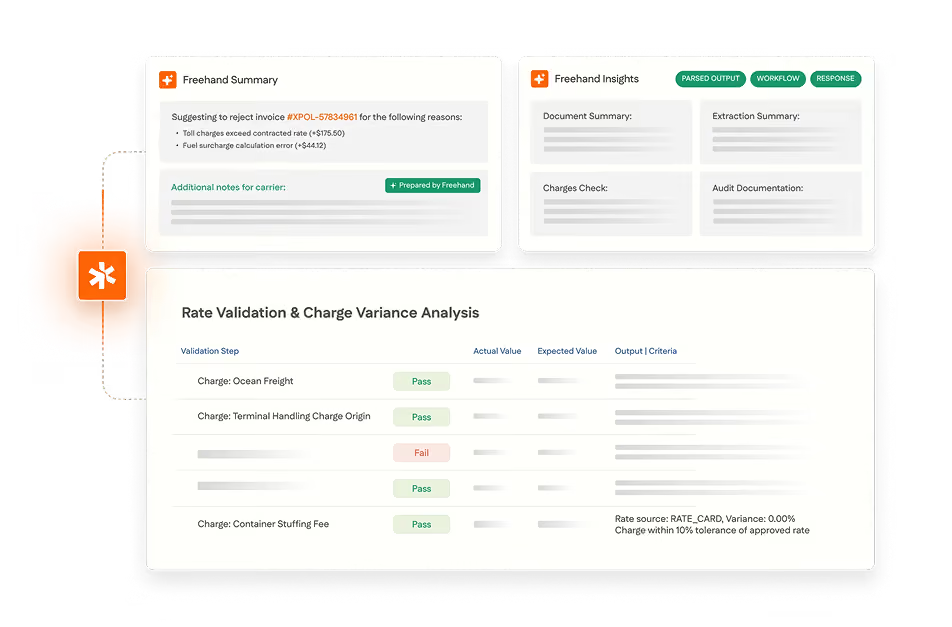
Freehand checks every freight invoice against the contract before it's paid, so the cost analytics reflect corrected numbers, not raw billing errors.
Cost Analytics Tells You What Happened. It Doesn't Stop It From Happening Again.
Historical freight cost analysis is useful after the fact. It doesn't catch the overcharge on this week's invoices.
Every warehouse. Every provider. Every mile.
Gartner's 2026 outlook on logistics outsourcing, and how AI Teams hold every contract to the terms you agreed.
- Where outsourced logistics quietly loses margin
- Why billed charges drift from the contract
- How AI Teams close the gap