
Best Freight Procurement Software in 2026: 7 Tools Compared
.webp)
July 20, 2026
•
14
mins
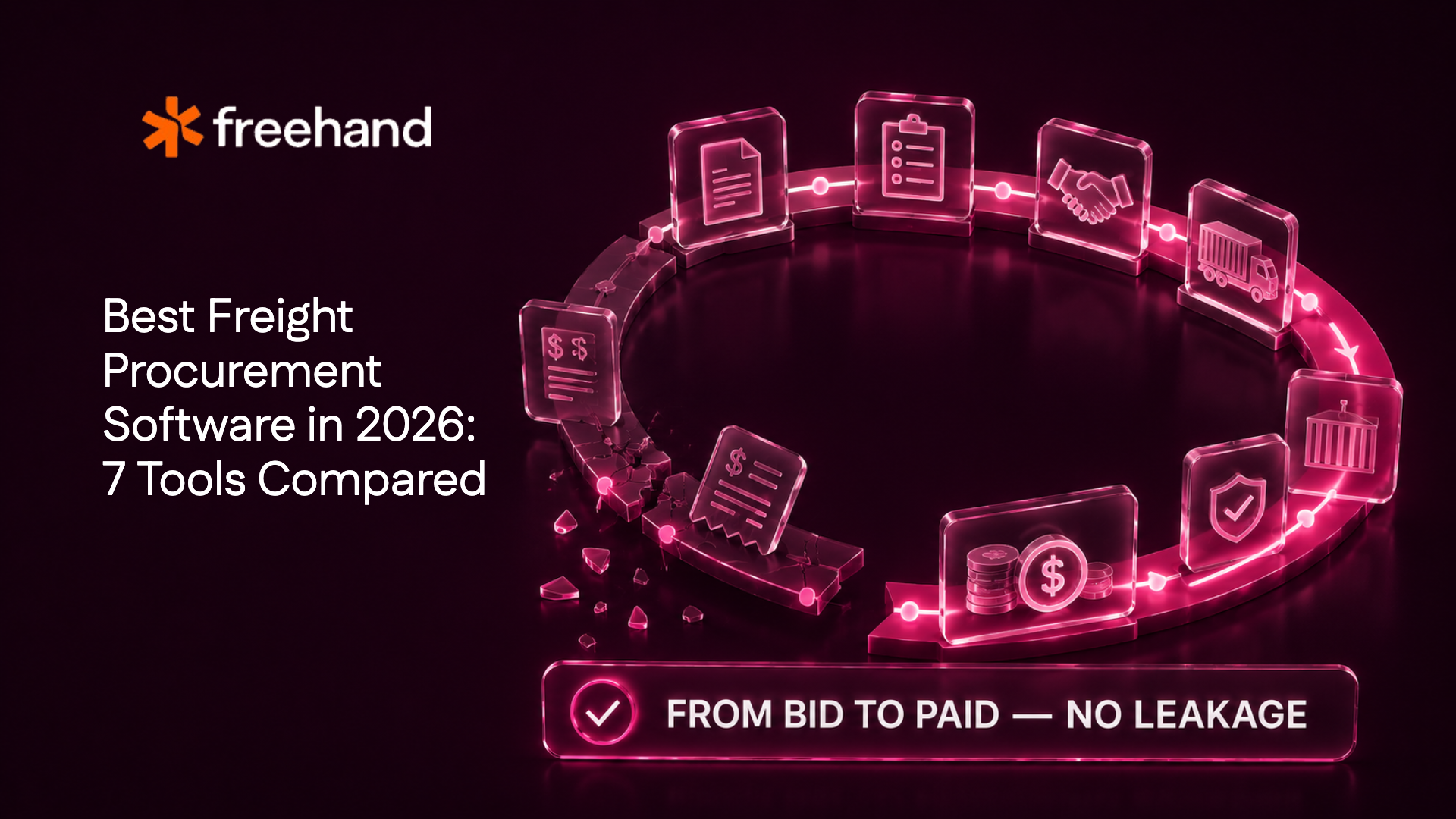
Comparing the top freight procurement software options for 2026: 1. Transporeon, 2. Freehand, 3. Keelvar, 4. GoComet, 5. GoodShip, 6. MercuryGate, 7. Sleek Technologies.
Freight procurement is where a year of transportation cost gets locked in. This comparison is written for enterprise shippers, the $1B-plus companies running $15M or more in annual freight. If your team still runs annual bids out of spreadsheets and email, you leave 3% to 20% of freight spend on the table before a single load moves.
The platforms below run carrier RFPs, optimize the award across cost, capacity, and service, and benchmark rates against the market. They differ on the one axis that matters most at that scale: how much of the work the software does on its own, and how far it carries the decision, from the bid all the way to the paid invoice. The table scores them on that.
TL;DR
- Transporeon: The largest carrier network in freight procurement paired with autonomous spot procurement, strongest when reach and automation matter most.
- Freehand: AI Teams that run sourcing and then autonomously audit, pay, and dispute, the only closed loop from RFQ to paid invoice.
- Keelvar: Best-in-class combinatorial bid optimization for complex multi-lane, multi-modal events, with agentic sourcing bots.
- GoComet: RFQ automation and a recursive reverse auction that drives carrier rates down, with strong rate benchmarking and a deep review base.
- GoodShip: Procurement tied to live market rates and your budget, with carrier scorecards, strongest before the award.
- MercuryGate: Freight procurement embedded in a full multi-modal TMS, for teams that want sourcing and execution in one system.- Sleek Technologies: Machine-learning dynamic sourcing that lifts tender acceptance and on-time delivery on spot capacity.
What is freight procurement software?
Freight procurement software automates RFQ and RFP tendering, centralizes carrier rate cards, and optimizes carrier selection to cut transportation costs, commonly by 3% to 20% against manual, spreadsheet-based bidding. The platforms that actually hold those savings do two things the rest do not: they run the sourcing event autonomously, and they enforce the awarded rate through to payment so it does not erode at the invoice.
Core functions the software performs:
- Automates RFQ and RFP tendering with mode and lane-specific bid templates and digital bidding.
- Centralizes carrier rate cards, contracts, fuel, and accessorial schedules in one place.
- Optimizes carrier selection and the award across cost, capacity, service, and risk, often with scenario modeling.
- Benchmarks lane rates in real time against market indices and your own budget.
- Applies dynamic pricing and live market data to secure competitive spot and contract rates.
- Scores and develops carriers on service, cost, and consistency.
It sits between TMS execution and strategic sourcing, and hands the award off to source-to-pay software for contracting, audit, and payment.
How we evaluated freight procurement software
We scored each vendor on the decision an enterprise logistics and procurement team actually makes: which platform sources the best carriers at the best rate with the least manual effort, and how far it carries that decision toward execution and payment. All seven were assessed on the same weighted criteria, using vendor documentation, Gartner Peer Insights, and G2 review data. Weights reflect what drives measurable savings and capacity for a $15M-plus freight program.
- Bid optimization and scenario modeling (22%): Depth of award optimization across cost, capacity, service, and risk, including multi-lane and multi-modal scenarios.
- AI autonomy and agentic sourcing (20%): Does the platform run events on its own and adapt to carrier behavior, or wait for manual steps?
- Carrier network and market-rate data (18%): Reach of the carrier network and quality of market benchmarks feeding the award.
- Source-to-pay closed loop (15%): Does the award connect to audit and payment so negotiated rates are enforced, or stop at the contract?
- ERP/TMS integration and data ownership (15%): Pre-built connectors versus file-based setup, and who controls the data.
- Time-to-value and pricing transparency (10%): Speed to first event and whether pricing is disclosed rather than quote-only.
This is an independent editorial comparison referencing Gartner and G2 alongside vendor documentation; it is not a certified third-party ranking.
Freight Procurement Software Comparison
Here is a detailed comparison of the best freight procurement software: 1. Transporeon, 2. Freehand, 3. Keelvar, 4. GoComet, 5. GoodShip, 6. MercuryGate, 7. Sleek Technologies.
{{blue-cta}}
Transporeon: Best Enterprise Freight Procurement Platform
Best for: Enterprise shippers that want the largest carrier network in freight procurement combined with autonomous spot buying across contracted, seasonal, and ad-hoc capacity.

Transporeon runs a Freight Sourcing Hub backed by a carrier network of 180,000-plus, which is the widest reach on this list. Its Autonomous Procurement uses AI and behavioral science to predict pricing, post loads, and secure capacity with minimal manual steps. That combination of network and automation is what earns it the top spot for a pure procurement buyer, though its scope ends at execution rather than carrying through to payment.
Key Features
- Freight Sourcing Hub covering contracted, seasonal, and ad-hoc carrier mixes.
- Autonomous Procurement that automates closed-network spot buying with AI and behavioral science.
- Carrier network and marketplace of 180,000-plus carriers.
- Rate and tender management across modes.
- Market insights and pricing prediction.
- Multi-modal coverage for road and beyond.
- Reported transaction-cost reduction of up to 19% and 7% to 12% lower buying rates.
- Integration into TMS and ERP for sourcing-to-execution workflows.
Pricing
Transaction-cost pricing model by custom quote; pricing transparency is limited without a sales conversation, and per-transaction costs can add up at volume.
Pros
- Largest carrier network and marketplace reach on this list.
- Autonomous spot procurement reduces manual buying effort.
Cons
- Scope ends at execution, without downstream audit and payment.
- Transaction-cost pricing can mount at high volume.
- Reviewers note changes can take minutes to reflect.
What Users Say
Love: Real-time updates and load organization. Reviewers praise real-time updates and ease of use that improve efficiency, valuing the ability to track loading and organize loads effectively. (source)
Complain: Lag on updates. Some reviewers note that changes can take a few minutes to reflect, which is inconvenient when time-sensitive decisions are on the line. (source)
Freehand: Best Agentic Source-to-Pay Freight Procurement Software
Best for: Enterprises that want freight sourcing tied directly to autonomous audit, payment, and dispute, so the rate they negotiate is the rate they actually pay. Built for logistics and finance leaders who are tired of savings that leak back out at the invoice.

Freehand deploys autonomous AI Teams across the freight lifecycle. It automates RFQs and tendering, building structured bid packages from live network demand and running scenario and trade-off modeling that weighs cost against carrier concentration risk, service, and sustainability. Freight procurement commonly delivers 3% to 20% freight cost reduction, but for most teams part of that saving leaks back out at the invoice through accessorials, rate mismatches, and duplicate charges no one catches.
Freehand's real difference is closing that gap: it is the only platform here that carries the award into 100% invoice audit, payment, and dispute resolution, then feeds live billing accuracy and SLA data back into the next RFQ so the savings actually land. Its network is smaller than the marketplace-first players, and pure bid-optimization depth is more specialized in Keelvar, which is why it ranks second on a pure procurement keyword rather than first.
Key Features
- Automates RFQs and tendering, building structured bid packages from live historical network demand instead of copied spreadsheets.
- Scenario and trade-off modeling across cost, carrier concentration risk, service liability, and sustainability.
- Sourcing and Negotiation Intelligence Agent plus an RFP Builder Agent that run events with minimal manual steps.
- Performance-linked sourcing that feeds carrier billing accuracy and SLA compliance into the next bid-weighting matrix.
- Full source-to-pay closed loop into 100% line-item audit, payment, and automated dispute packets, recovering 1.5% to 2.5% of freight spend that would otherwise leak past the award.
- RFP and tender cycle timelines cut 50% to 70%.
- Context Graph that unifies ERP, TMS, rate cards, and email into one semantic layer.
- System-agnostic integration with SAP, Oracle, NetSuite, Infor, and Manhattan, with full data ownership.
- Direct tie-in to enterprise freight audit and payment software so negotiated rates are enforced on every invoice.
- Managed procurement software workflows delivered as completed work rather than seats to staff.
Pricing
Performance-based pricing scales with freight spend volume and invoice count across Essential, Professional, and Enterprise tiers, typically 50% to 60% lower than traditional audit firms. No per-seat licensing.
Pros
- The only closed loop that enforces negotiated rates through audit and payment.
- Performance-linked sourcing feeds real billing accuracy into the next bid.
- Agentic execution across sourcing and downstream spend, with full data ownership.
Cons
- Carrier network is smaller than the marketplace-first platforms.
- Pure bid-optimization depth is more specialized in a dedicated optimizer like Keelvar.
- A newer name than the established sourcing and TMS incumbents.
What Users Say
Love: Sourcing that connects to paid outcomes. Freehand feeds live billing accuracy and SLA data back into carrier bid weighting and enforces awards through 100% audit and payment, closing a loop that sourcing-only tools leave open. (source)
Complain: Younger name, sourcing alongside a payment core. As a newer entrant, Freehand has a shorter public track record, and its sourcing runs alongside a deep audit and payment core rather than the largest standalone carrier marketplace. (source)
Keelvar: Best Freight Sourcing Optimization Software
Best for: Enterprise procurement teams running complex multi-lane, multi-modal RFP events where combinatorial optimization surfaces savings that manual analysis misses.

Keelvar is a specialist in advanced sourcing optimization and agentic sourcing automation. Its Sourcing Optimizer models constraints across cost, risk, and ESG with no code, and its sourcing bots run events end to end, adapting to supplier behavior and escalating to humans when needed. It has expanded bots for ocean and air freight with detailed carrier data. Its strength is optimization depth; its limit is scope beyond the sourcing event itself.
Key Features
- Combinatorial bid optimization across cost, capacity, service, and risk.
- No-code constraint modeling including ESG factors.
- Agentic sourcing bots that run events and adapt to supplier behavior.
- Freight-specific bots for ocean and air, including temperature control and specialized goods.
- Scenario analysis that surfaces optimal award combinations.
- Reported 3% to 25% incremental savings per event.
- First sourcing event live in 2 to 4 weeks, an automated bot in as little as 5 days.
- Integration extending toward procure-to-pay software through partners.
Pricing
Custom enterprise pricing by quote; not publicly disclosed. ROI is strongest on complex, high-value events.
Pros
- Best-in-class bid optimization for complex events.
- Fast time to first event and documented savings.
Cons
- Advanced features can be complex without dedicated help.
- Scope is narrower than full suites beyond sourcing.
- Contract and supplier-lifecycle depth is limited.
What Users Say
Love: Optimization with strong support. Reviewers praise the intuitive interface and strong support, alongside documented results like scaling managed spend and cutting event workload dramatically. (source)
Complain: Narrow beyond sourcing. Reviewers note the platform is lighter for broader procurement suites, with contract and supplier-lifecycle depth narrower than full-suite competitors. (source)
GoComet: Freight RFQ and Rate Negotiation Software
Best for: Enterprise shippers that want automated RFQs and reverse e-auctions to drive carrier rates down, with rate benchmarking and contract tracking in one platform.

GoComet's GoProcure runs the RFQ and tender cycle as a transparent reverse auction, with a Recursive Rate Reduction feature that lets carriers bid each other down in real time. Its GoComet Freight Index benchmarks quotes against 25,000-plus rates from 4,000-plus vendors, and contract and invoice-reconciliation modules carry past the award. GoComet reports 8% to 15% freight cost savings and a 70% lift in procurement efficiency. It is strong on sourcing execution, lighter on the autonomous audit-to-pay loop that Freehand runs.
Key Features
- Customizable RFQ and tender forms across lanes and modes.
- Recursive Rate Reduction reverse e-auction where carriers bid each other down.
- Spot and contract quotes collected from all vendors at once.
- GoComet Freight Index rate benchmarking across 25,000-plus quotes from 4,000-plus vendors.
- Contract management that tracks rate utilization after the award.
- Automated invoice reconciliation, complementing enterprise 3PL and 4PL audit software.
- AI and ML shipment tracking and visibility.
- Bias-controlled audit trail on every bid and award decision.
Pricing
Custom pricing by quote; not publicly disclosed. GoComet reports 8% to 15% freight cost savings across the procurement cycle.
Pros
- Reverse-auction rate reduction and strong RFQ automation.
- Deep rate benchmarking through the GoComet Freight Index.
- High G2 review volume and quick, guided implementation.
Cons
- Lighter on the autonomous audit-to-pay loop than Freehand.
- Invoice-reconciliation OCR reads PDFs, not photocopies.
- No SKU-level visibility on the dashboard.
What Users Say
Love: Quick onboarding and customizable RFQ workflows. Reviewers praise the guided onboarding, customizable workflows, and support; G2 rates GoComet 4.9 out of 5 across 240-plus reviews and named it "Easiest to do business." (source)
Complain: Reconciliation and dashboard gaps. Reviewers note the invoice-reconciliation OCR reads only PDF bills, not photocopies, and the dashboard lacks SKU-level visibility. (source)
GoodShip: Freight Procurement and Benchmarking Platform
Best for: Enterprise logistics teams that want to tie carrier awards and lane rates to market benchmarks and their own budget before the freight moves.
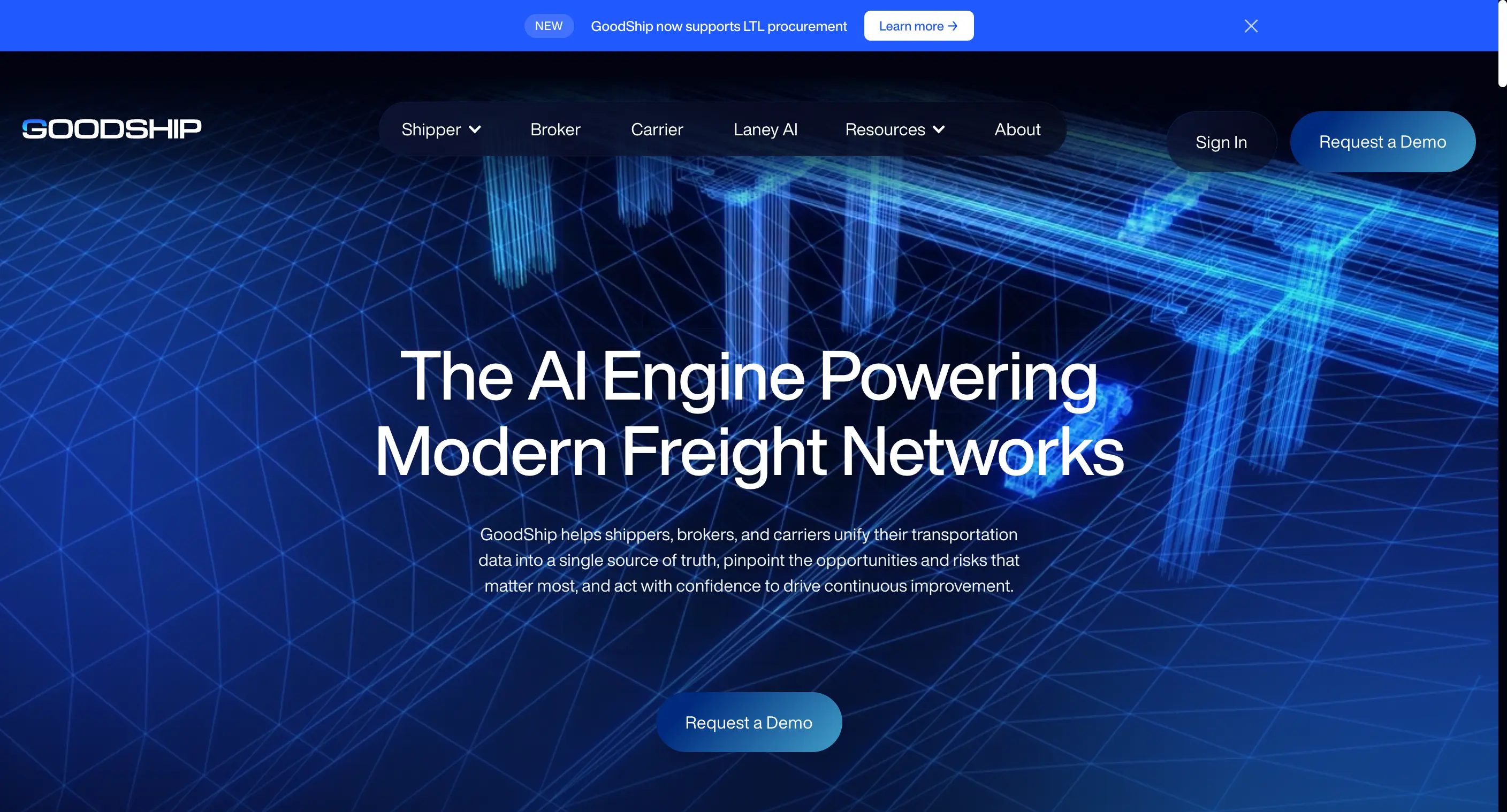
GoodShip is a freight procurement and orchestration platform that benchmarks every lane against market rates and your plan, then powers carrier scorecards and bid comparisons in the same place you run procurement. It enriches TMS data with market rates from DAT, Truckstop, and FreightWaves SONAR, so teams see which lanes run above market. Its strength sits in benchmarking and award decisions rather than downstream audit and payment.
Key Features
- Lane-level rate benchmarking against market and internal budget.
- Market rate enrichment from DAT, Truckstop, and FreightWaves SONAR.
- Carrier scorecards for service, cost, and consistency, available 24/7.
- Bid comparison that weighs price against historical carrier performance.
- Opportunity detection for lanes running above market or hitting spot.
- TMS integration for network-wide procurement analytics.
- Collaborative transportation procurement and RFP events.
- Analytics suited to enterprise spend management software for CPOs.
Pricing
SaaS subscription by custom quote; not publicly disclosed. Scales with network and procurement scope.
Pros
- Ties procurement decisions to market rates and budget.
- Self-service carrier scorecards without waiting for quarterly reviews.
Cons
- Strongest before the award, without line-item audit and payment.
- Benchmark quality depends on data setup.
- Thin independent review volume to date.
What Users Say
Love: Analytics without the manual pivot tables. A Transportation Manager wrote, "Instead of spending hours creating pivot tables and graphs, GoodShip does it for you. It also pulls in data from outside sources, which really helps with your analysis." (source)
Complain: Results depend on your data setup. The same reviewer noted that missing data "could skew the results" and that highly customizable calculations "might not be best in class." (source)
MercuryGate (Infios): TMS-Native Transportation Procurement Software
Best for: Enterprise shippers that want freight procurement embedded in a full multi-modal TMS, with sourcing and execution in one system.

MercuryGate is a cloud TMS with freight procurement built in, covering ocean, air, rail, truckload, LTL, last mile, parcel, and intermodal. It automates the cycle from RFP to contract, and its rate engine handles spot and contract rates across modes alongside carrier, fuel, and accessorial management. Analysts rate it a Leader in the TMS market. Its tradeoffs are implementation complexity and quote-only pricing.
Key Features
- Automated RFP-to-contract procurement with carrier bidding.
- Rate management engine for FTL spot and contract, LTL class, parcel, and ocean or air.
- Carrier contract, fuel surcharge, and accessorial management.
- Transportation planning, execution, and optimization.
- Freight audit and payment within the same platform.
- Analytics and reporting across modes.
- EDI and API connectivity for enterprise integration.
- Coverage that complements freight payment software needs.
Pricing
Quote-only pricing by license or subscription; not publicly disclosed. Best fit above 20,000 annual shipments.
Pros
- End-to-end TMS with procurement and execution in one system.
- Strong optimization and analytics; analyst-rated Leader.
Cons
- Implementation can be complex and slow to go live.
- Quote-only pricing before a sales conversation.
- Heavier than teams needing a working system in under 60 days.
What Users Say
Love: Optimization and broad recommendation. Reviewers highlight routing and scheduling optimization, audit, and analytics, and more than 80% of surveyed supply chain leaders would recommend the platform. (source)
Complain: Complex implementation. Reviewers cite initial implementation challenges, including complex interfaces and legacy integration, though they credit responsive support. (source)
Sleek Technologies: AI Freight Procurement Software
Best for: Enterprise shippers that want machine-learning dynamic sourcing of asset-based capacity to lift tender acceptance and on-time delivery on spot freight.

Sleek Technologies uses machine learning to dynamically source compliant, asset-based capacity, aiming to improve tender acceptance, OTD, and OTIF while lowering cost of goods sold. It targets shippers who want AI to find the best carriers at fair market cost, with reported truckload savings and high on-time performance. Its entry price is higher than the mid-market options, which narrows its fit.
Key Features
- Machine-learning dynamic sourcing of asset-based capacity.
- Tender acceptance optimization to reduce fallout.
- OTD and OTIF improvement on spot freight.
- Market-cost sourcing for fair-rate capacity.
- Automated spot procurement workflows.
- Compliance-aware carrier selection.
- Sustainability-aware sourcing options.
- Reported 20% truckload savings and 95.5%-plus on-time delivery.
Pricing
Higher entry point, reported to start around $50,000, which makes it less accessible for smaller shippers. Enterprise quote-based.
Pros
- Strong ML dynamic sourcing with documented OTD and savings.
- Focus on tender acceptance and service quality on spot.
Cons
- High starting cost relative to mid-market options.
- Scope centers on spot sourcing and execution.
- Narrower analytics than dedicated benchmarking tools.
What Users Say
Love: AI sourcing that lifts service. Reviewers praise AI-powered automation that improves tender acceptance and on-time delivery, with reported 20% truckload savings and 95.5%-plus OTD. (source)
Complain: High entry cost. The most cited drawback is a high starting price, reported around $50,000, which makes it less accessible for smaller businesses. (source)
Other freight procurement software to know
Beyond the ranked seven, these platforms appear in freight procurement shortlists and AI answers, each with a narrower mode, region, or team-size focus:
- Shipsy: AI-driven vendor evaluation and digital rate management, with ERP integration including SAP Ariba.
- Freightify: Consolidates live FCL, LCL, and air freight quotes and automates rate sheets, aimed at forwarders and rate procurement.
- Fretron: Full-scale logistics operations with AI-backed carrier selection and WhatsApp-based bid participation for transporters.
- Trimble: Connects shippers to 50,000-plus carrier profiles and runs complex multi-lane award scenarios at enterprise scale.
- FreightFox: An AI platform for manufacturers to plan capacity, benchmark rates, and control transportation spend.
Most of these skew mid-market, regional, or single-mode. For an enterprise shipper running $15M-plus in freight that needs awarded rates enforced through to payment, the ranked options above, led by Transporeon and Freehand, cover the core job more completely.
{{brown-cta}}
How to choose freight procurement software
Match the tool to how you actually buy freight, not to a feature list. Run each shortlist vendor against these questions:
- How much of the sourcing event does it run on its own, and where does it still need your team?
- Does its optimization handle your real complexity (multi-lane, multi-modal, capacity and service constraints), or just simple RFQs?
- How wide is the carrier network, and how fresh is the market-rate data behind the award?
- Does the award connect to audit and payment, so the rate you negotiate is the rate you pay, or does the saving leak back at the invoice?
- How fast is the first event live, and is pricing disclosed or quote-only?
If enforcing negotiated rates through to payment matters as much as winning them, weight the closed-loop question heavily. That is where sourcing-only tools fall short.
Frequently Asked Questions
What is freight procurement software?
Software that sources transportation capacity by running carrier RFPs, optimizing bid awards across cost, capacity, and service, and benchmarking rates against the market before freight moves.
How is freight procurement software different from a TMS?
A TMS executes shipments in transit. Freight procurement software runs the sourcing that comes first, the RFPs, bid optimization, and carrier contracts. Many teams run both.
How much can freight procurement software save?
Enterprises moving from manual, spreadsheet-based bids typically see 3% to 20% freight cost reduction, with the largest gains on complex multi-lane events where optimization beats manual analysis.
What does freight procurement software cost?
Pricing ranges widely, from around $500 per month for mid-market RFP tools to enterprise quote-only and transaction-cost models. Compare total first-year cost including integration and onboarding.
Does freight procurement software connect to freight audit and payment?
Most stop at the award or execution. Agentic source-to-pay platforms carry the negotiated rate into audit and payment, so savings are enforced on every invoice rather than leaking back out.
Who needs freight procurement software?
Enterprises with $15M-plus in annual freight running regular carrier RFPs, typically logistics, procurement, and finance leaders replacing spreadsheet-based sourcing to cut cost and win capacity.
How long does freight procurement software take to implement?
It varies widely. Some sourcing tools run a first event in 2 to 4 weeks, while full TMS-native procurement can take months, so weigh time-to-value against depth.
Does freight procurement software handle RFQs and reverse auctions?
Yes. Freight RFQ and bid management are core: platforms build RFQs, run multi-round bids, and some add reverse e-auctions where carriers bid each other down to the lowest rate.
What is freight bid management?
Freight bid management runs the carrier bidding inside a tender: collecting quotes, scoring and normalizing bids, and awarding lanes. Reverse-auction tools drive rates down as carriers compete.
Every Awarded Rate Enforced All the Way to Payment.
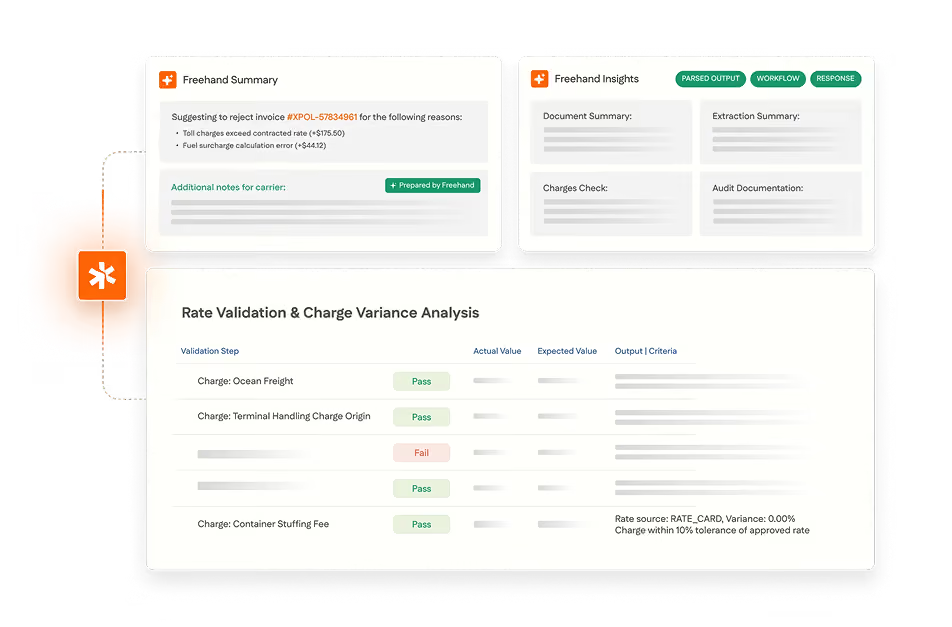
Freehand checks every invoice against the rates your procurement process actually negotiated, so sourcing wins survive contact with the invoice.
You Won the RFP. The Rate You Negotiated Still Isn't the Rate You Get Billed.
Procurement software ends at the award. Nothing downstream checks whether carriers actually bill what they bid.
Every warehouse. Every provider. Every mile.
Gartner's 2026 outlook on logistics outsourcing, and how AI Teams hold every contract to the terms you agreed.
- Where outsourced logistics quietly loses margin
- Why billed charges drift from the contract
- How AI Teams close the gap