
Best Freight Tender Management Software for 2026: 7 Tools Compared
.webp)
July 20, 2026
•
15
mins
.png)
Comparing the top freight tender management software options for 2026: 1. Transporeon, 2. Freehand, 3. Alpega, 4. Keelvar, 5. Freightender, 6. SAP TM, 7. GoComet.
This comparison is written for enterprise shippers, the $1B-plus companies that run a formal freight tender every year or quarter across EU and global lanes. If your annual RFP still lives in spreadsheets and email threads, the tender itself becomes the bottleneck: weeks of data cleaning, manual bid normalization, and awards that erode the moment invoices start arriving.
The platforms below run the tender end to end. They differ on how much of the event the software runs on its own, the carrier network behind it, and whether the awarded rate is enforced all the way to payment. The table scores them on that.
TL;DR
- Transporeon: The largest carrier network for load tendering, strongest when tender reach and capacity assurance matter most.
- Freehand: AI Teams that run the tender and then autonomously audit, pay, and dispute, the only closed loop from RFP to paid invoice.
- Alpega: A dedicated European freight tendering platform through Transwide and Ticontract, with load tendering and freight audit in one suite.
- Keelvar: Best-in-class combinatorial optimization for complex multi-lane, multi-modal tenders, with agentic sourcing bots.
- Freightender: A cloud e-tender specialist for fast RFQs, mini-tenders, and lane requests across road, air, and ocean.
- SAP TM: Enterprise tendering inside the TMS with broadcast and peer-to-peer RFQs, best for teams standardized on SAP.
- GoComet: RFQ automation with a recursive reverse auction that drives carrier rates down, plus rate benchmarking.
What is freight tender management software?
Freight tender management software runs the periodic process where a shipper solicits carrier bids across its lanes, evaluates them, and awards contracts to secure the best mix of rate, capacity, and service for a set period.
Core functions the software performs:
- Builds bid packages from clean lane data and distributes RFPs and RFQs to invited carriers.
- Runs single or multi-round tenders, including mini-tenders and spot bids across modes.
- Normalizes and scores carrier responses for a fair, apples-to-apples comparison.
- Models award scenarios against cost, capacity, service, and risk before you commit.
- Manages carrier rate cards and contracts once the award is made.
A well-run tender balances rate against service and reliability, not price alone. The 2026 differentiator is whether the platform runs the rounds autonomously and carries the award into procurement software and payment, so the rate you awarded is the rate you actually pay.
How we evaluated freight tender management software
We scored each vendor on the decision an enterprise logistics and procurement team makes when it runs a freight tender: which platform sources the best carriers at the best rate with the least manual effort, and how far it carries that award toward execution and payment. All seven were assessed on the same weighted criteria, using vendor documentation, Gartner Peer Insights, and G2 review data. Weights reflect what drives a successful tender for a $15M-plus freight program.
- Tender workflow and multi-round management (22%): How well the platform builds, runs, and normalizes single and multi-round tenders, including mini-tenders.
- Bid optimization and scenario modeling (20%): Depth of award optimization across cost, capacity, service, and risk.
- Carrier network and market data (18%): Reach of the carrier network and quality of market benchmarks feeding the tender.
- AI autonomy and agentic tendering (15%): Does the platform run rounds on its own and adapt, or wait for manual steps?
- Source-to-pay closed loop (15%): Does the award connect to audit and payment so awarded rates are enforced, or stop at the contract?
- Time-to-value and pricing transparency (10%): Speed to launch a tender and whether pricing is disclosed rather than quote-only.
This is an independent editorial comparison referencing Gartner and G2 alongside vendor documentation; it is not a certified third-party ranking.
Freight Tender Management Software Comparison
| Tool | Best For | Tender Approach | AI Autonomy | Execution Scope | Pricing Model |
|---|---|---|---|---|---|
| Transporeon | Enterprises wanting the largest carrier network for tendering | Network-backed load tendering | Autonomous spot procurement | Tendering to execution, not payment | Transaction-cost, custom quote |
| Freehand | Teams wanting the tender tied to autonomous audit and payment | Agentic RFP build and scenario modeling | Agentic: runs the tender, audits, and pays | ✔ Full source-to-pay closed loop | Performance-based, scales with spend |
| Alpega | European shippers wanting a dedicated tendering platform | Transwide / Ticontract load tendering | Assistive workflow automation | Tendering plus freight audit | Modular, custom quote |
| Keelvar | Complex multi-lane tenders needing optimization | Combinatorial bid optimization | Agentic sourcing bots | Award recommendation, not payment | Custom, enterprise quote |
| Freightender | Fast, structured e-tenders across modes | Cloud e-tender and mini-tenders | Assistive scenario modeling | Sourcing to award, not payment | Pay-per-tender or annual |
| SAP TM | Enterprises standardized on SAP | Broadcast and peer-to-peer tendering | Assistive optimization | Tendering plus audit inside the TMS | License, quote-only |
| GoComet | Teams driving rates down with reverse auctions | RFQ and recursive rate-reduction auction | Assistive AI, human-run events | Benchmarking and reconciliation | Custom quote |
Here is a detailed comparison of the best freight tender management software: 1. Transporeon, 2. Freehand, 3. Alpega, 4. Keelvar, 5. Freightender, 6. SAP TM, 7. GoComet.
{{blue-cta}}
Transporeon: Best Enterprise Freight Tender Management Software
Best for: Enterprise shippers that want the largest carrier network behind their tenders, with real-time load tendering across road, rail, sea, and air.
Transporeon runs load tendering on a carrier network of 100,000-plus, the widest reach on this list, which is its core advantage for a tender program that needs guaranteed capacity. Its Autonomous Procurement automates closed-network spot buying with AI and behavioral science. That combination of network and automation earns it the top spot for a pure tendering buyer, though its scope ends at execution rather than carrying through to payment.
Key Features
- Real-time load tendering across road, rail, sea, and air.
- Carrier network and marketplace of 100,000-plus carriers.
- Autonomous Procurement for closed-network spot buying.
- Rate and tender management across modes.
- Market insights and pricing prediction.
- Multi-round tender workflows.
- Reported transaction-cost reduction of up to 19%.
- Integration into TMS and ERP for tender-to-execution workflows.
Pricing
Transaction-cost pricing model by custom quote; pricing transparency is limited without a sales conversation, and per-transaction costs can add up at volume.
Pros
- Largest carrier network for tendering on this list.
- Autonomous spot procurement reduces manual buying effort.
Cons
- Scope ends at execution, without downstream audit and payment.
- Transaction-cost pricing can mount at high volume.
- Reviewers note changes can take minutes to reflect.
What Users Say
Love: Real-time updates and load organization. Reviewers praise real-time updates and ease of use that improve efficiency, valuing the ability to track loading and organize loads effectively. (source)
Complain: Lag on updates. Some reviewers note that changes can take a few minutes to reflect, which is inconvenient when time-sensitive decisions are on the line. (source)
Freehand: Best Agentic Source-to-Pay Freight Tender Software
Best for: Enterprises that want the tender tied directly to autonomous audit, payment, and dispute, so the rate they award is the rate they actually pay. Built for logistics and finance leaders tired of tender savings that erode at the invoice.

Freehand deploys autonomous AI Teams across the freight lifecycle. Its RFP Builder Agent and Negotiation Intelligence Agent build and run the tender from live network demand, and scenario modeling weighs cost against carrier concentration risk, service, and sustainability. A tender commonly recovers savings that then leak back out at the invoice through accessorials and rate mismatches no one catches. Freehand closes that gap: it is the only platform here that carries the award into 100% invoice audit, payment, and dispute resolution, then feeds billing accuracy and SLA data back into the next tender. Its carrier network is smaller than Transporeon's, which is why it ranks second on a pure tendering keyword rather than first.
Key Features
- RFP Builder Agent and Negotiation Intelligence Agent that run tenders with minimal manual steps.
- Scenario and trade-off modeling across cost, carrier concentration risk, service, and sustainability.
- RFP and tender cycle timelines cut 50% to 70%.
- Performance-linked tendering that feeds billing accuracy and SLA compliance into the next round.
- Full source-to-pay closed loop into 100% line-item audit, payment, and automated dispute packets.
- Recovers 1.5% to 2.5% of freight spend that would otherwise leak past the award.
- Context Graph that unifies ERP, TMS, rate cards, and email into one semantic layer.
- Direct tie-in to enterprise freight audit and payment software so awarded rates are enforced on every invoice.
- Managed freight payment software execution with full data ownership.
Pricing
Performance-based pricing scales with freight spend volume and invoice count across Essential, Professional, and Enterprise tiers, typically 50% to 60% lower than traditional audit firms. No per-seat licensing.
Pros
- The only closed loop that enforces awarded rates through audit and payment.
- Performance-linked tendering feeds real billing accuracy into the next round.
- Agentic execution across the tender and downstream spend, with full data ownership.
Cons
- Carrier network is smaller than the marketplace-first platforms.
- Pure bid-optimization depth is more specialized in a dedicated optimizer like Keelvar.
- A newer name than the established tendering and TMS incumbents.
What Users Say
Love: Tenders that connect to paid outcomes. Freehand feeds billing accuracy and SLA data back into tender awards and enforces them through 100% audit and payment, closing a loop that tendering-only tools leave open. (source)
Complain: Younger name, tender alongside a payment core. As a newer entrant, Freehand has a shorter public track record, and its tendering runs alongside a deep audit and payment core rather than the largest standalone carrier network. (source)
Alpega: European Freight Tendering Platform
Best for: European and global shippers that want a dedicated tendering platform with load tendering and freight audit in one modular suite.
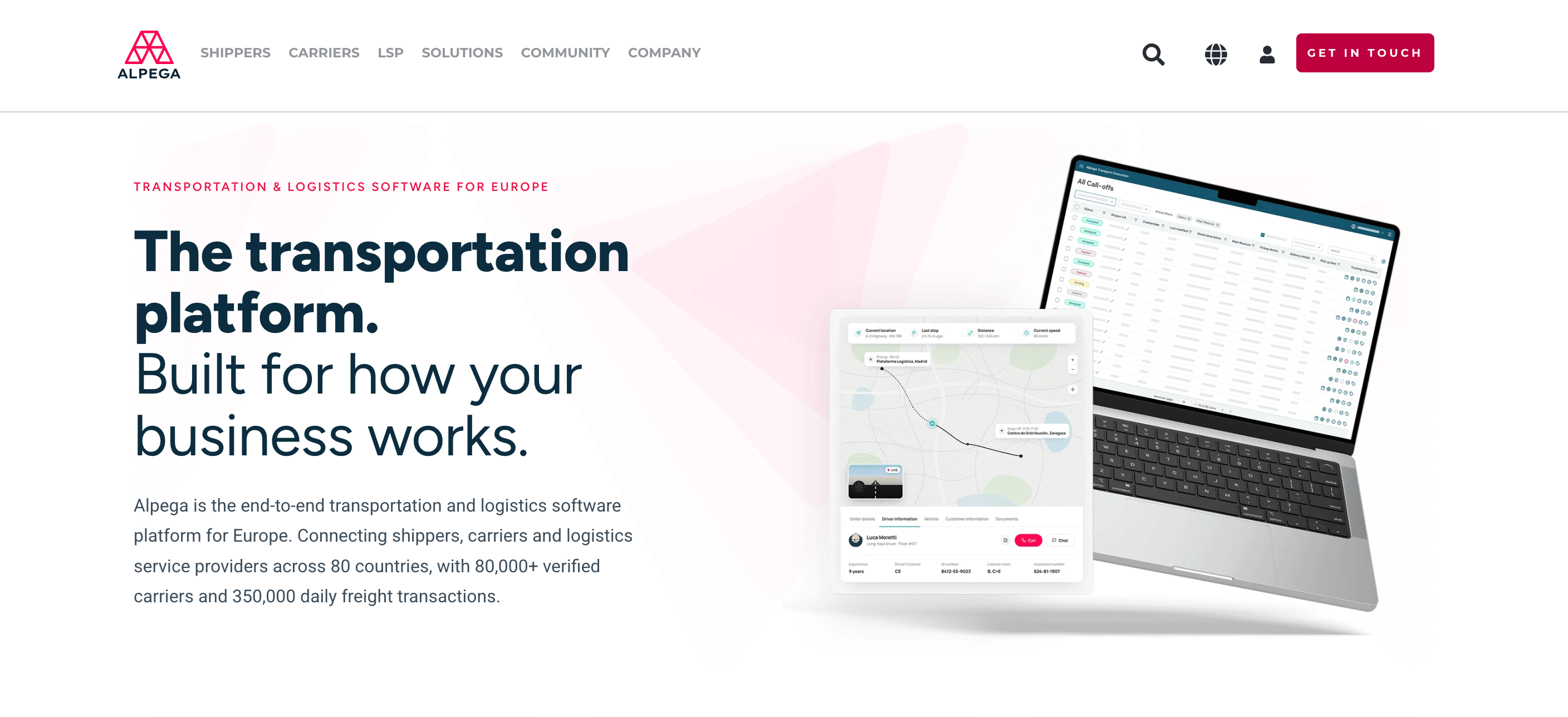
Alpega Group delivers freight tendering through its Transwide and Ticontract products, with a strong European footprint. It automates transport orders and load tendering, keeps tender details on a single view, and extends into appointment scheduling, freight audit, and surcharge reconciliation. It is a practical fit for shippers who want a modular tendering suite rather than a monolithic TMS.
Key Features
- Load tendering that automates transport orders and documentation.
- Transwide and Ticontract tendering modules.
- Single-view tender details for weight, pallet count, and specs.
- Online appointment and dock scheduling.
- Freight cost monitoring, settlement, and surcharge reconciliation.
- Contract management for awarded rates.
- Strong European carrier coverage.
- Modular design that pairs with 3PL and 4PL audit software needs.
Pricing
Modular pricing by custom quote; not publicly disclosed. Scales with modules and tender volume.
Pros
- Dedicated tendering with a strong European footprint.
- Freight audit and reconciliation in the same suite.
Cons
- Reviewers report periodic system downtime.
- Limited visibility into line-haul rates within a load tender.
- Assistive workflow rather than autonomous tendering.
What Users Say
Love: Efficient tendering with strong support. Reviewers say Transwide made them more efficient at tendering loads to carriers and helped reduce detention costs, praising its ease of use and customer service. (source)
Complain: Downtime and rate visibility. Reviewers note the system can go down periodically and that line-haul rates are not visible within each load tender. (source)
Keelvar: Freight Tender Optimization Software
Best for: Procurement teams running complex multi-lane, multi-modal tenders where combinatorial optimization surfaces savings that manual analysis misses.
Keelvar specializes in advanced sourcing optimization and agentic sourcing automation. Its Sourcing Optimizer models constraints across cost, risk, and ESG with no code, and its sourcing bots run tender events end to end, adapting to carrier behavior. It has expanded bots for ocean and air freight. Its strength is optimization depth; its limit is scope beyond the tender event itself.
Key Features
- Combinatorial bid optimization across cost, capacity, service, and risk.
- No-code constraint modeling including ESG factors.
- Agentic sourcing bots that run tenders and adapt to carrier behavior.
- Freight-specific bots for ocean and air.
- Scenario analysis surfacing optimal award combinations.
- Reported 3% to 25% incremental savings per event.
- First tender live in 2 to 4 weeks.
- Integration extending toward procure-to-pay software through partners.
Pricing
Custom enterprise pricing by quote; not publicly disclosed. ROI is strongest on complex, high-value tenders.
Pros
- Best-in-class optimization for complex tenders.
- Fast time to first tender and documented savings.
Cons
- Advanced features can be complex without dedicated help.
- Scope is narrower than full suites beyond the tender.
- Contract and supplier-lifecycle depth is limited.
What Users Say
Love: Optimization with strong support. Reviewers praise the intuitive interface and strong support, alongside documented results like scaling managed spend and cutting event workload. (source)
Complain: Narrow beyond sourcing. Reviewers note the platform is lighter for broader procurement suites, with contract and supplier-lifecycle depth narrower than full-suite competitors. (source)
Freightender: Cloud Freight E-Tender Software
Best for: Shippers that want to launch fast, structured e-tenders and mini-tenders across road, air, and ocean without heavy setup.

Freightender is a cloud e-tender platform focused on the inbound side of freight cost management. It runs RFIs, RFQs, mini-tenders, lane requests, and spot bids, with rate card creation and a managed carrier database. It leans on flexible technology plus hands-on consultant support during tenders, and reports around 10% average freight savings.
Key Features
- RFI, RFQ, mini-tender, lane request, and spot-bid workflows.
- Air, road, and ocean tender coverage.
- Rate card creation and centralized carrier database.
- Scenario building and rate benchmarking.
- Fast tender launch with consultant support.
- Award comparison before commitment.
- Reported tender cycle cut from weeks to days.
- Coverage that pairs with source-to-pay software processes.
Pricing
Three models: pay-per-tender, a fixed number of events, or an annual fee. Numeric pricing not publicly disclosed.
Pros
- Fast, intuitive tender launch across modes.
- Flexible pricing tied to tender volume.
Cons
- Thin independent review volume to triangulate.
- Narrower than a full procurement or TMS suite.
- Assistive workflow rather than autonomous tendering.
What Users Say
Love: Fast, structured tenders. Buyers highlight intuitive tender workflows and fast time-to-launch, with customer stories citing a tender cycle cut from three weeks to about seven days. (source)
Complain: Thin independent review footprint. Major review directories show little verified rating volume for Freightender, so buyers have fewer third-party data points. (source)
SAP Transportation Management: Enterprise Tendering in the TMS
Best for: Enterprises standardized on SAP that want tendering inside the same system that plans and executes freight.

SAP TM runs freight tendering natively, with broadcast tendering that sends RFQs to all carriers at once and peer-to-peer tendering that sends them in sequence. It generates formal RFQs with pickup, delivery, and load specs, delivered by email, EDI, or web portal, inside an end-to-end planning cockpit. Its strength is native integration for SAP shops; its tradeoff is implementation complexity.
Key Features
- Broadcast and peer-to-peer freight tendering.
- Formal RFQ generation via email, EDI, or portal.
- End-to-end planning cockpit for rate shopping and load building.
- Carrier selection and quote evaluation.
- Native integration with SAP S/4HANA.
- Route optimization and multi-modal execution.
- Freight settlement and audit inside the TMS.
- Connectivity for enterprise accounts payable automation software.
Pricing
License and quote-only pricing; not publicly disclosed. Best fit for existing SAP landscapes.
Pros
- Native tendering for SAP-standardized enterprises.
- Broad planning, optimization, and execution in one system.
Cons
- Complex optimizer and data-heavy implementation.
- Quote-only pricing before a sales conversation.
- Heavier than teams wanting a fast tendering tool.
What Users Say
Love: Native SAP integration and results. One enterprise replaced a 15-year-old in-house TMS with SAP TM, lifting on-time delivery from 92% to 97% and cutting roughly 6% off annual freight spend. (source)
Complain: Implementation complexity. Reviewers note a very complex optimizer and data-heavy projects that can be exhausting to stand up. (source)
GoComet: Freight RFQ and Tender Software
Best for: Enterprise shippers that want automated RFQs and reverse e-auctions to drive carrier rates down during the tender, with rate benchmarking built in.

GoComet's GoProcure runs the RFQ and tender cycle as a transparent reverse auction, with a Recursive Rate Reduction feature that lets carriers bid each other down in real time. Its GoComet Freight Index benchmarks quotes against 25,000-plus rates from 4,000-plus vendors, and contract and invoice-reconciliation modules carry past the award. It reports 8% to 15% freight cost savings, and is strong on tender execution if lighter on the autonomous audit-to-pay loop.
Key Features
- Customizable RFQ and tender forms across lanes and modes.
- Recursive Rate Reduction reverse e-auction.
- Spot and contract quotes collected from all vendors at once.
- GoComet Freight Index rate benchmarking across 25,000-plus quotes.
- Contract management tracking rate utilization after the award.
- Automated invoice reconciliation on confirmed rates.
- AI and ML shipment tracking and visibility.
- Bias-controlled audit trail on every bid and award, complementing parcel audit software.
Pricing
Custom pricing by quote; not publicly disclosed. GoComet reports 8% to 15% freight cost savings across the procurement cycle.
Pros
- Reverse-auction rate reduction and strong RFQ automation.
- Deep rate benchmarking through the GoComet Freight Index.
- High G2 review volume and quick, guided implementation.
Cons
- Lighter on the autonomous audit-to-pay loop than Freehand.
- Invoice-reconciliation OCR reads PDFs, not photocopies.
- No SKU-level visibility on the dashboard.
What Users Say
Love: Quick onboarding and customizable workflows. Reviewers praise the guided onboarding, customizable RFQ workflows, and support; G2 rates GoComet 4.9 out of 5 across 240-plus reviews. (source)
Complain: Reconciliation and dashboard gaps. Reviewers note the invoice-reconciliation OCR reads only PDF bills, not photocopies, and the dashboard lacks SKU-level visibility. (source)
Other freight tender software to know
A few more platforms appear in tender shortlists, each with a narrower or regional focus:
- Oracle OTM: Enterprise TMS with bid management, routing-guide management, and a carrier contract repository across modes.
- MercuryGate: TMS-native Strategic Sourcing with automated RFP creation, bid evaluation, and carrier awards.
- kg3: A tool built for running large and complex transportation tenders.
These fit specific stacks or tender scales. For an enterprise that wants awarded rates enforced through to payment, the ranked options above, led by Transporeon and Freehand, cover the tender-to-pay job more completely.
{{brown-cta}}
How to choose freight tender management software
Match the tool to how you actually run your tender, not to a feature list. Run each shortlist vendor against these questions:
- Does it run multi-round tenders and mini-tenders, or only a single annual event?
- How wide is the carrier network behind the tender, and how fresh is the market-rate data?
- Does the optimizer handle your real complexity (multi-lane, multi-modal, capacity and service constraints)?
- Does the award connect to audit and payment, so the rate you award is the rate you pay?
- How fast can you launch a tender, and is pricing disclosed or quote-only?
Weight the carrier network and the closed loop highest. A wide network wins capacity; enforcement through payment is what keeps the savings you negotiated.
Frequently Asked Questions
What is freight tender management software?
Software that solicits carrier bids across your lanes, evaluates them, and awards contracts to secure the best rate, capacity, and service for a set period.
How is a freight tender different from freight procurement?
A tender is the formal bid event, the RFP round where carriers quote lanes. Freight procurement is the broader discipline that also includes benchmarking, contracting, and carrier management.
How often should you run a freight tender?
Most enterprises run a full tender annually, with mini-tenders quarterly or as lanes shift. High-volatility networks tender more often to keep rates and capacity aligned to the market.
What does freight tender management software cost?
Pricing ranges from pay-per-tender models to enterprise license and transaction-cost quotes. Most vendors do not publish figures, so compare total cost including setup and integration.
Can freight tender software connect to audit and payment?
Most stop at the award or execution. Agentic source-to-pay platforms carry the awarded rate into audit and payment, so savings are enforced on every invoice, not eroded after the tender.
Who needs freight tender management software?
Enterprises with $15M-plus in annual freight running regular carrier tenders, typically logistics, transportation, and procurement leaders replacing spreadsheet-based RFPs to cut cost and secure capacity.
How long does a freight tender take?
A manual tender runs three weeks or more. Software cuts it to days by automating data prep, bid normalization, and scenario modeling, sometimes from three weeks to about seven days.
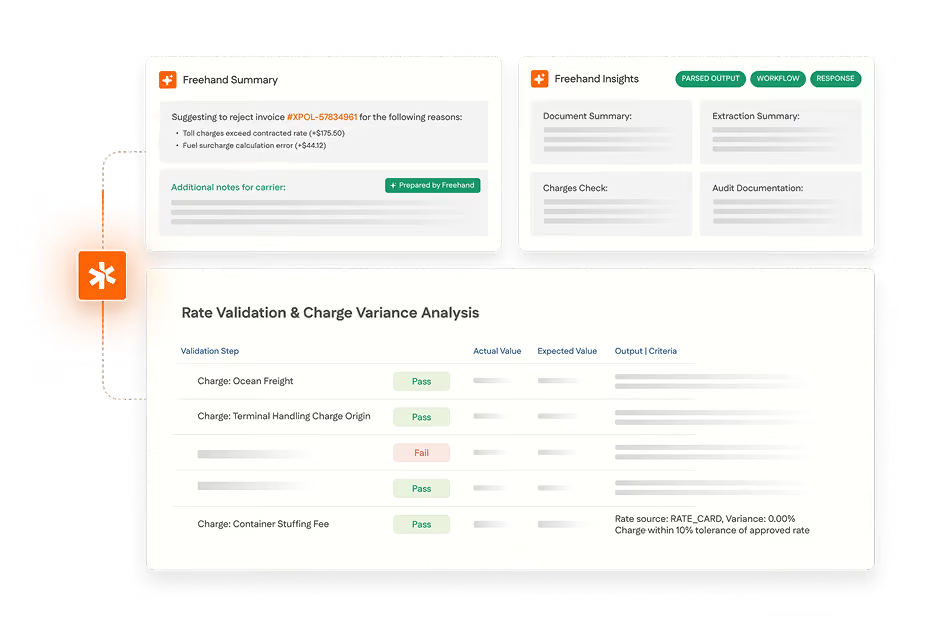
Every Tendered Rate Checked Against What You're Actually Billed.
Freehand validates every invoice against the rate awarded in the tender, closing the gap between what you agreed to and what clears payment.
A Clean Tender Doesn't Guarantee a Clean Invoice.
The carrier that wins the tender still reclasses shipments and drifts fuel surcharges once freight actually starts moving.
Every warehouse. Every provider. Every mile.
Gartner's 2026 outlook on logistics outsourcing, and how AI Teams hold every contract to the terms you agreed.
- Where outsourced logistics quietly loses margin
- Why billed charges drift from the contract
- How AI Teams close the gap