

Freight Class: How It's Determined, and Where It Gets Disputed
Freight class runs on density, stowability, handling, and liability, under the NMFC system. See how it's calculated, and why reclassification is a leading billing dispute.
.webp)
August 12, 2026
•
9
mins

Freight class is an NMFC classification, running from class 50 to class 500, that sets the base rate for an LTL shipment. It's determined by density, stowability, handling, and liability, not weight alone. Getting it wrong, whether at booking or after a carrier's post-pickup inspection, is one of the most common sources of LTL billing disputes.
Key Takeaways
- Freight class is one of 18 NMFC classifications (class 50 to class 500) that sets the base rate for an LTL shipment, based on density, stowability, handling, and liability.
- Density, weight divided by cubic feet, is the single biggest driver of freight class, and it can move the rate significantly even when the actual weight doesn't change.
- Carriers can reclassify a shipment after pickup based on their own inspection, and that reclassification is one of the leading causes of LTL billing disputes.
- A reclass without an inspection certificate behind it is a disputable charge, not an automatic correction.
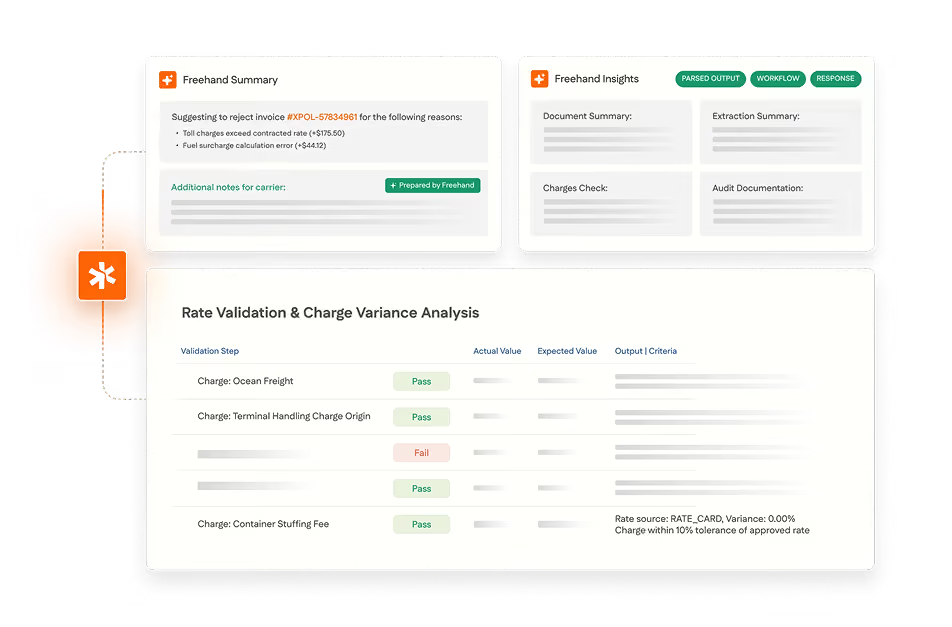
- Freehand's invoice audit agent checks the freight class on every invoice against the original booking and any inspection documentation, at 100% coverage instead of a sample.
What is freight class, and why does it matter for LTL pricing?
Freight class is one of 18 standardized classifications, running from class 50 to class 500, published in the NMFC (National Motor Freight Classification) system and maintained by the NMFTA (National Motor Freight Traffic Association). A lower class (50) means dense, easy-to-handle freight that costs less to ship. A higher class (500) means light, bulky, or fragile freight that costs more per pound.
Freight class matters because it can move the rate significantly even at the exact same weight. Two shipments weighing 500 lbs can bill at very different rates if one is dense, palletized steel and the other is light, bulky insulation.
For how freight class fits into the broader LTL pricing structure, alongside weight and the carrier's hundredweight rate, see our guide to LTL vs. FTL rates.
How is freight class actually determined?
Freight class is determined by four factors: density, stowability, handling, and liability, with density carrying the most weight in practice. All four come from the NMFC system, not from a shipper's own judgment call.
| Factor | What it measures |
|---|---|
| Density | Pounds per cubic foot, weight divided by volume. The single biggest driver of class. |
| Stowability | How easily the shipment fits and stacks with other freight in a trailer. |
| Handling | Whether the shipment needs special equipment or care to load and unload. |
| Liability | Risk of theft, damage, or spoilage, and the shipment's dollar value relative to its weight. |
Density alone often decides the class. Stowability, handling, and liability can push a shipment's class higher even when density alone would suggest a lower one, an oddly shaped or fragile item classifies higher than its density implies.
{{blue-cta}}
How do you calculate the density that drives freight class?
Density is weight in pounds divided by cubic feet, and cubic feet comes from length times width times height in inches, divided by 1,728. Getting this number right before booking is the difference between the class you expect and the class a carrier assigns after inspection.
The formula: density (lbs/ft³) = weight ÷ [(length × width × height in inches) ÷ 1,728]
A pallet that's dense and compact lands in a low class. The same weight spread across a larger, lighter-packed pallet lands in a higher one, at a higher rate, even though nothing about the actual product changed.
Freight Density & Estimated Class Calculator
Enter one shipment's weight and dimensions. This estimates density and the typical class band, actual class also depends on stowability, handling, and liability.
What does a freight class chart actually look like?
The 18 NMFC freight classes group into a few practical bands, and a freight class chart showing where a shipment type usually lands makes the abstract density math easier to sanity-check. These are typical ranges, not guarantees, since stowability, handling, and liability can still shift a specific shipment up or down.
| Class range | Typical density | Example commodities |
|---|---|---|
| Class 50-60 | 30+ lbs/ft³ | Bricks, steel, cement |
| Class 70-85 | 12-30 lbs/ft³ | Car parts, thick appliances |
| Class 92.5-125 | 7-12 lbs/ft³ | Electronics, computers |
| Class 150-250 | 3-7 lbs/ft³ | Wooden furniture, mattresses, TVs |
| Class 300-500 | Under 3 lbs/ft³ | Ping-pong balls, empty wood cabinets |
Why does a carrier reclassify a shipment after pickup?
Carriers reclassify a shipment when their own inspection, at the dock or via handheld scanner, produces a different density or handling assessment than what the shipper declared at booking. This is legitimate when the original booking was wrong. It's a dispute when it isn't.
- Legitimate reclass: the shipper underestimated dimensions or weight, and the carrier's inspection is accurate and documented.
- Disputable reclass: the carrier changes the class without a documented inspection, or the inspection method itself is inconsistent with what was actually shipped.
A reclass changes the bill. It doesn't automatically mean the original booking was wrong.
How do you know if a freight class dispute is worth fighting?
A freight class dispute is worth fighting when the reclass has no inspection certificate behind it, or when the inspection method doesn't match the shipment that actually moved. Most teams don't have a systematic way to check this on every invoice, so the check only happens when the dollar amount is large enough to notice.
Freehand's invoice audit agent checks the freight class billed on every invoice against the original booking and any inspection documentation the carrier provides, at 100% coverage instead of a sample. A reclass without documentation gets flagged before payment clears, not disputed months later after it's already been paid.
{{brown-cta}}
Frequently Asked Questions
What is freight class?
Freight class is one of 18 NMFC classifications, from class 50 to class 500, that sets the base rate for an LTL shipment based on density, stowability, handling, and liability.
How many freight classes are there?
There are 18 NMFC freight classes, running from class 50 (dense, easy to handle, low liability) to class 500 (light, bulky, or high liability).
How do you calculate freight density?
Density in pounds per cubic foot equals weight divided by cubic feet. Cubic feet comes from length times width times height in inches, divided by 1,728.
Can a carrier change the freight class after pickup?
Yes. Carriers can reclassify a shipment based on their own inspection at the dock or via handheld scanner. That's legitimate when the original booking was inaccurate, and disputable when the reclass has no documented inspection behind it.
What's the difference between freight class and NMFC number?
Freight class is the numeric rating (50 to 500) that drives the rate. The NMFC number is the specific commodity code within the classification system that a given product falls under, which determines which class applies. See our guide to NMFC codes for how the code itself is structured and how to find yours.
Every Freight Class, Checked Against the Original Booking.
Freehand's invoice audit agent checks the billed class on every invoice against the booking and any inspection documentation, at 100% coverage instead of a sample.
A Reclass Without an Inspection Certificate Isn't a Correction.
Carriers can reclassify a shipment after pickup based on their own inspection. Without documentation behind it, that's a disputable charge, not an automatic one.
Every warehouse. Every provider. Every mile.
Gartner's 2026 outlook on logistics outsourcing, and how AI Teams hold every contract to the terms you agreed.
- Where outsourced logistics quietly loses margin
- Why billed charges drift from the contract
- How AI Teams close the gap