

How to Optimize Days Payable Outstanding in Logistics
Optimize Days Payable Outstanding (DPO) in logistics by separating audit speed from payment timing. See the formula, a good ratio, and 6 practical steps.
.webp)
August 7, 2026
•
16
mins
.png)
To optimize Days Payable Outstanding in logistics, audit invoices fast enough that you never have to pay early. Then release payment on the last day your terms allow. Fast audit and payment timing are two separate levers. DPO only improves when you pull both on purpose.
Most freight AP teams pull neither. They pay early because audit is still running, or late because a dispute is.
Key Takeaways
- Days Payable Outstanding (DPO) measures the average number of days a company takes to pay its suppliers. The formula: average accounts payable divided by cost of goods sold, times days in the period.
- The goal is to maximize DPO up to, but not past, your contracted terms. Paying early gives away working capital for nothing. Paying late risks fees and carrier relationships.
- Slow freight audit hurts DPO two ways. It forces early payment while validation catches up, and forces late payment while a dispute drags on.
- There's no credible freight-specific DPO benchmark publicly available. The closest honest reference point is APQC's cross-industry median of around 40 days, not a freight number.
- Freehand's AI Teams validate every invoice fast enough that payment timing becomes a deliberate choice again. Audit speed stops deciding it for you.
- The process in seven steps: audit every invoice fast enough to avoid early payment, resolve exceptions fast enough to avoid late payment, fix internal approval bottlenecks, set payment release rules for your last allowable day, track DPO alongside audit accuracy, confirm terms before extending them, review DPO against the cash conversion cycle.
What is DPO in logistics, and how is it calculated?
DPO is the average number of days between receiving a carrier invoice and paying it. It's weighted by how much you owe. The formula is average accounts payable divided by cost of goods sold, multiplied by the number of days in the period. That's typically 365 for an annual figure.
A rising DPO usually means you're holding cash longer before it goes out the door. A falling DPO usually means the opposite. That can be a deliberate choice, or a symptom of something breaking upstream.
DPO gets paired constantly with Days Sales Outstanding (DSO), the same idea on the receivables side, how long your customers take to pay you. They measure opposite directions of cash and shouldn't be confused, but a logistics provider tracking both is managing its full cash conversion cycle, not just one half of it.
{{blue-cta}}What's a good DPO for a logistics AP program?
A good DPO matches your contracted payment terms exactly. It isn't a specific number of days. A 30-day term with a 30-day DPO is optimized. A 30-day term with a 22-day DPO is leaving working capital on the table. A 30-day term with a 38-day DPO is running late.
There's no credible, sourced DPO benchmark specific to freight or logistics. The closest honest reference point is APQC's cross-industry median of roughly 40 days, with a typical range of 30 to 50 days. That spans every industry APQC tracks, not just freight.
Treat any single freight-specific DPO figure you see elsewhere with the same caution.
The number that actually matters is your own. Track DPO against your own negotiated terms, not against a benchmark built from unrelated industries.
How do you optimize DPO in logistics step by step?
You optimize it by separating validation speed from payment timing. Then deliberately target the last day your terms allow. Fast audit is the precondition. It isn't the goal by itself.
Step 1: Audit every invoice fast enough to never force an early payment
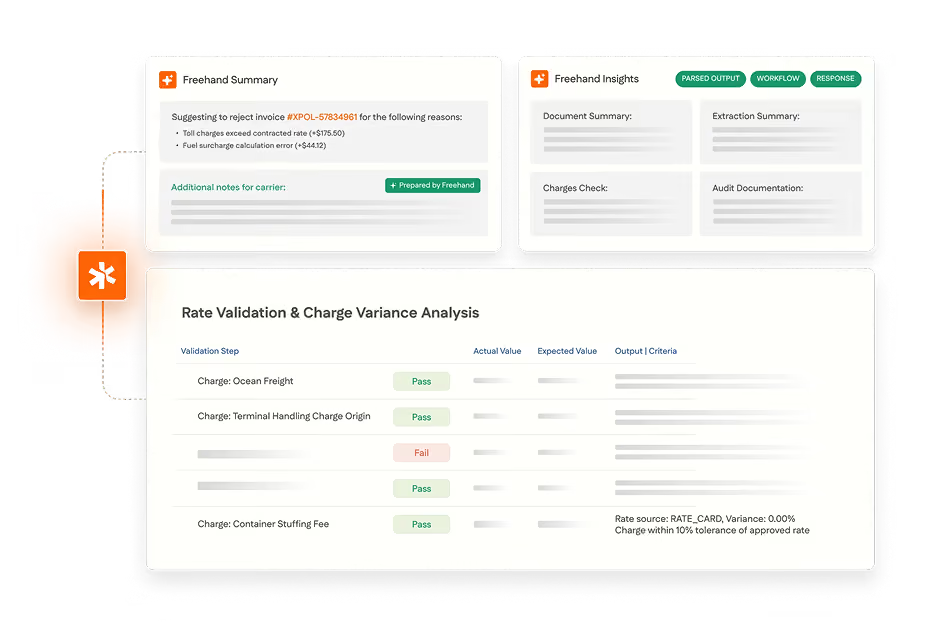
If validation finishes well inside your payment terms, you never have to choose between paying unverified and risking a late fee. That single fix removes the most common reason DPO erodes without anyone deciding it should.
Speed here comes from automating three manual steps. Capture carrier bill data automatically instead of keying it in by hand. Match each invoice against its BOL and POD on receipt, not days later. Validate rates against contracted pricing instead of a spot-check sample.
Step 2: Resolve exceptions fast enough to never force a late payment
A rate mismatch or an accessorial dispute needs a resolution path that closes before the due date, not after. An exception queue with no deadline is how audits that started on time still end up paying late.
Step 3: Fix internal approval bottlenecks, not just audit speed
A validated invoice can still sit for days in an approval chain built for exceptions, not routine payments. Auto-approve anything that matches contracted rates within a small, predefined variance. Give managers a mobile path to clear real exceptions, instead of waiting for a desk. Cut departmental reviews that exist out of habit, not necessity. Audit speed buys nothing back if approval routing burns the days it saved.
Step 4: Set payment release rules to target your last allowable day
Once validation is fast and reliable, configure payment to release on the final day of terms by default. Don't let it release on whatever day audit happens to clear. Once the audit itself is fast, paying on day 12 of a 30-day term is a rule problem, not an audit problem.
Two common defaults work against this. A fixed weekly or biweekly payment run pays every invoice on the same day, regardless of its own due date. That pushes some payments early and others uncomfortably close to late. Paper checks add mail and processing float that same-day EFT or a virtual card doesn't. That makes the actual release date less predictable than the rule intends.
Step 5: Track DPO alongside audit accuracy and cycle time
DPO by itself can hide a problem. Say your first-pass match rate only covers a sample of invoices, but DPO still matches terms perfectly. The number looks optimized, while overcharges keep clearing underneath it.
Step 6: Confirm your terms before you try to extend them
Extending payment terms with a carrier is a separate negotiation from optimizing DPO against the terms you already have. Trying to negotiate longer terms while you can't reliably hit your current ones tends to go nowhere.
Step 7: Review DPO against the cash conversion cycle, not alone
DPO paired with DSO and inventory days tells you something DPO alone can't. Is your logistics AP program actually improving working capital, or just moving a number that looks better in isolation?
Why does slow freight audit hurt DPO?
Slow audit hurts DPO in two opposite ways. Most AP teams only notice one of them. Either problem gives away the working capital DPO is supposed to protect.
The first is forced early payment. If validation takes days and terms are tight, some teams pay on receipt just to avoid missing the due date. That pays the invoice before it's confirmed correct. It also gives away every day of DPO you could have held.
The second is forced late payment. If a dispute or exception sits unresolved past the due date, the invoice pays late by default. That's not a choice, and it's not DPO optimization. It's a penalty risk and a carrier-relationship cost, with no offsetting benefit.
Does optimizing DPO conflict with a faster invoice-to-payment cycle?
No. The two aren't the same thing, and conflating them is where the confusion starts. Cycle time measures how fast an invoice can be validated. Payment timing measures when you choose to actually release the funds. Fast validation is what makes deliberate payment timing possible in the first place.
Here's an illustrative way to see the cash impact. It's not a cited industry figure, just the math. Take $50M in annual freight spend. Shift average payment timing 10 days later, and you free up roughly $50M divided by 365, times 10. That's about $1.4M in short-term cash.
The exact number depends on your own spend and current timing. The mechanism is the same regardless of scale.
Compressing the invoice-to-payment cycle from 30-plus days to under 3 doesn't mean paying in 3 days. It means the validation that used to eat most of your payment term now takes almost none of it. That leaves the rest of the term available to hold cash on purpose.
For the mechanics of how that validation actually runs, see our guide to the freight audit process.
What mistakes hurt DPO in a logistics AP program?
Most DPO problems come from treating payment timing as a side effect of audit speed instead of a decision on its own.
- Paying on receipt to avoid audit risk. If you pay early because you don't trust validation to finish on time, that's not a payment strategy. It's an audit problem wearing a payment-timing costume.
- Letting disputes run past the due date by default. A stalled exception doesn't pause the clock. It just converts into a late payment nobody chose.
- Chasing a benchmark DPO instead of your own terms. A generic "good DPO" number from outside freight tells you nothing about whether you're using the terms you actually negotiated.
- Tracking DPO without tracking coverage. A DPO that hits the target while only a sample of invoices gets audited isn't a win. It's optimizing the wrong half of the problem.
How do you make payment timing a deliberate choice instead of a side effect?
You make it deliberate by running audit fast enough, and accurately enough, that payment timing stops being a race. It's no longer decided by whichever finishes first, validation or the due date. Freehand's freight audit and payment platform validates every invoice against your contracted rates well inside your payment terms. It resolves exceptions before the due date, not after it.
That's what turns DPO from a number that happens to you into one your AP team actually controls. Want a side-by-side look at platforms running audit at this speed? Our roundup of the best AI freight audit and payment software breaks down how the leading options compare.
Freehand doesn't set your payment terms or negotiate your contracts. It runs the validation fast enough that hitting the terms you already have becomes the default, not the exception.
{{brown-cta}}
Frequently Asked Questions
What is DPO in logistics?
DPO, Days Payable Outstanding, measures the average number of days a logistics AP program takes to pay its carriers and vendors. It's calculated from average accounts payable and cost of goods sold. It's the same metric used in any industry, applied to freight and carrier payables specifically.
What's a good DPO ratio?
A good DPO matches your contracted payment terms exactly, whatever those terms are. There's no universal "good" number. A DPO of 30 is optimized against 30-day terms, and premature against 45-day terms.
Should DPO be high or low?
Higher DPO generally means better working capital, since cash stays available longer. That's only true up to your contracted terms. Pushing DPO past what your contracts allow risks late fees and damaged carrier relationships, and that risk outweighs the cash benefit.
What's the difference between DPO and DSO?
DPO measures how long you take to pay your carriers and suppliers. DSO measures how long your customers take to pay you. They track opposite directions of cash, and a company can have a strong DPO while still needing to fix a weak DSO.
Does paying carriers faster hurt or help DPO?
It lowers DPO, since you're holding cash for fewer days before paying out. Paying faster than your contracted terms require gives away working capital with no offsetting benefit. The term was already available to you.
Can extending DPO hurt carrier relationships?
Extending DPO within your existing contracted terms doesn't, since that's the payment window the carrier already agreed to. Extending it past those terms is a late payment, not a DPO strategy. That's what damages the relationship.
Does it ever make sense to pay a carrier early?
Only if the discount is worth more than the cost of capital you give up. That's a separate financial decision from DPO optimization itself. Early payment and dynamic discounting programs deliberately trade DPO for a fixed discount. Whether that's the right call depends on your cost of capital. Either way, it's a distinct tradeoff, not the same goal as maximizing DPO against your existing terms.
Is a slow approval process the same problem as slow audit?
No. Audit speed determines when an invoice is confirmed correct. Approval speed determines how long it then waits for a human sign-off before payment can be scheduled. A fast audit with a slow approval chain still loses the days DPO depends on.
Validated Fast Enough That Payment Timing Becomes a Choice Again.
Freehand audits every invoice well inside your terms, so DPO stops being decided by whichever finishes first, validation or the due date.
Paying Early Isn't Caution. It's Working Capital You Didn't Have to Give Up.
Audit that finishes slow forces a choice: pay before it's verified, or risk paying late.
Every warehouse. Every provider. Every mile.
Gartner's 2026 outlook on logistics outsourcing, and how AI Teams hold every contract to the terms you agreed.
- Where outsourced logistics quietly loses margin
- Why billed charges drift from the contract
- How AI Teams close the gap