

How to Recover Freight Overpayments (Before the Deadline)
Recover a freight overpayment in 4 steps: confirm the overcharge, calculate the exact amount, file within 18 months, and track the carrier response deadline.
.webp)
August 5, 2026
•
14
mins

To recover a freight overpayment, confirm the charge against your contract, calculate the exact overpaid amount, assemble the documentation, and file a written claim. You have 18 months from delivery to act, not the 3 years several freight blogs claim.
Miss that window and the overcharge becomes a permanent write-off, no matter how clear the billing error was.
Key Takeaways
- A freight overpayment is money paid to a carrier above the contracted rate, recoverable through a written overcharge claim rather than a cargo claim.
- Federal law gives you 18 months from delivery to bring a civil action to recover an overcharge. A 3-year window only applies if you file an administrative complaint instead of going to court.
- Once you file, the carrier has 30 days to acknowledge the claim and 60 days to pay, decline, or settle, a shorter clock than the 120 days carriers get on cargo loss and damage claims.
- Enterprises catching overcharges only through a manual sample recover a fraction of the 1.5-2.5% of freight spend that's typically overbilled.
- Freehand's AI Teams calculate the exact overpayment, assemble the dispute packet, and file it before the clock runs, instead of leaving recovery to whoever remembers to check.
- The process in five steps: confirm the charge against your contract, calculate the exact overpaid amount, assemble your documentation, file the claim in writing, track and escalate if it stalls.
What is a freight overpayment?
A freight overpayment is the difference between what you paid a carrier and what the contract actually required, and it's recovered through an overcharge claim, not a cargo claim. The two get confused constantly inside AP teams that handle both.
A cargo claim recovers money for freight that arrived lost, damaged, or short. An overpayment claim recovers money for a bill that was simply wrong: the wrong rate, a duplicate charge, an accessorial fee with no basis. Different problem, different filing deadline, different regulation entirely.
That distinction is exactly why the deadline below surprises people who've only dealt with cargo claims.
{{blue-cta}}What causes freight overpayments?
Most freight overpayments trace back to one of four patterns, and knowing which one you're looking at determines what evidence you need to prove it. A duplicate charge and a stale rate card don't get disputed the same way.
| Cause | What it looks like | How you catch it |
|---|---|---|
| Duplicate billing | The same shipment invoiced twice, under two invoice numbers or two dates | Match every invoice to a single shipment record |
| Accessorial charges with no service event | Detention or liftgate billed with no confirmed timestamp or delivery record | Verify the trigger, not just the rate |
| Classification or weight errors | Carrier-input weight or freight class doesn't match the actual shipment | Compare against the original bill of lading |
| Contract misalignment | The invoiced rate drifts from the negotiated rate card, tier, or discount | Validate against a current, digitized contract |
Contract misalignment is the quiet one. A rate card that's a few weeks out of date makes every invoice in that window look correct when it isn't, since the charge matches a number that's simply the wrong number.
What documents do you need to recover a freight overpayment?
You need the original invoice, the contracted rate, and a clear calculation showing the gap between what was billed and what should have been billed. Without a specific dollar figure and its basis, the carrier has no claim to act on.
| Document | What it proves | Where it comes from |
|---|---|---|
| Original invoice | The exact amount billed and charged | Your AP system |
| Contract or rate card | The rate, discount tier, or accessorial fee that should have applied | Your carrier agreement |
| Shipment record | Weight, class, and service level actually used | Your TMS |
| Overpayment calculation | The specific dollar gap, line by line | Built from the three above |
A claim that says "this invoice looks too high" isn't a claim. One that shows a $950 contracted linehaul rate billed at $1,100 is.
How long do you have to recover a freight overpayment?
Federal law gives you 18 months from delivery to bring a civil action to recover an overcharge, running from the date the carrier delivered or tendered delivery of the shipment. That's the number that matters, and it's shorter than what a lot of freight-audit blogs advertise.
Several sources cite a flat 3-year window. That figure is real, but it only applies if you file a formal administrative complaint with the regulatory body that has jurisdiction over the carrier instead of going straight to civil court. Absent that election, 18 months is the deadline.
There's one extension worth knowing. If a carrier disallows part of your claim in writing, you get 6 more months from that disallowance to escalate, even if the original 18-month window would otherwise have closed.
Here's what that looks like on a timeline. A $4,200 duplicate charge posts on a shipment delivered March 1. The 18-month clock runs to roughly September 1 of the following year.
You file a written claim in June, and the carrier partially disallows it in October. That disallowance resets the clock: you now have until April of the year after, 6 months past the disallowance, to escalate the disputed portion.
Once you file, the carrier is on its own clock. It has to acknowledge within 30 days, then pay, decline, or settle within 60 days. That's a different, shorter timeline than the 120-day disposition rule that applies to cargo loss and damage claims.
How do you recover a freight overpayment step by step?
You recover it by confirming the overcharge, calculating the exact amount, assembling proof, filing within 18 months, and tracking the carrier's response. Each step builds the case the next one needs.
Step 1: Confirm the charge against your contract
Pull the invoice line by line against the contracted rate, discount tier, and accessorial schedule. A charge only becomes an overpayment once you can point to the specific term it violates.
Step 2: Calculate the exact overpaid amount
State the dollar figure precisely: contracted rate versus billed rate, multiplied by the relevant weight, volume, or unit. A round estimate invites a round rejection.
Step 3: Assemble your documentation
Gather the original invoice, the contract or rate card, and the shipment record showing the weight, class, and service level actually used. Attach your calculation to all three.
Step 4: File the claim in writing
Submit the claim to the carrier's claims department with the shipment identified, the overcharge stated, and the specific dollar amount demanded. An email is enough; a phone call asking to "look into a billing issue" is not.
Step 5: Track the response and escalate if it stalls
Log the filing date, the 30-day acknowledgment deadline, and the 60-day disposition deadline. If the carrier disallows part of the claim, note the date, since that's what triggers your 6-month extension on the disputed portion.
That's the process run by hand, and it's exactly where recovery leaks. It isn't that carriers refuse valid claims outright. It's that enterprises auditing on a sample only find part of what's overbilled in the first place, and the claims they do find often sit past the 18-month window before anyone files.
What mistakes cause a valid overpayment claim to fail?
Most failed claims never get disputed on the merits. They fail on deadline, documentation, or a mix-up with the wrong claims process entirely.
- Relying on the 3-year figure. Filing at month 20 assuming you have 3 years, when no administrative complaint was ever filed, means the claim is already time-barred.
- Filing a round-number estimate. A claim demanding "about $5,000" without a line-item calculation gives the carrier grounds to stall for specifics you should have sent the first time.
- Confusing an overpayment claim with a cargo claim. Filing a billing dispute through the loss-and-damage claims process, or vice versa, routes it to the wrong desk and burns weeks before anyone notices.
- Losing track of the disallowance date. The 6-month extension only helps if you know exactly when the carrier disallowed the claim in writing.
How do you recover freight overpayments without missing the window?
You recover them by running a freight audit process that checks 100% of invoices before payment, so most overcharges never turn into a claim you have to chase. A claims process built to catch what a sample missed is still better than nothing, but it's recovery after the fact on a clock that's already running.
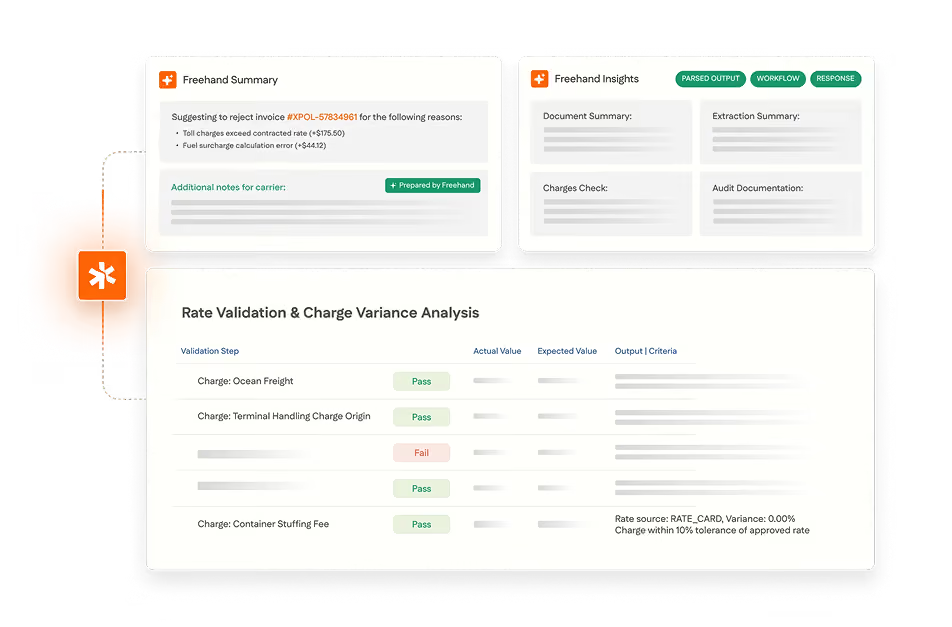
Freehand's AI Teams validate every invoice against your contracted rates before payment clears, and when an overcharge does get through, they calculate the exact amount, assemble the dispute packet, and file it well inside the 18-month window instead of waiting for someone to notice.
Freehand doesn't replace your TMS or ERP. It runs the audit and the recovery on top of them, delivered as completed work, so overpayment recovery stops depending on who remembered to check the calendar.
If you're evaluating dedicated tools instead, our roundup of the best freight audit software breaks down how the leading options handle overcharge detection and recovery.
{{brown-cta}}
Frequently Asked Questions
How long do you have to recover a freight overpayment?
18 months from the date of delivery to bring a civil action. A 3-year window applies only if you file a formal administrative complaint with the carrier's regulatory body instead of going to court.
What's the difference between a freight overpayment claim and a freight claim?
An overpayment claim recovers money for a billing error, a wrong rate or duplicate charge. A freight claim recovers money for cargo that was lost, damaged, or short. They run under different regulations with different deadlines.
What happens if a carrier disallows part of my overcharge claim?
You get 6 more months from the date of disallowance to escalate the disputed portion, even if that falls past the original 18-month window.
How long does a carrier have to respond to an overcharge claim?
30 days to acknowledge the claim, then 60 days to pay, decline, or settle it. That's shorter than the 120-day disposition window that applies to cargo loss and damage claims.
Is a freight overpayment the same as a short payment?
No. A short payment is money a customer withheld from what you billed them, on the receivables side. A freight overpayment is money you paid a carrier above the contracted rate, on the payables side. They involve opposite directions of money and different processes entirely.
What are the two types of freight overpayment?
Charges that shouldn't have been billed at all, like duplicate invoices or accessorial fees with no service event, and charges billed at the wrong amount, like a misclassified shipment or a rate that drifted from the contract.
How do you record a recovered freight overpayment in your books?
As a credit against accounts payable or freight expense. Carriers typically issue either a credit memo applied to a future invoice or a direct refund, and your GL entry should reference the original invoice it corrects.
Who is responsible for filing a freight overpayment claim?
Whoever holds the carrier contract and made the payment, typically the shipper's AP or logistics team, not the consignee receiving the freight. A cargo claim can sometimes be filed by whoever held title to the goods at the time of loss.
Every Overpayment Calculated, Filed, and Tracked Before the Window Closes.
Freehand validates every invoice against your contracted rate, and when an overcharge slips through, it assembles and files the claim well inside the 18-month deadline.
The Clock Starts at Delivery, Not When Someone Notices the Overcharge.
18 months from delivery, not the 3 years most freight blogs claim. Miss it and a clear billing error becomes a permanent write-off.
Every warehouse. Every provider. Every mile.
Gartner's 2026 outlook on logistics outsourcing, and how AI Teams hold every contract to the terms you agreed.
- Where outsourced logistics quietly loses margin
- Why billed charges drift from the contract
- How AI Teams close the gap