

LTL Freight Invoices: Line Items, Errors, and How to Audit Them
.webp)
July 2, 2026
•
11
mins
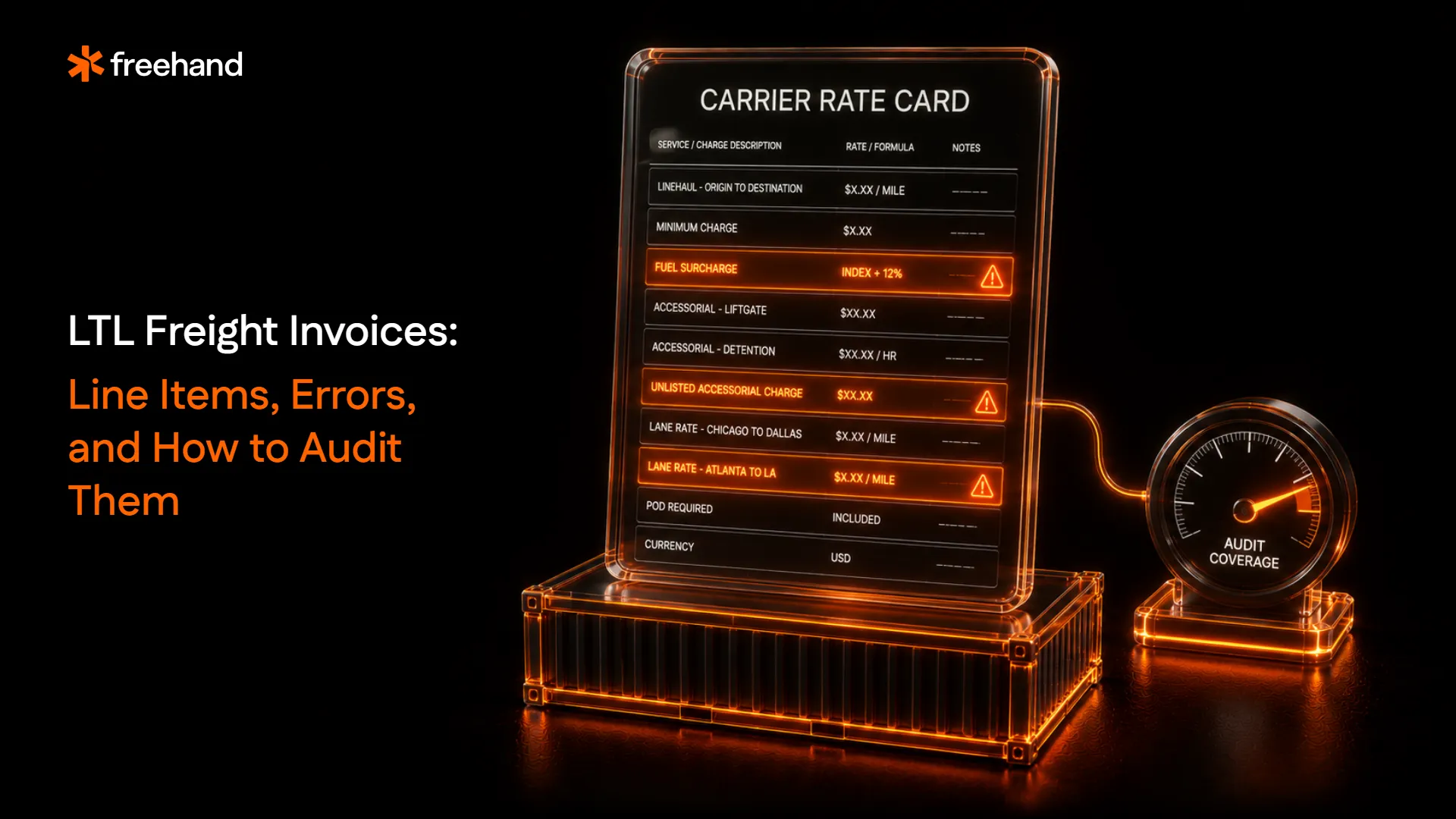
An LTL shipper running 1,200 monthly invoices sees three patterns after every billing cycle:
- A handful of invoices reclassed from Class 70 to Class 100 after delivery, adding hundreds per invoice
- Fuel surcharges that do not match the contracted formula for the departure week
- Accessorial charges (detention, liftgate, residential) for services the delivery record cannot confirm
The invoices process. AP approves. The overcharges clear. And the next billing cycle looks exactly the same.
Key Takeaways
- LTL freight invoices are the most error-prone billing documents in transportation. Pre-audit error rates run 8 to 12% of total LTL spend because LTL has more billing variables than any other mode: freight class, density, FAK exceptions, fuel surcharge tiers, minimum charges, and 30+ accessorial types.
- Errors concentrate in four categories: accessorial charges (42.8% of errors per AFS Logistics), fuel surcharges (14.4%), freight misclassifications (12.3%), and discount, minimum, or rate errors (10.3%).
- LTL billing is often finalized after delivery. Reweighs and reclassifications appear on invoices weeks later, making errors harder to detect and easier to miss.
- Systematic LTL audit programs recover 2 to 5% of annual LTL spend. For a Fortune 500 LTL program spending $50M+ per year, recoverable audit findings routinely run $2M to $4M annually.
- The audit outcome that most enterprises miss: feeding LTL audit findings back into the next MRA negotiation. The billing patterns identified across 12 months of invoices are the strongest evidence base for renewal rate discussions.
What Is an LTL Freight Invoice?
An LTL (Less-than-Truckload) freight invoice is a bill for a shipment that occupies part of a trailer shared with other shippers' freight. It contains a base rate, fuel surcharge, one or more accessorial charges, and any post-delivery adjustments applied by the carrier for weight or classification changes.
Unlike FTL where a shipper pays for the full trailer at a negotiated line-haul rate, LTL pricing is built from multiple variables that interact: freight class (NMFC commodity code, 18 classes from 50 to 500), billed weight in hundredweight (CWT), distance and rate table lookup, discount tier applied against the base tariff, fuel surcharge calculated per carrier-specific table, and accessorial charges triggered by service events. The complexity is why LTL has the highest pre-audit error rate of any freight mode.
Why LTL Invoices Have More Errors Than FTL
FTL billing is straightforward: one shipper, one trailer, one lane rate. LTL billing is not. One shipment sits inside a trailer with 10 to 20 others. Weight and dimensions are verified at the terminal, not at pickup. Class can be disputed and reclassified after delivery. Accessorial charges depend on driver-reported events and dock conditions. Every one of those variables is a place the invoice can be wrong.
What Line Items Appear on an LTL Freight Invoice?
An LTL invoice contains 6 to 10 line categories, each governed by a different clause in the Master Rate Agreement (MRA) or the NMFC.
The MRA governs which of these can be applied and under what conditions. The invoice reflects what the carrier's billing system produced.
{{blue-cta}}Where Do the Errors Actually Concentrate?
AFS Logistics analyzed 250,000 LTL invoices and found 11,881 errors — approximately 4.5% of invoices audited. The error distribution:
- 42.8% Accessorial charges (5,088 errors)
- 14.4% Fuel surcharges (1,708 errors)
- 12.3% Freight misclassifications (1,466 errors)
- 10.3% Discount, minimum, or rate errors (1,229 errors)
These four categories account for 80% of all LTL billing errors. Each one has a specific mechanism.
Freight Class Reclassification (NMFC Reclass)
The most consistently significant LTL error type. The carrier disputes the freight class the shipper declared on the BOL and reinvoices at a higher class, often weeks after delivery.
How it happens: the carrier reweighs or measures the shipment at a terminal. If dimensions or density fall into a different class band, the carrier reclasses, and the reclassification appears on the invoice as a post-delivery adjustment.
Why it is often wrong: the reclass is based on partial measurement, not full NMFC criteria. The carrier's system defaults to higher-class if any variable is ambiguous. The shipper's original class declaration was correct per NMFC schedule but not defended with the right evidence.
The NMFTA density-based classification updates that took effect in 2025 mean freight class now depends on precise shipment dimensions, not just commodity type. A minor measurement variance can push a shipment into a higher pricing tier and trigger reclassification.
Catching a bad reclass requires the original BOL with declared class, the NMFC schedule current at time of shipment, a reweigh certificate if weight is being challenged, and photos or terminal records supporting dimensions.
Fuel Surcharge Errors
FSC is calculated as a percentage of the base rate, applied from a carrier-specific table that changes weekly. The MRA specifies which index, which reset day, and what tier table applies.
Common FSC errors:
- Wrong tier applied for the departure week
- Carrier's published FSC table used instead of the MRA-specified formula
- FSC cap in the contract not enforced when the index exceeded the cap
- FSC calculated on gross rate instead of discounted rate
The gap: if AP does not have the fuel index value for the week of shipment, FSC validation is not possible. Most shippers accept FSC charges without verification.
Accessorial Charges Without Trigger Events
Accessorials are the largest error category by count. Each has a contracted rate and a triggering condition, and each is a common overbill target.
Detention gets billed without verified arrival and departure timestamps. Liftgate gets charged on dock-to-dock shipments. Residential delivery surcharges appear on commercial addresses. Inside delivery charges show up when the driver only unloaded at the dock.
Recent AI-triggered accessorial billing makes this worse. Many carriers now apply accessorials automatically via GPS geofencing or driver inputs, without documented proof. By the time the invoice arrives 30 days later, the driver's actual dwell time cannot be verified.
Duplicate Invoices with Suffix Numbers
Carriers routinely reissue freight invoices with a suffix (INV-1234 becomes INV-1234-A) to add a missed charge. Standard AP software treats the "-A" as a unique invoice number and pays it, even when the original was already settled.
Solution: audit against the root PRO number (the shipment-level identifier), not the invoice number.
Minimum Charge Overrides
"The minimum charge is the most underrated line in an LTL contract. It gets billed thousands of times. A clean minimum-charge clause is worth more than a 2% better discount on most programs." — Rob Eller, ElleraAudit
If the MRA specifies a minimum charge override for specific lanes or corridors, and the carrier's system defaults to the tariff minimum, every affected invoice overpays by the difference.
How Much Do LTL Billing Errors Actually Cost?
At an 8 to 12% pre-audit error rate on LTL spend, the financial exposure scales directly with LTL volume.
The gap between pre-audit exposure and recoverable amount is the audit efficiency question. Not every error is recoverable within the dispute window. Not every dispute is accepted by the carrier without evidence. Systematic audit programs consistently recover 2 to 5% of LTL spend.
Worked example: a $15M industrial LTL program
A North American industrial manufacturer runs $15M annually in LTL freight across 850 monthly shipments. Before deploying automated audit:
- Accessorial errors averaging $38 per invoice: $387,600 annual exposure
- FSC tier misapplications averaging $22 per affected invoice: $67,320 annual exposure
- Class reclass overcharges averaging $145 per reclass event (10% of invoices): $147,900 annual exposure
Total pre-audit exposure: approximately $602,820 per year on a $15M spend base.
After deploying Freehand's freight audit and payment software, systematic recovery in the first 12 months: $421,000. The remaining exposure required MRA amendment to close (accessorial billing definitions and minimum charge clauses). (Freehand platform data)
How Do You Audit an LTL Freight Invoice?
A proper LTL audit runs 6 to 10 checks against every invoice line before payment clears. Not sampling. Every invoice.
The 8-Point LTL Audit Sequence
1. Match invoice to BOL and PO
Confirm the shipment happened as described. PRO number aligns with BOL record. Weight and pieces match.
2. Validate freight class against NMFC schedule
Class declared on BOL matches the NMFC commodity code current at time of shipment. Reject post-delivery reclass without supporting documentation (reweigh certificate, NMFC citation).
3. Verify base rate against MRA
Rate per CWT × billed weight = correct amount per the class-and-distance rate table. Discount tier applied matches contracted tier for the corridor.
4. Check fuel surcharge formula
FSC index value for the departure week matches the MRA-specified index. Tier applied matches contracted tier. FSC cap enforced if index exceeded threshold.
5. Validate every accessorial against service event
Each accessorial charge tied to a verified triggering condition. Detention requires arrival and departure timestamps. Liftgate requires delivery-address confirmation of no dock. Residential requires address classification match.
6. Check minimum charge application
If contracted minimum override exists for the lane, verify the override rate was used, not the tariff default.
7. Audit for duplicates against PRO number
Every invoice compared against prior invoices with the same PRO number, regardless of invoice number suffix.
8. Verify total against contract compliance
Sum of validated line items equals invoice total. If not, dispute the delta with line-item evidence.
Dispute Windows and Statutes
The LTL freight overcharge dispute window is 180 days from receipt of the bill under most MRAs. After that window closes, the overpayment is unrecoverable.
Pre-payment dispute (short-pay):
- Identify the error before payment clears
- Remit only the contractually correct amount with reason code (e.g., "Re-rated per MRA #1234")
- Keep working capital in the shipper's account while dispute resolves
Post-payment dispute:
- File overcharge claim within 180 days
- Provide evidence: MRA reference, BOL, NMFC citation, service event records
- Recovery via credit memo or check
Pre-payment audit is always the preferred strategy. Post-payment recovery requires more administrative effort and ties up cash flow during resolution.
What Are the Best Practices for LTL Invoice Auditing?
Audit 100% of LTL Invoices, Not Just High-Value Ones
Threshold-based auditing misses the majority of accessorial errors, which are individually small ($15 to $75) but collectively significant across thousands of shipments.
Build a Structured MRA Reference Library
Every clause in the MRA becomes a line-item validation rule:
- Freight class lock clauses
- FAK (Freight All Kinds) exceptions and applicable lanes
- FSC formula and cap
- Minimum charge overrides by corridor
- Accessorial schedule with trigger definitions
- Discount tiers by volume and lane
Store the MRA as structured rate data, not as a PDF.
Feed Audit Findings Back Into the Next MRA Negotiation
The audit outcome most enterprises miss: 12 months of billing patterns are the strongest evidence for renewal negotiations.
If a carrier consistently:
- Reclasses shipments at 15% above the shipper's declared classes
- Applies detention accessorials on 22% of shipments (contracted schedule assumes 8-10%)
- Bills the FSC at one tier above the MRA formula on 30% of invoices
These patterns are negotiation ammunition. Enter the next MRA with the audit data in hand, and the carrier discusses those patterns. Do not enter with audit data, and the same patterns continue in the next contract period.
Track Carrier-Specific Error Patterns
Not every LTL carrier makes the same errors. Track error type by carrier:
- Some carriers concentrate errors in reclass
- Others concentrate in FSC or accessorials
- Track error rate as a KPI in the next carrier scorecard
Separate Weight Disputes from Class Disputes
Reweighs and reclasses are two different issues:
- Weight disputes are about how many pounds
- Class disputes are about which NMFC code applies
Bundling them makes both harder to resolve. Dispute each separately with the appropriate evidence.
How Does the NMFC Density-Based Classification Shift Affect LTL Billing?
The NMFTA classification updates that took effect in 2025 shifted LTL freight class determination toward density-based pricing.
What changed:
- Freight class is now based on precise shipment dimensions and density calculations
- Commodity-based classification is deprecated for many product categories
- Density thresholds define class bands (higher density = lower class = lower rate)
Why it matters for billing:
- A minor measurement variance can push a shipment into a higher pricing tier
- Reclass volumes have increased across the LTL industry
- Density validation now requires dimensional data on every shipment
Practical implications:
- Shippers need to capture accurate dimensions at pickup
- BOL dimensions must reconcile with terminal-reweigh dimensions
- Reclass disputes now require density calculations, not just NMFC commodity code references
Enterprises without dimensional data capture at pickup are at a structural disadvantage on reclass disputes.
What KPIs Distinguish a Working LTL Audit Program?
How Does Freehand Audit LTL Freight Invoices?
Most LTL audit approaches concentrate on line-item validation. That is necessary. It is not sufficient at enterprise LTL volumes.
Freehand's approach connects three layers:
Line-item validation: Every invoice, every line, validated against the MRA, NMFC, and shipment record before payment clears.
Pattern detection across the portfolio: Which carriers concentrate which error types. Which lanes carry which reclass risks. Which accessorials are systematically overbilled. This data compounds every billing cycle.
Sourcing feedback loop: Audit findings flow directly into the next MRA negotiation, not into a spreadsheet that no one reviews.
Freehand's freight audit and payment platform covers LTL alongside FTL, parcel, ocean, and rail. The validation logic is tuned per mode, and LTL-specific checks include NMFC class validation, FSC formula enforcement, minimum charge override tracking, and reclass dispute automation.
At 2 to 5% of LTL spend recoverable through systematic audit, a $50M LTL program returns $1M to $2.5M annually. Not through better rates. Through enforcing the rates already negotiated.
Freehand is recognized in the 2026 Gartner Market Guide. The platform serves industrial manufacturers, FMCG enterprises, retailers, and logistics service providers managing LTL portfolios above $10M annually.
Request a demo to see what LTL audit recovery looks like against your carrier portfolio.
{{brown-cta}}
Frequently Asked Questions
What is an LTL freight invoice?
A bill for a less-than-truckload shipment listing base rate, fuel surcharge, accessorial charges, and any post-delivery adjustments for weight or classification changes. LTL invoices have more billing variables than any other mode, which is why they carry the highest error rate.
Why do LTL invoices have so many errors?
Because LTL billing depends on freight class, weight, density, distance, discount tiers, fuel surcharge formulas, and 30+ accessorial types, each governed by different MRA clauses. Every variable is a place the invoice can be wrong. Pre-audit error rates run 8 to 12% of total LTL spend.
What is NMFC reclassification in LTL?
The process where a carrier disputes the freight class the shipper declared and reinvoices at a higher class after delivery. Since NMFTA's 2025 shift to density-based pricing, minor dimensional variances can trigger reclass. Disputes require NMFC schedule references and dimensional evidence.
How much do LTL billing errors cost?
8 to 12% of total LTL spend before audit. On a $20M LTL program, that is $1.6M to $2.4M in annual exposure. Systematic audit programs recover 2 to 5% of spend, or $400K to $1M annually.
What are the most common LTL invoice errors?
Accessorial charges (42.8%), fuel surcharges (14.4%), freight misclassifications (12.3%), and discount or rate errors (10.3%) per AFS Logistics' analysis of 250,000 invoices. These four categories account for 80% of all LTL billing errors.
How long do you have to dispute an LTL invoice?
180 days from receipt of the bill under most MRAs and per freight overcharge statute. After that window closes, the overpayment is unrecoverable. Pre-payment audit is always preferred to post-payment dispute for cash flow reasons.
What is the difference between LTL and FTL invoicing?
FTL invoicing is straightforward: one shipper pays a negotiated line-haul rate for the full trailer. LTL invoicing involves multiple variables (class, weight, density, discount tier, FSC, accessorials) because the trailer is shared. LTL error rates run 3 to 4x higher than FTL.
What is short-paying an LTL invoice?
Remitting only the contractually correct amount when a dispute is identified before payment, with a documented reason code (e.g., "Re-rated per MRA #1234"). Keeps working capital in the shipper's account while the dispute resolves. Alternative to post-payment overcharge claim.
Every LTL Charge Checked Against the Class, the Rate, and the Trigger.
Freehand validates freight class, fuel tier, and accessorial triggers on every LTL invoice, not just the base rate.
The Reclass Happens After Delivery. The Charge Sticks Anyway.
Class 70 becomes Class 100 once the freight moves, and the invoice reflects the new number whether or not it's justified.
Every warehouse. Every provider. Every mile.
Gartner's 2026 outlook on logistics outsourcing, and how AI Teams hold every contract to the terms you agreed.
- Where outsourced logistics quietly loses margin
- Why billed charges drift from the contract
- How AI Teams close the gap