
Real-Time Logistics: What It Actually Means for Freight Spend and Audit
.webp)
August 11, 2026
•
7
mins
Real-time logistics means using continuously updated data, GPS, IoT, EDI, and system integrations. It tracks shipments, inventory, and costs as they happen, instead of relying on a periodic report. Most enterprises apply that continuous-data model to shipment tracking. Almost none apply it to freight spend, which is why the audit numbers a CFO reviews are often weeks behind what actually happened.
Key Takeaways
- Real-time logistics is the use of continuously updated data, GPS, IoT, EDI, and system integrations, to monitor shipments, inventory, and costs as they happen, instead of on a periodic reporting cycle.
- Most real-time logistics investment goes into shipment tracking and visibility. Freight spend and audit data, the numbers finance actually reviews, usually still run on a days-or-weeks delay.
- Freehand's spend intelligence agent delivers real-time freight liability visibility, with accruals that update continuously from tendered and in-transit shipments instead of a month-end surprise.
- Enterprises running real-time spend visibility and anomaly detection recover $800,000 to $1.3M a year from cost spikes and rate drift that a periodic report catches too late to act on.
- Real-time spend visibility cuts manual reporting time by roughly 60%, since a natural-language query replaces a dashboard request or an analyst pull.
What does real-time logistics actually mean?
Real-time logistics is the use of continuously updated data to monitor shipments, inventory, and costs as they happen, rather than through a periodic report that's already out of date by the time someone reads it. GPS, IoT sensors, EDI feeds, and direct system integrations are the mechanisms that make that continuous update possible.
Logistics data splits into two layers. The operational layer covers where a shipment physically is, and what condition it's in. The financial layer covers what that shipment is costing, and whether the charge matches what was agreed. Most real-time logistics investment goes into the first layer. The second is where most enterprises are still working from a delay.
For a broader look at where AI applies across both layers of logistics, not just the real-time question, see our guide to AI in logistics.
{{blue-cta}}Where does real-time visibility already exist in logistics?
Real-time visibility is well established on the operational side: GPS and IoT track a shipment's location and condition, and EDI feeds update a TMS the moment a status changes. A dispatcher can see where a truck is right now. A warehouse manager can see inventory levels update as items move.
That visibility answers "where is it" and "what condition is it in." It doesn't answer "what is this costing me" or "does this charge match what we agreed to." Those are financial questions. The systems built for operational tracking were never designed to answer them.
Why does freight spend still run on a delay, even with real-time tracking everywhere else?
Freight spend runs on a delay because the systems that hold cost data, the TMS, the ERP, and carrier invoices, don't talk to each other in real time, even when each one individually updates fast. A TMS can show a shipment's live status while the invoice for that shipment still sits unprocessed for weeks.
Most freight audit and accrual reporting follows a periodic cadence by design: a monthly close, a quarterly review, a report someone requests and waits for. That cadence made sense when pulling the data together took real analyst time. It just means the number finance reviews reflects last month's activity, not this week's.
What does real-time freight spend visibility actually look like?
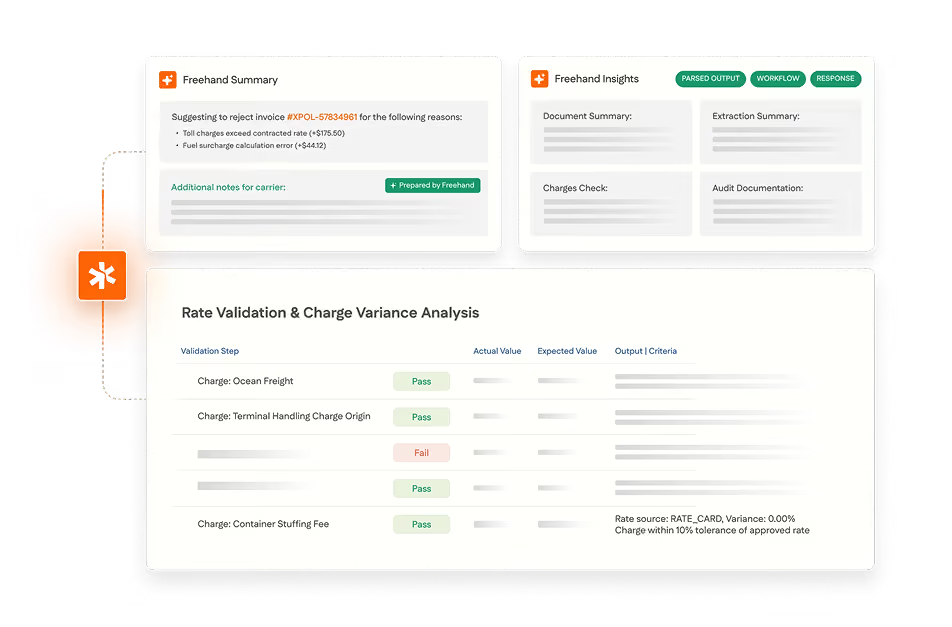
Real-time freight spend visibility means the cost of a shipment is known and auditable at the point of tender or transit, not reconstructed weeks later from invoices. Freehand's spend intelligence agent pulls freight spend data from every system, ERP, TMS, audit results, and carrier invoices, into one continuously updated view.
It answers cost questions in seconds through a natural-language query, instead of a dashboard report or an analyst request. It also maintains live accruals from tendered and in-transit shipments, instead of an end-of-month estimate. It also monitors spend continuously. The moment a cost spike, a rate change, or a contract anomaly shows up, it sends an alert, rather than surfacing it in next month's report.
What mistakes keep freight spend from actually being real-time?
Most programs that call themselves real-time are really a faster version of the same periodic process, not a continuously updated one.
- Treating a dashboard refresh as real-time. A dashboard that pulls last month's audit results on a schedule isn't real-time. It's a faster look at old data.
- Tracking shipments in real time while auditing invoices in batches. Real-time GPS data paired with a monthly invoice audit still leaves the cost side weeks behind the operational side.
- Estimating accruals instead of calculating them from live activity. A month-end accrual estimate is a guess dressed up as a number. A live accrual, built from tendered and in-transit shipment data, is the actual number.
- Waiting for a report to catch a cost spike. A rate anomaly that surfaces in next month's review already cost a month of unnecessary spend before anyone saw it.
How do you get from real-time tracking to real-time spend visibility?
You get there by connecting the same systems that already update in real time on the operational side, and feeding that data into a continuously updated spend and audit layer. The TMS and ERP already know what shipped and when. The missing piece is a layer that turns that activity into an auditable cost number right away, instead of weeks later.
Freehand's spend intelligence agent is that layer. It consolidates freight spend across every system into one view. It keeps accruals live instead of estimated, and answers a cost question in seconds instead of a report cycle. Full-coverage freight audit runs underneath it continuously, so the numbers it shows are already validated, not just fast.
{{brown-cta}}
Frequently Asked Questions
What is real-time logistics?
Real-time logistics is the use of continuously updated data, GPS, IoT, EDI, and system integrations, to monitor shipments, inventory, and costs as they happen, instead of through a periodic report.
Is real-time GPS tracking the same as real-time spend visibility?
No. GPS tracking answers where a shipment is right now. Spend visibility answers what it's costing and whether the charge matches what was agreed. Most enterprises have the first without the second.
Does real-time logistics require a TMS?
A TMS helps with the operational tracking layer. It doesn't make freight spend real-time on its own. Spend visibility requires that TMS data to be connected to the ERP and carrier invoices in one continuously updated view. A TMS alone doesn't provide that.
What's the difference between a live dashboard and real-time spend visibility?
A dashboard that refreshes on a schedule is still showing whatever data was last pulled, often from a periodic audit or report cycle. Real-time spend visibility means the underlying accrual and audit data itself updates continuously, not just the display.
What's the ROI of real-time freight spend visibility?
Enterprises running real-time spend visibility and anomaly detection typically recover $800,000 to $1.3M a year, from cost spikes and rate drift caught before they compound. That's on top of roughly a 60% reduction in time spent on manual spend reporting.
Can real-time spend visibility replace a monthly close process?
It changes what the close process is working from. Instead of reconstructing the month's freight costs from invoices after the fact, a live accrual keeps the numbers current throughout the month. They're not estimated at the end of it.
See What Your Freight Actually Costs, Right Now.
Freehand keeps freight spend and accruals live, updated from every tendered and in-transit shipment, so the number you see is the number that's actually true today.
Your Freight Data Updates in Real Time. Your Spend Report Doesn't.
GPS tells you where the truck is right now. Most finance teams still find out what it cost weeks later.
Every warehouse. Every provider. Every mile.
Gartner's 2026 outlook on logistics outsourcing, and how AI Teams hold every contract to the terms you agreed.
- Where outsourced logistics quietly loses margin
- Why billed charges drift from the contract
- How AI Teams close the gap