
Supply Chain vs. Logistics: What's the Actual Difference?
Supply chain is the entire network, from sourcing to delivery. Logistics is the function that moves and stores goods within it. See how they relate.
.webp)
August 21, 2026
•
8
mins
.png)
Supply chain is the entire network that gets a product from raw material to customer. That includes sourcing, manufacturing, procurement, logistics, and returns. Logistics is one function within that network: moving and storing goods. It covers transportation, warehousing, and fulfillment. Logistics is a part of supply chain. It was never a synonym for it.
Key Takeaways
- Supply chain is the full network of activities that get a product from raw material to end customer, including sourcing, manufacturing, procurement, logistics, and returns. Logistics is one function inside that network, not a separate, parallel term.
- Logistics specifically covers the movement and storage of goods: transportation, warehousing, inventory management, and order fulfillment.
- The confusion between the two terms is common enough that it's a recurring question on industry forums and business-school resources, largely because logistics is the most visible, physical part of the supply chain, so it gets used as shorthand for the whole thing.
- Within logistics specifically, freight transportation carries its own financial control layer, freight audit and spend management, that's easy to overlook when the two broader terms already get conflated.
What is supply chain management?
Supply chain management is the coordination of every activity involved in turning raw materials into a product a customer receives. It spans sourcing, manufacturing, procurement, logistics, and the reverse flow of returns. It's the full network, not any single function inside it.
Supply chain management asks: which suppliers do we use, how much do we make and when, how much inventory do we hold, and how does the finished product reach the market. Logistics only answers that last part.
Day to day, supply chain management typically covers:
- Sourcing and buying raw materials
- Selecting and managing suppliers
- Planning factory production
- Designing the overall product and network strategy
What is logistics?
Logistics is the function within supply chain management responsible for moving and storing goods. It covers transportation, warehousing, inventory management, and order fulfillment. It's execution, not strategy. Logistics doesn't decide what to make or who to source from. It moves and stores what supply chain planning already decided on.
Day to day, logistics typically covers:
- Moving goods by truck, ship, rail, or air
- Storing items in warehouses
- Packing and shipping orders
- Tracking inventory in real time
For where AI applies specifically within the logistics function, see our guide to AI in logistics.
{{blue-cta}}Where do these two terms actually come from?
Logistics is the much older term, with roots in military supply movements. "Supply chain management" is a specific, datable business term, coined in 1982. The age gap explains part of why the two get conflated: logistics had a head start of centuries before supply chain management existed as a distinct discipline to separate itself from.
Military historians point to Alexander the Great's campaigns as an early example of logistics mastery, moving and supplying an army across vast distances long before "logistics" was a business term. Supply chain management has a much more specific origin: consultant Keith Oliver coined the term in a 1982 interview with the Financial Times, defining it as planning, implementing, and controlling supply chain operations to meet customer requirements as efficiently as possible.
How do supply chain and logistics actually relate to each other?
Logistics manages flow and execution. Supply chain management manages the entire system. Supply chain takes the broad view: designing the network and the strategy behind it. Logistics is the specific process of planning, executing, and managing the movement of goods within that network. Supply chain is the whole system. Logistics is the part of that system that physically moves and stores product.
| Supply chain management | Logistics | |
|---|---|---|
| Scope | The entire network, spanning multiple companies: suppliers, manufacturers, carriers, distributors | One function, usually managed inside a single company |
| Approach | Strategic: thinks long-term, designs the network | Tactical: manages day-to-day operations |
| Typical activities | Supplier selection, demand planning, procurement, network design | Transportation, warehousing, inventory, fulfillment |
| Main focus | Building a competitive advantage across the network | Meeting customer requirements: the right goods, the right place, on time |
What does this look like in practice?
Take a furniture manufacturer. Deciding which lumber supplier to use, how many units to build this quarter, and whether to open a new distribution center on the West Coast are supply chain decisions. Once those decisions are made, the trucking company that picks up finished pallets from the plant, the warehouse that stores them, and the carrier that delivers them to a retailer, that's logistics. Supply chain decided the network should exist. Logistics runs it.
Why do people mix up supply chain and logistics so often?
Logistics is the most visible, physical part of the supply chain, so it ends up used as shorthand for the whole thing. A truck showing up late or a warehouse running out of space is something everyone in the business notices. Supplier selection and demand planning happen further upstream, out of sight. So logistics gets treated as if it were the entire operation.
That shorthand causes real confusion when it's time to fix a problem. A cost issue that's actually about sourcing or demand planning gets misdiagnosed as a "logistics problem." It ends up with the wrong team.
Where does freight spend and audit fit inside logistics?
Freight transportation is one piece of the logistics function, and it carries its own financial control layer, easy to lose track of once "supply chain" and "logistics" are already being used loosely. Freight audit is the process of checking that what a carrier bills actually matches what was contracted. It sits specifically inside the transportation piece of logistics, not the warehousing or fulfillment side.
That distinction matters because the two broader terms already get conflated in casual use. Add a third layer, which specific logistics cost is even being tracked, and it gets lost even faster.
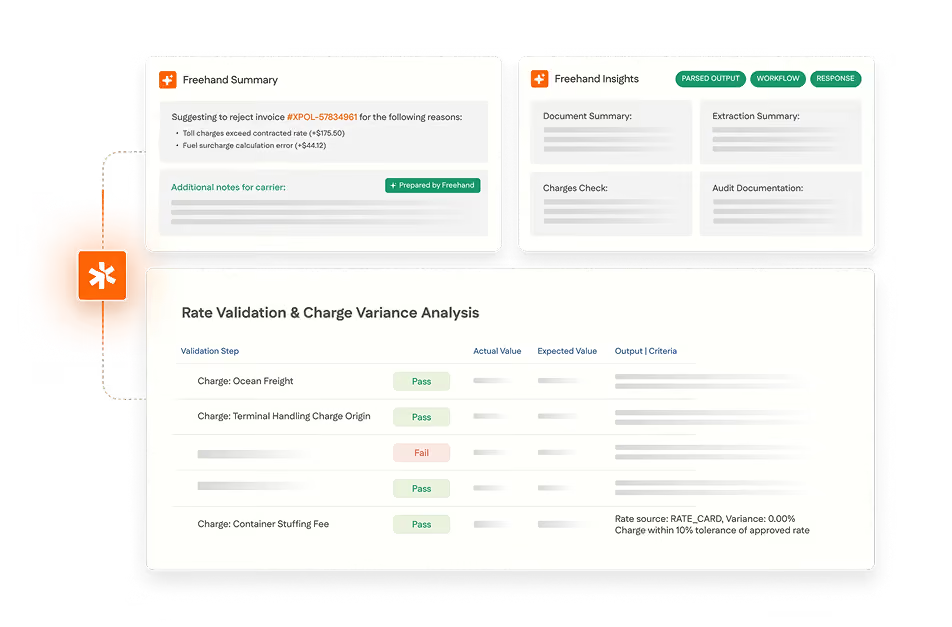
For how that financial layer works specifically for freight, see our guide to freight audit. Freehand's invoice audit agent checks 100% of freight invoices instead of a sample. That's what keeps a logistics-level billing error from getting lost inside a broader supply chain number.
{{brown-cta}}
Frequently Asked Questions
What is the difference between supply chain and logistics?
Supply chain is the entire network from raw material to customer. It includes sourcing, manufacturing, procurement, logistics, and returns. Logistics is one function within that network: moving and storing goods.
Is logistics a type of supply chain management?
Logistics is a function within supply chain management, not a separate type of it. Supply chain management includes logistics along with sourcing, manufacturing, procurement, and other functions.
Can a company have logistics without supply chain management?
Every company that moves physical goods has logistics activity by definition. Whether it's formally managed as part of a broader strategy, with sourcing and procurement coordinated alongside it, is a separate question of maturity.
Which is the bigger field, supply chain or logistics?
Supply chain is the broader field. Logistics is one function inside it, alongside sourcing, procurement, manufacturing, and demand planning.
Does freight audit belong to supply chain or logistics?
Freight audit sits inside logistics, in the transportation piece of it. It's a financial control function that checks whether carrier invoices match contracted rates. That's separate from the physical movement of the freight itself.
What do supply chain and logistics have in common?
Both exist to get the right goods to the right place at the right cost, and both directly affect the customer experience. The difference is altitude, not goal: logistics executes that goal day to day, supply chain plans and coordinates it across the whole network.
See What Agentic AP Actually Looks Like.
The concept is easy to describe and harder to picture. Watch it run against a real freight invoice.
One Blurred Term Means One Blurred Cost.
When supply chain and logistics get used interchangeably, the spend inside each one gets blurred too. Freehand keeps freight spend visible at its own layer instead of folded into a broader number.
Every warehouse. Every provider. Every mile.
Gartner's 2026 outlook on logistics outsourcing, and how AI Teams hold every contract to the terms you agreed.
- Where outsourced logistics quietly loses margin
- Why billed charges drift from the contract
- How AI Teams close the gap