
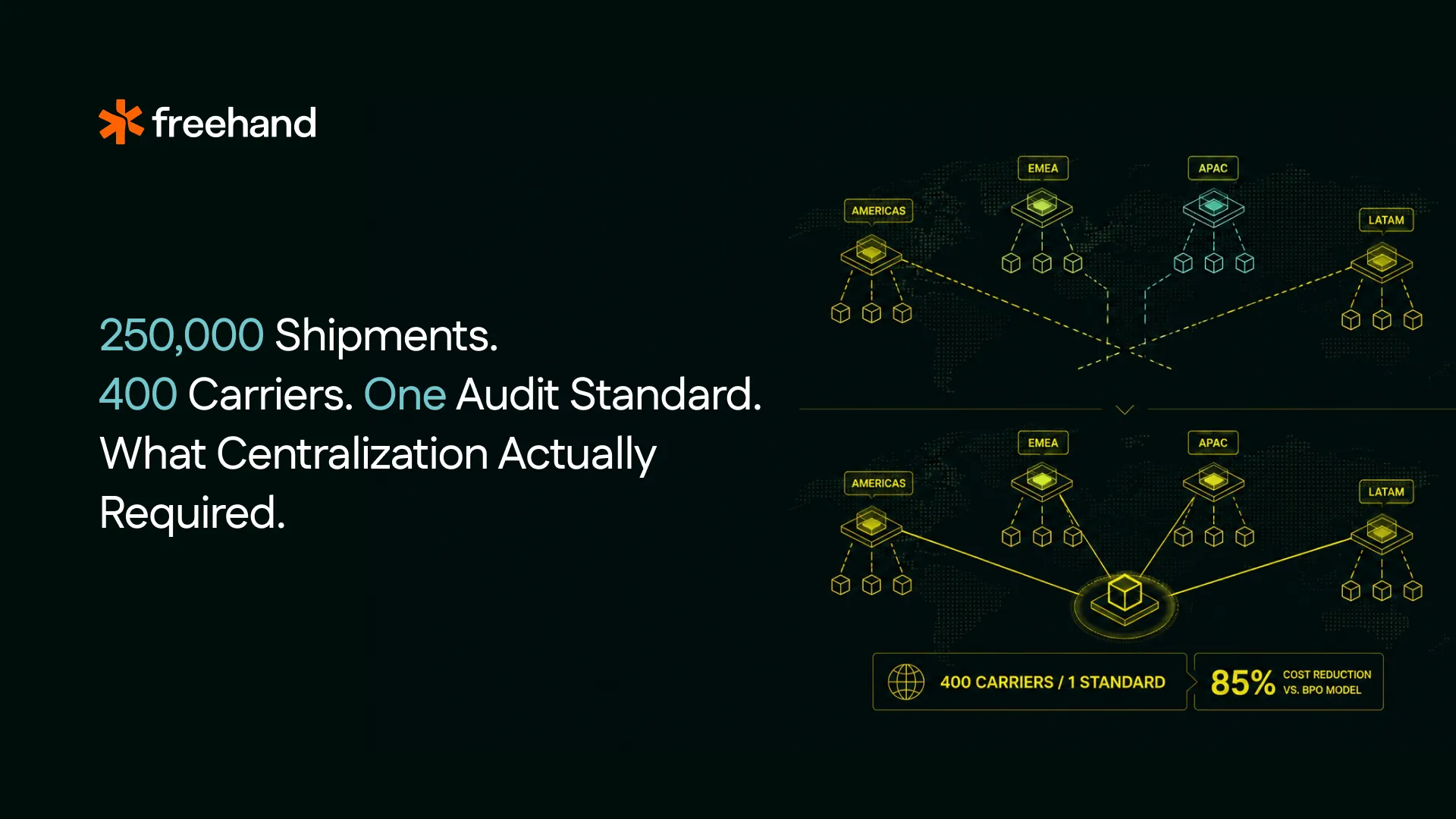
250,000 Shipments. 400 Carriers. One Audit Standard. What Centralization Actually Required.
Regional teams apply regional interpretations. The same shipment, billed by the same carrier, can produce different audit outcomes in two different offices.

July 23, 2026
•
3
mins
Regional teams apply regional interpretations. The same shipment, billed by the same carrier, can produce different audit outcomes in two different offices.
A global energy technology company managing freight operations across North America, EMEA, APAC, and LATAM had built its freight audit infrastructure through regional outsourcing. Different vendors handled different regions. Different audit standards applied to different carrier relationships. The company moved 250,000 shipments annually across air, ocean, trucking, parcel, customs, and warehousing. Its freight audit coverage was a patchwork, some regions well-covered, some barely audited, the whole incapable of producing a single consistent view of freight spend across the global network.
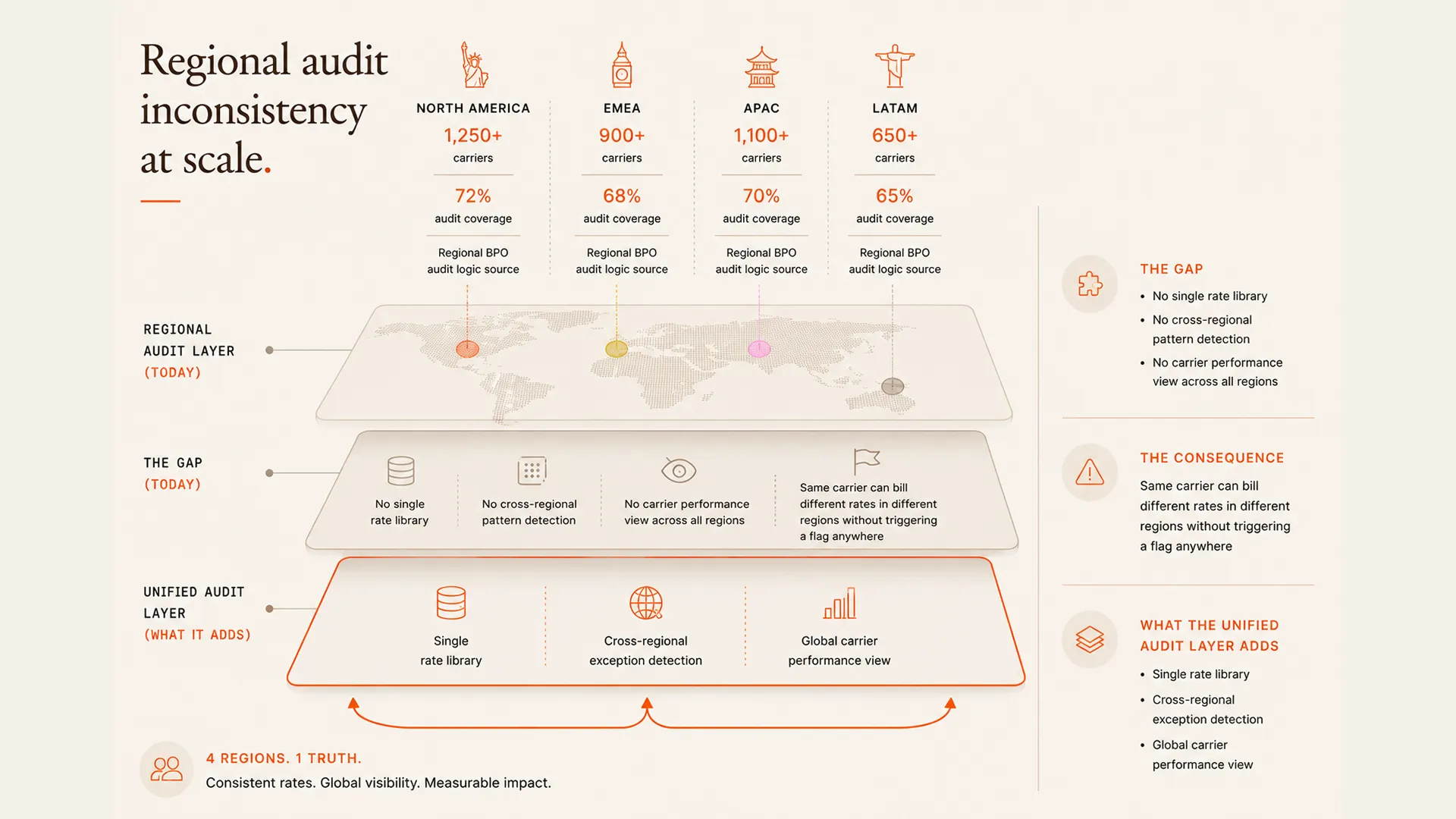
The problem was not the individual BPOs. Each managed its region competently by the standards of the model. The problem was what the patchwork could not produce: a unified rate library that applied the same audit logic to the same carrier regardless of which region the shipment moved through, a single view of carrier billing accuracy across all 400-plus relationships, and the ability to identify systemic patterns in carrier billing behavior that were invisible when each region's invoices were audited in isolation.
What regional inconsistency costs
Regional audit inconsistency produces a specific and underappreciated cost. When carrier A bills the same accessorial charge at two different rates in two different regions, and both regional audit teams accept their respective charges because each charge is within the locally-configured tolerance, the company is paying two different prices for the same service. Neither regional team is making an error. The error is in the architecture: there is no single version of the contracted rate for carrier A that all regions enforce consistently.
At a carrier network of 400-plus relationships, each with its own rate structures, regional variations, and amendment histories, the number of potential inconsistencies is substantial. The company's own finance team had no visibility into how many of these inconsistencies existed because the regional audit systems had never been connected to a single data layer. The invoices were being processed. The patterns were invisible.
What centralization required in practice
Centralizing audit across 400-plus global carriers required building a version-controlled rate library that held every carrier's contracted rates, regional variations, and amendment history in a single repository. When a carrier's rate changed, the update applied globally, not in one region's audit configuration while the others continued using the previous rate. The rate library became the single source of truth that all regional invoice processing validated against.
The multi-leg shipment problem required separate technical work. The company's SAP ERP and Oracle Transportation Management systems struggled with multi-leg shipments that required multiple invoice matches per shipment. Planned costs existed in the TMS but the audit logic could not reconcile complex routing scenarios where a single shipment might cross three handoffs with three different carrier invoices for three different legs. Semantic understanding of the full shipment journey, not just individual invoice-to-PO matching, was required to audit multi-leg movements correctly.
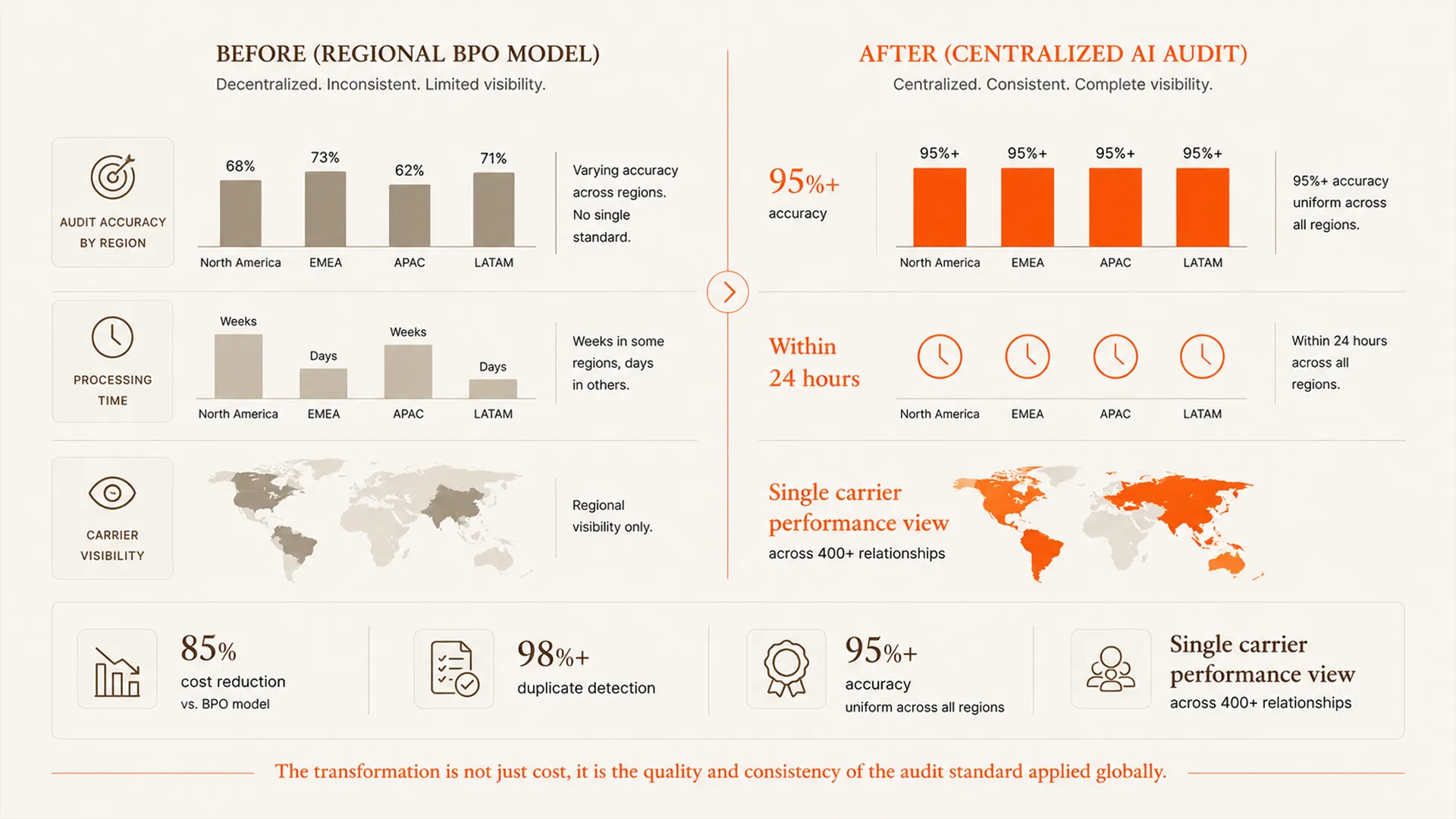
The outcome was 95% invoice processing accuracy within 24 hours across all 250,000 annual shipments, an 85% reduction in audit costs versus the prior BPO model, and 98%+ duplicate detection rate across all modes. The company's finance team moved from chasing carriers through fragmented regional email chains to reviewing a consolidated exception dashboard that showed the full global picture. The shift from regional patchwork to centralized audit produced the visibility that 400-plus carrier relationships had never provided before.