
Agentic Policies: The Governance Layer That Makes Autonomous AI Compound Over Time
The agents will commoditize. The policies that govern them, built on years of Fortune 500 exception data, will not.

July 27, 2026
•
4
mins
The agents will commoditize. The policies that govern them, built on years of Fortune 500 exception data, will not.
Every AI agent in a supply chain AP deployment operates on two things: the context it can see (the invoice, the contract, the shipment data, the historical exception records) and the policies that govern how it should act on that context. The context determines what the agent knows. The policies determine what the agent does. Most discussions of agentic AI in enterprise settings focus extensively on the context, the data architecture, the context graph, the information sources. The policies receive less attention. They are, in a meaningful sense, the more important of the two.
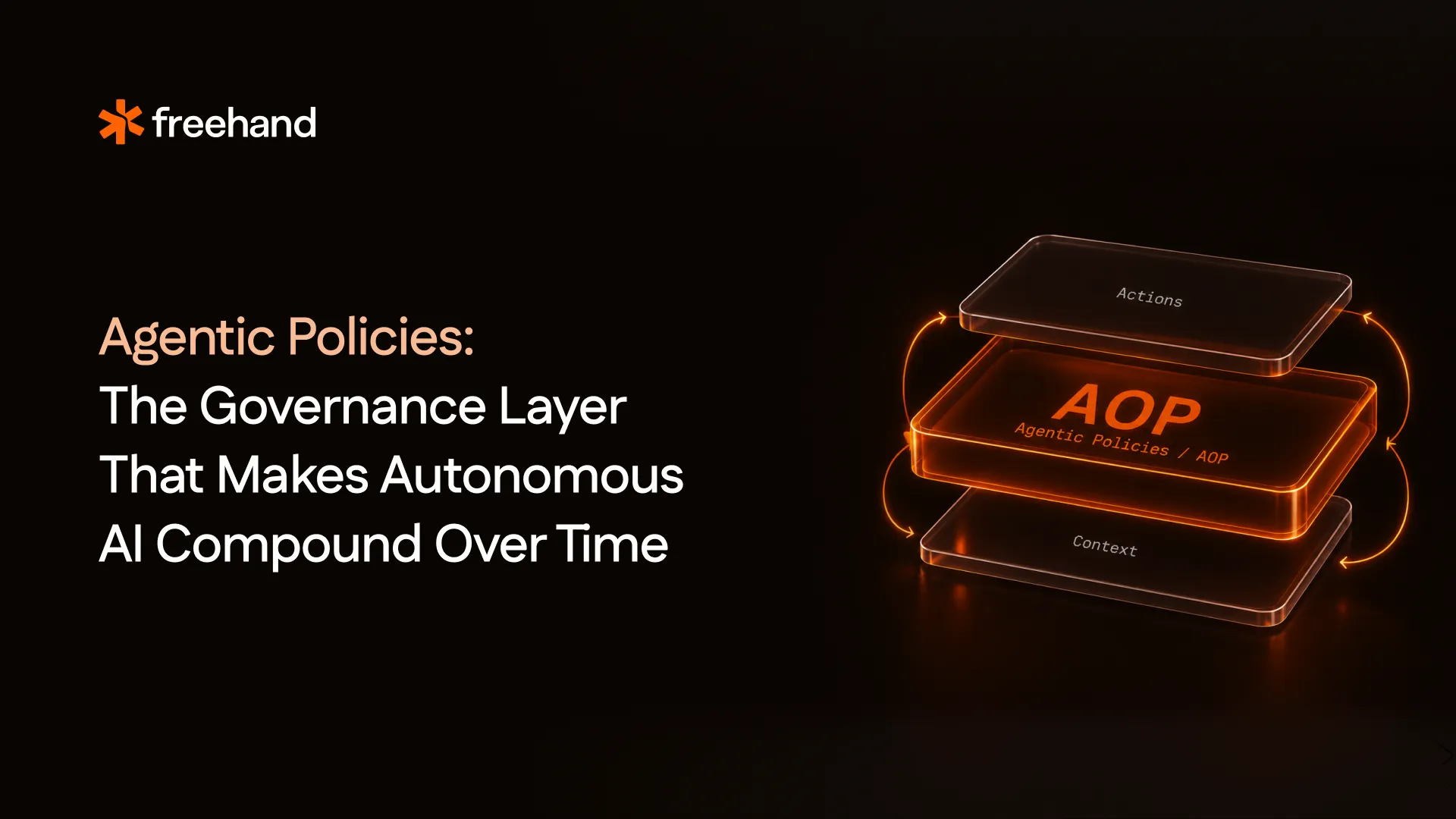
A policy is an executable rule that encodes how a decision gets made. When to auto-approve an invoice. When to dispute a charge. What evidence to assemble before initiating a dispute. Which carriers require a different dispute process than the standard. What variance tolerance applies to this spend category but not to that one. Each of these rules exists in some form in every enterprise AP operation, sometimes documented, more often institutional. The Agentic Operating Process, or AOP, is the governance layer that captures these rules, makes them executable, and accumulates them as the system processes more decisions.
How the AOP is built
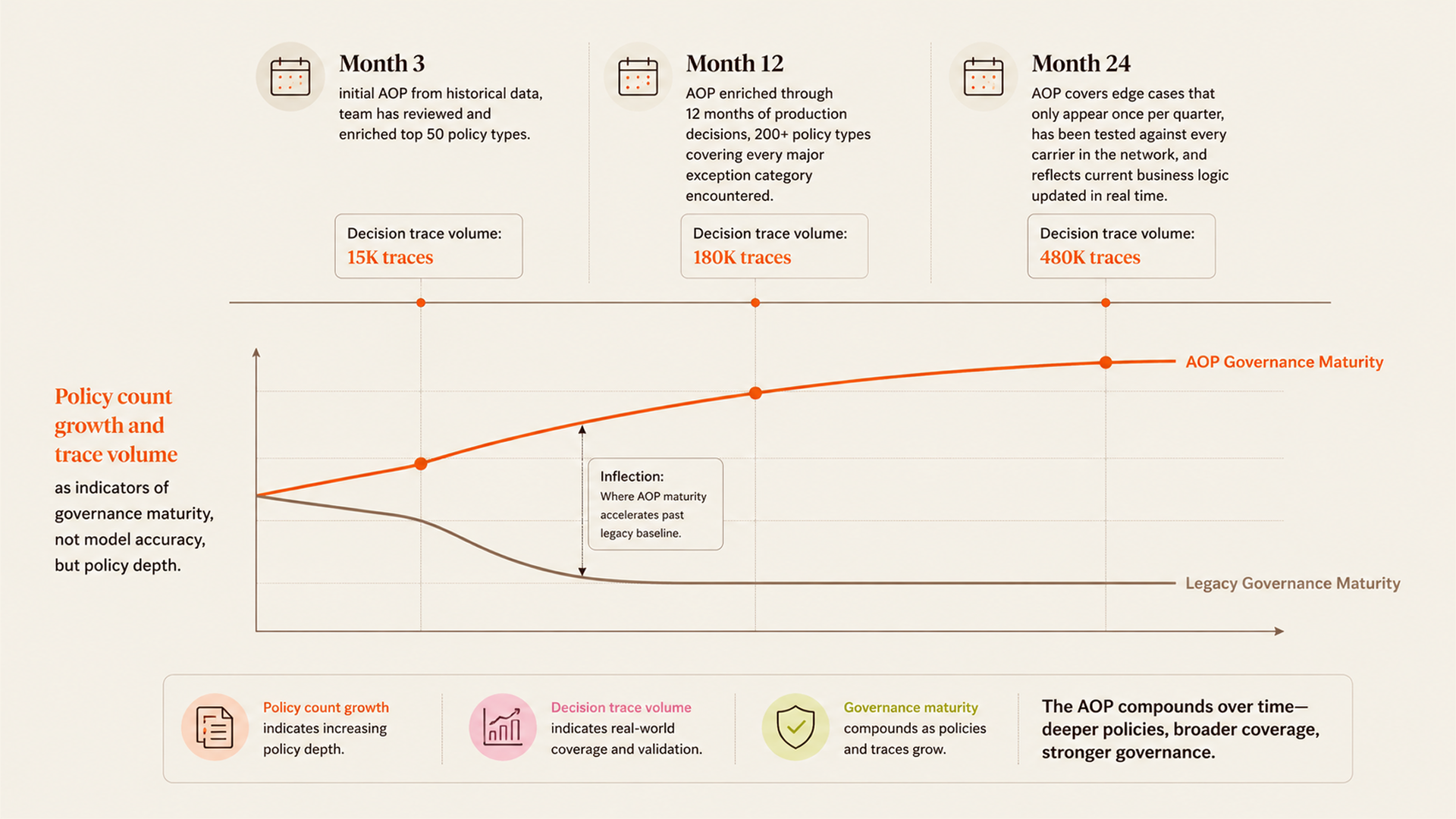
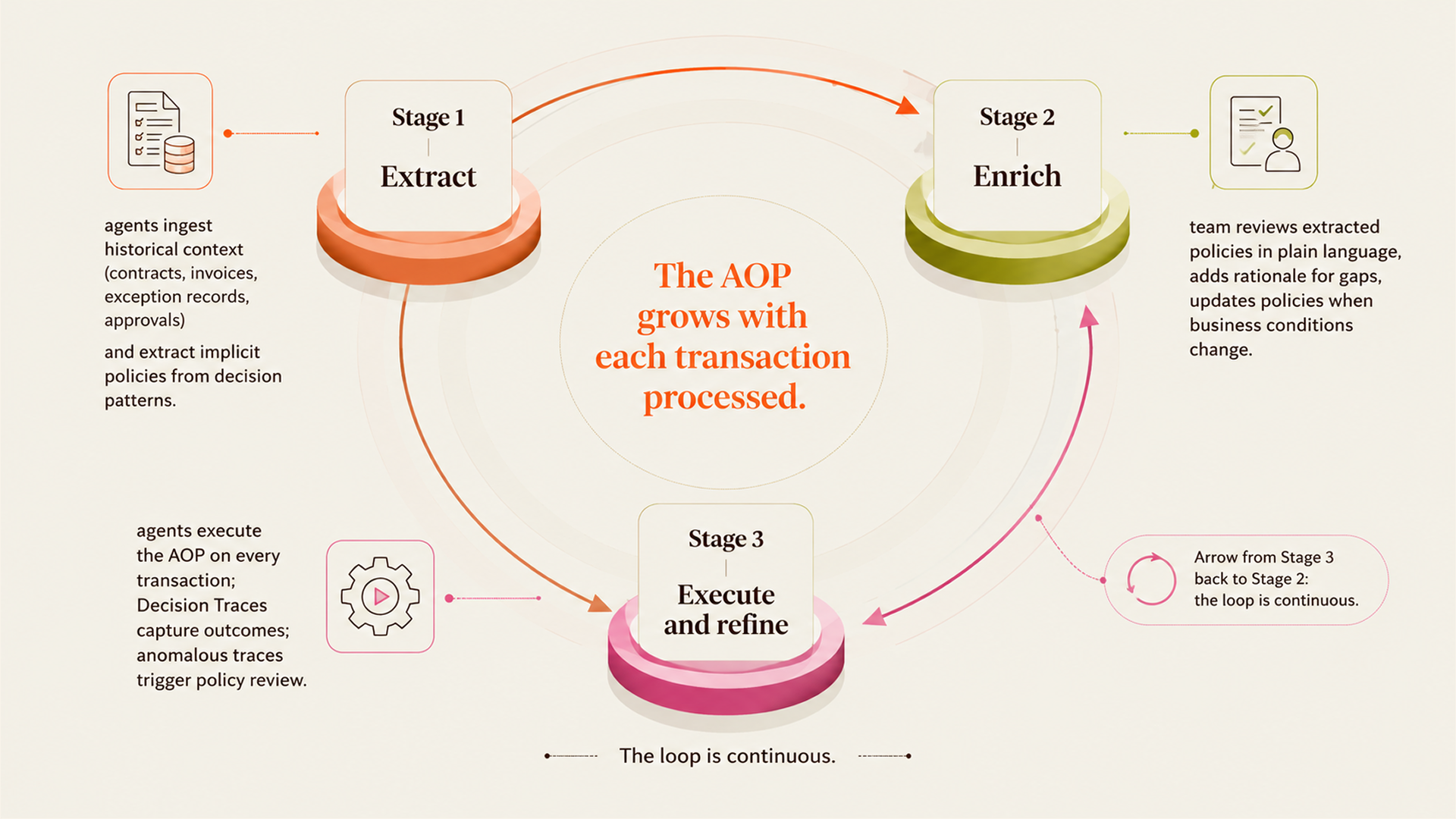
The AOP is not configured at implementation. It is gleaned from the context and then enriched by the team. When Freehand is deployed on a new AP category, the agents begin with the available context, the contracts, the rate cards, the historical invoice data, the exception records, and extract from that context the policies that are implicit in how decisions have been made. An approval pattern that appears consistently across hundreds of similar invoices encodes a policy even if nobody ever wrote it down. A recurring exception type that was always resolved the same way encodes a resolution policy even if it was never formally documented.
The extracted policies form an initial AOP that is then reviewed and enriched by the team in plain language. When a policy is incomplete, the agent can see that a certain exception type was always approved, but cannot determine why from the historical data, a team member adds the rationale in plain English. When a policy needs to be updated because business conditions have changed, the update is made in plain language and propagates immediately to every agent that references that policy. The team is not writing code. They are teaching the system how their business works.
Decision Traces and the governance connection
The AOP governs what agents do going forward. Decision Traces record what agents have done. Every policy execution generates a trace that documents which facts were referenced, which policy was applied, what the outcome was, and what would have produced a different outcome. The trace is the audit record that makes autonomous AI defensible to an external auditor, an internal controls team, or a finance executive who wants to understand why a specific invoice was approved at a specific amount.
The connection between the AOP and Decision Traces is what makes the governance layer self-improving. When a trace reveals that a policy produced an unexpected outcome, an invoice that should have been disputed was approved, or an exception was misclassified, the policy is updated. The update propagates to all future transactions in the same category. The system learns not through model retraining but through policy refinement, which is significantly faster, more targeted, and more auditable than model-level changes.
Why the AOP compounds where the agents cannot
The agents themselves, the LLMs, the reasoning engines, the matching algorithms, are available to any software company with the resources to integrate them. The model quality gap between competitors is real but narrowing. What cannot be rapidly replicated is an AOP built on years of Fortune 500 AP data, refined through millions of real decisions, and enriched by the institutional knowledge of finance teams at Apple, Meta, J&J, Cardinal Health, and dozens of other enterprise operators. Each transaction that the AOP governs makes it more precise. Each category that the AOP is extended to makes it deeper.
The moat in agentic AI for enterprise AP is not the technology. It is the accumulated body of executable policies that encode how the world's most complex supply chain operations make accounts payable decisions. That cannot be purchased, cannot be downloaded, and cannot be built in six months. It is the compounding output of every transaction the system has governed.