
Best-of-Breed vs. Suite for AP: The Trade-Off That Agentic AI Eliminates

August 13, 2026
•
4
mins
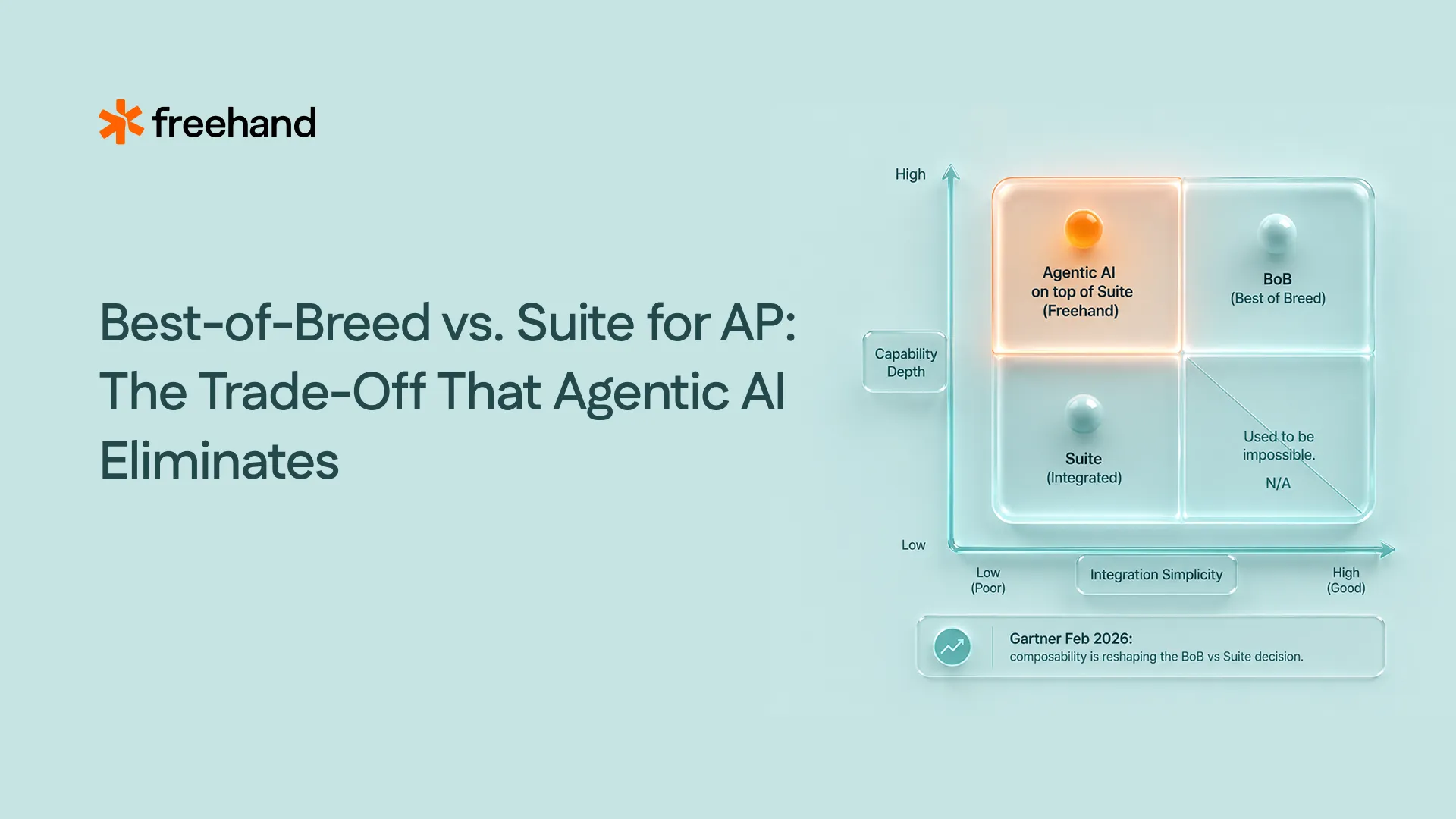
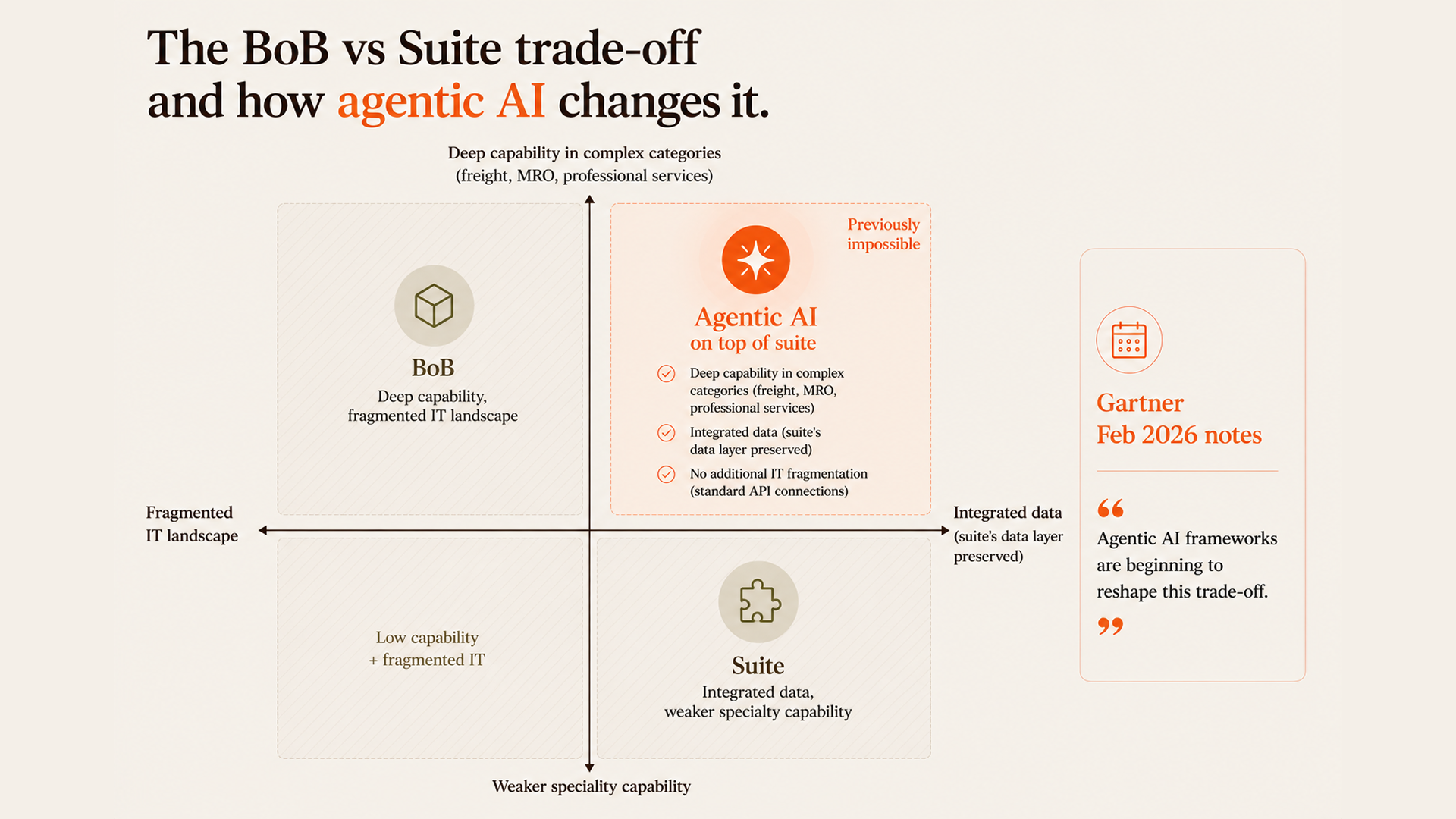
Category depth without the fragmented IT landscape. That used to be impossible. It is what agentic AI sitting on top of any suite produces.
The best-of-breed versus suite debate in enterprise technology has a clear tension that every procurement team navigating an AP transformation understands. Best-of-breed solutions offer depth in their specific domain, freight audit, sourcing, or AP automation, that suite vendors cannot match. Suite solutions offer integrated data, simpler vendor management, and a consistent user experience across the AP function. The trade-off has historically been: choose depth or choose integration. You could not fully have both.
Gartner's February 2026 research on best-of-breed versus suite solutions acknowledges that agentic AI frameworks are beginning to reshape this trade-off. Their analysis notes that composability through microservices and agentic AI 'enables flexible integration of specialized tools, while agentic AI frameworks allow autonomous agents to adapt and collaborate.' The implication for AP technology is direct: an AI-native platform that sits on top of any existing suite, SAP, Oracle, Coupa, Workday, can provide category depth in freight, MRO, and professional services AP without fragmenting the data layer that the suite already owns.
What the integration architecture actually looks like
Freehand's integration with existing suites operates through the same APIs that the suite's other integrations use, the same connections that the TMS, WMS, and procurement systems already use. Freehand reads ERP data, posts GL entries back to the suite's ledger, feeds audit data to the data warehouse, and integrates with the payment layer. IT sees a connected freight AP layer, not a competing system. The data layer owned by the suite is not disrupted.
The capability that the suite does not provide, category-specific invoice validation for freight, MRO, and professional services at production scale, is what Freehand adds. The suite continues governing the AP workflow for the standard categories it handles well. Freehand adds autonomous execution for the complex categories where the suite's AP invoice automation module is limited. The user experience is unchanged because the agents operate in the background; the finance team's workflow interfaces with the same systems they have always used, but the work that previously required human review no longer appears in their queue.
Where suite AP automation is weakest
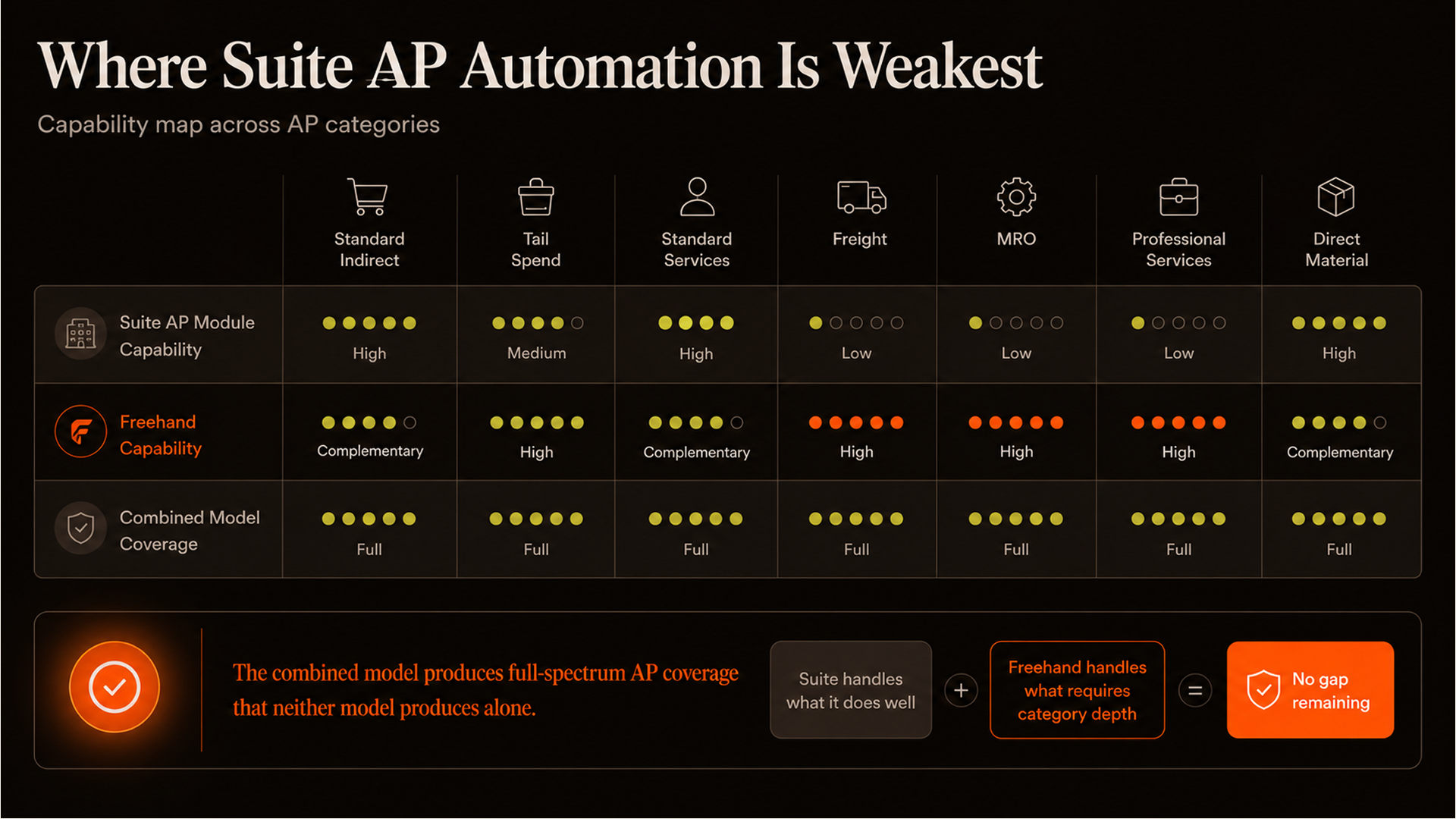
Gartner's Critical Capabilities analysis for AP and procure-to-pay platforms consistently identifies AP invoice automation as the weakest module for the market's leading suite vendors. This is not a criticism of those vendors' overall platforms, they are leaders in indirect P2P, category management, and procurement analytics. It is a structural observation about where the category complexity of freight, MRO, and professional services exceeds what suite-level AP automation modules were designed to handle.
Suite vendors prioritize breadth across all AP categories over depth in any specific category. For the 70% of AP volume that follows standard procurement patterns, breadth is exactly what is needed. For the 30% that requires category expertise, the freight accessorials, the MRO pricing tier structures, the professional services SOW interpretations, the suite's AP module produces exception rates that require significant human review. That is not a failure of the suite. It is the natural boundary of what breadth-first design produces.
The Gartner TCO argument for the combined approach
Gartner's best-of-breed versus suite analysis identifies the total cost of ownership as the critical evaluation dimension, noting that 'although suite solutions may appear attractive due to potentially lower overall licensing costs, this saving can be eroded if the functionality is too weak.' For freight AP, the functionality weakness in suite AP modules produces a measurable ongoing cost: the labor required to handle the exceptions that the suite cannot resolve autonomously, the overcharges that pass through because the audit logic lacks category depth, and the recovery shortfall relative to what full-coverage category-specific audit produces.
The combined model, suite for standard AP categories, Freehand AI Teams for complex categories, preserves the suite's integration advantages while closing the capability gap that the suite's own researchers have identified. The TCO calculation for this model accounts for the Freehand platform cost minus the BPO or internal team cost that it displaces, plus the incremental recovery from the complex categories that were previously under-audited. For most organizations, that calculation produces a net positive within the first year of deployment.