
Gartner Says 6 to 18 Months to Deploy Anomaly Detection in Finance AP. What That Estimate Assumes.

August 11, 2026
•
4
mins
The 6-18 month timeline assumes building from scratch. The question is whether that assumption applies to your deployment.
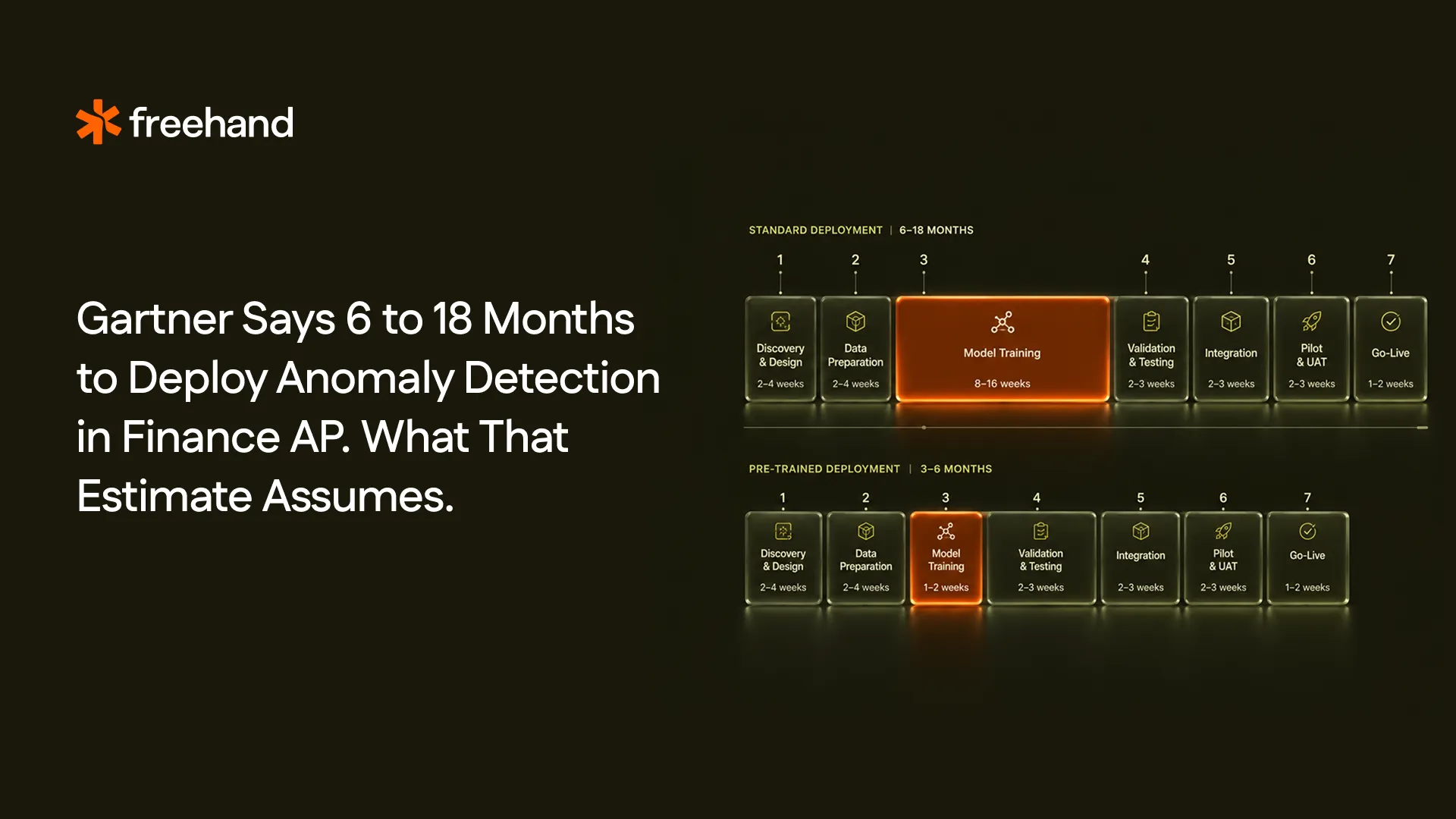
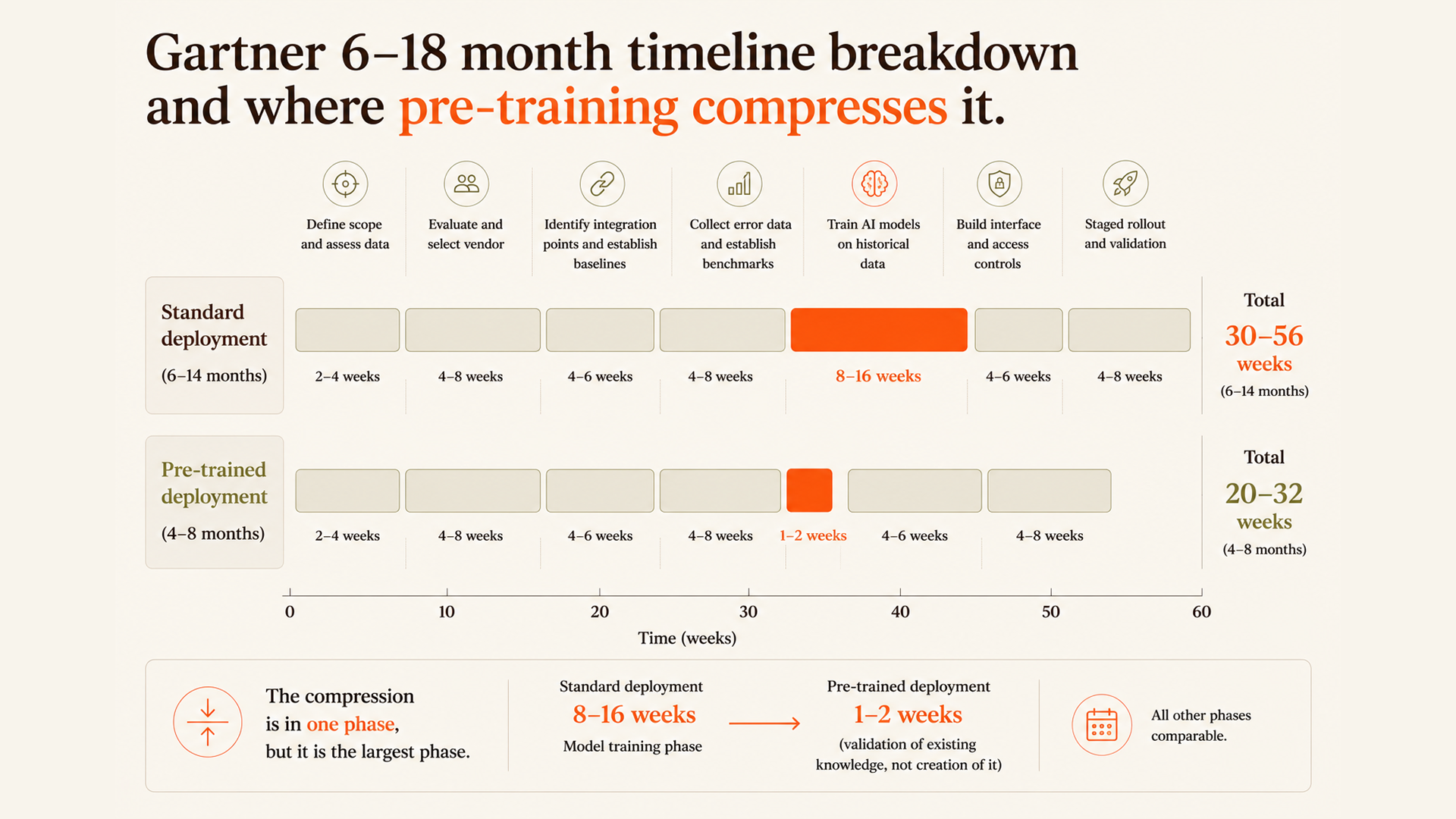
Gartner's AI Implementation Guide for anomaly and error detection in finance AP, published in January 2026, puts the average implementation timeline at six to eighteen months. The estimate is not wrong. It accurately describes what a from-scratch deployment of AI-driven anomaly detection requires: defining the scope of processes and systems to be covered, evaluating and selecting an AI approach or vendor, identifying integration points, collecting error and anomaly rates to establish benchmarks, training models using historical data, building a secure interface with role-based access, and deploying in a staged rollout by business unit, region, or transaction type.
Each of these steps takes real time when done correctly. The model training step alone, 'train the AI/ML models using historical data for in-scope systems and fields, ensuring coverage of known anomalies, seasonal patterns, and rare events to calibrate detection thresholds', assumes that you are building the detection capability from the data you have, not deploying one that has already been trained on comparable data. That assumption is the variable that changes the timeline.
What pre-trained production data changes
A logistics language model pre-trained on years of production freight invoice data from Fortune 500 AP operations arrives with carrier-specific billing patterns already encoded. The model does not need to be trained on what carrier A's fuel surcharge calculation looks like on LTL shipments from Chicago to the Southeast corridor, it already knows, because it has processed thousands of those invoices. The calibration step that takes months in a from-scratch deployment takes days in a pre-trained deployment, because you are confirming that the model's existing knowledge matches your specific contract terms rather than building that knowledge from your data.
The integration step, connecting to ERP, payment gateways, and reconciliation modules, takes the same amount of time regardless of whether the model is pre-trained. The interface build, the access control configuration, and the staged rollout validation also take comparable time. The difference is concentrated in the model preparation phase, which in a from-scratch deployment is typically the longest phase of the 6-18 month range. When that phase is reduced from months to days, the overall deployment timeline compresses substantially.
What the Gartner guide flags as common pitfalls
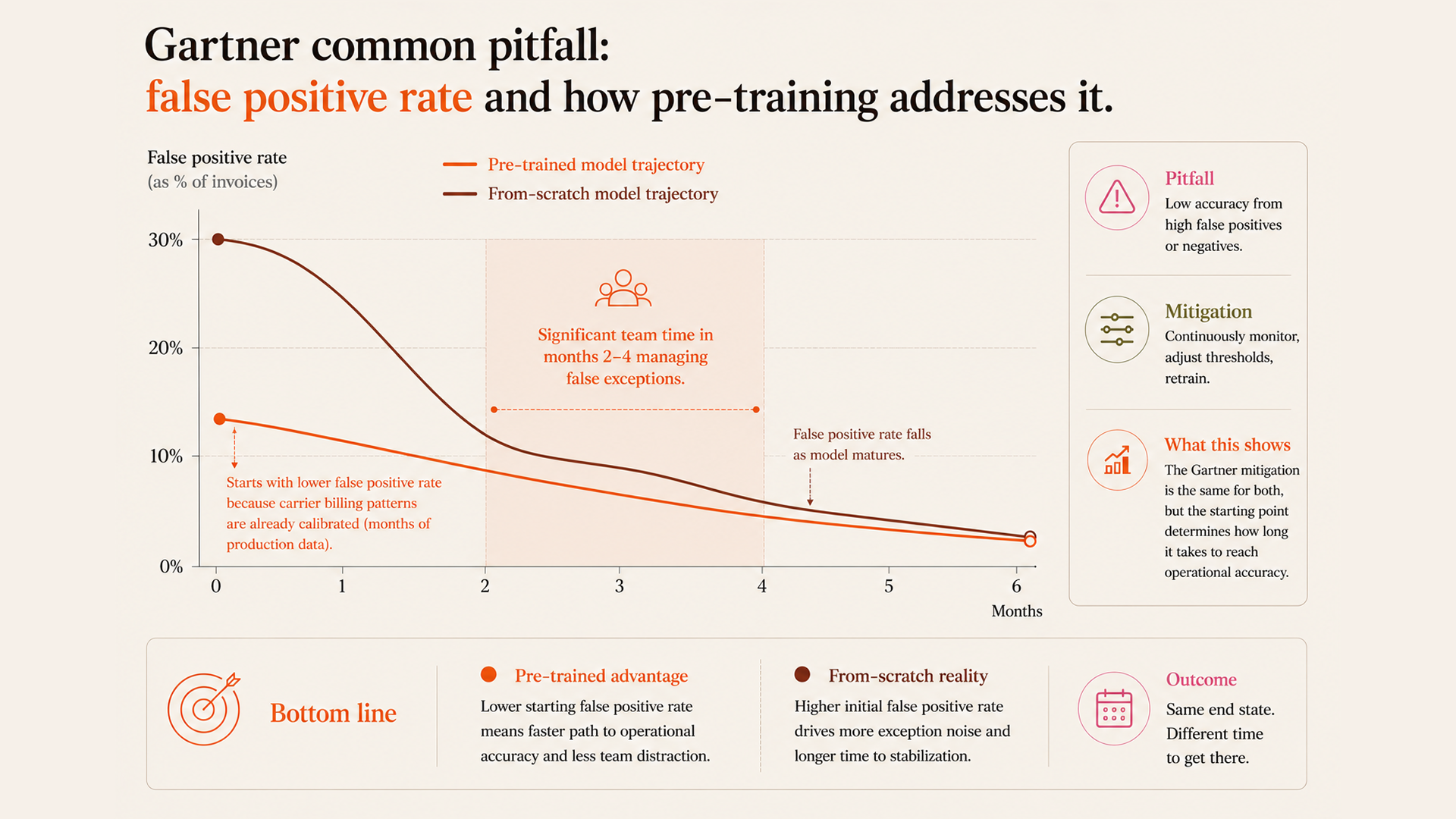
The Gartner guide identifies three common pitfalls that extend deployment timelines: incomplete data integration, low accuracy from high false positive or false negative rates, and insufficient regulatory alignment. The mitigation for incomplete data integration is mapping ERP, payment, and source systems end to end and enforcing data contracts. The mitigation for low accuracy is continuously monitoring model outputs, adjusting detection thresholds, and retraining models using updated validated datasets. The mitigation for insufficient regulatory alignment is maintaining documentation on model changes and audit logs for regulatory review.
Each mitigation works differently depending on whether you are building from scratch or deploying a pre-trained system. Continuous monitoring and threshold adjustment for a system that is still in its initial training phase produces different outcomes than continuous monitoring for a system that already has 18 months of production data as its baseline. Regulatory documentation for a system that records Decision Traces for every policy execution is structurally different from documentation for a system that was configured through manual threshold settings and periodically retrained. The guide's recommendations are sound; their implementation timeline varies significantly based on the starting point.
The staged rollout argument and why it still applies
Gartner's recommendation to use a staged rollout approach, by business unit, region, or transaction type, remains valid regardless of whether the model is pre-trained. A staged rollout is not primarily about model preparation time. It is about change management, organizational readiness, and the identification of edge cases that appear only in production at scale. A pre-trained model still benefits from being validated in a controlled environment before full deployment. The validation phase is shorter when the model arrives with established detection accuracy, but the organizational preparation that staged rollout supports does not compress proportionally.
The practical implication: a freight AP deployment with a pre-trained logistics AI can complete the technical implementation in eight to twelve weeks while following Gartner's staged rollout recommendation. The integration work, the staged validation, and the regulatory alignment documentation happen on that compressed timeline. The model training phase that drives most of the 6-18 month estimate has been front-loaded by the vendor rather than executed by the deploying organization.