
How a $127M Freight Operation Automated 200+ GL Allocation Rules in 20 Weeks
The GL allocation problem was not a configuration task. It was a data architecture task. That distinction determined how long it took.

July 18, 2026
•
3
mins
The GL allocation problem was not a configuration task. It was a data architecture task. That distinction determined how long it took.
A global technology company managing $127 million in annual freight spend across air, parcel, LTL, ocean, and FTL had a GL allocation problem that had resisted every previous attempt at a fix. More than 200 allocation rules, each varying by region and shipment type, governed how freight costs mapped to cost centers. The rules were documented across spreadsheets, institutional memory, and regional overrides that nobody had fully consolidated. Every quarter, audits produced exceptions. Every month, the finance team corrected allocations manually.
The prior freight audit provider processed invoices but provided no automated GL coding. Oracle Transportation Management, the Oracle ERP, and the audit system operated as disconnected silos. Mismatches between shipment references, invoice numbers, and cost centers were a persistent operational cost. The company's logistics finance team had tried to resolve the problem through configuration. The problem was not in the configuration. It was in the underlying data architecture.
What 200+ rules actually means
Two hundred allocation rules sounds like a large number until you understand what each rule represents. Each rule encodes a decision that someone made at some point, this shipment type on this lane for this business unit maps to this cost center. Some rules were exceptions to other rules. Some rules had regional variants. Some rules reflected historical business logic that had never been formally documented but had been embedded in manual approval workflows for years.
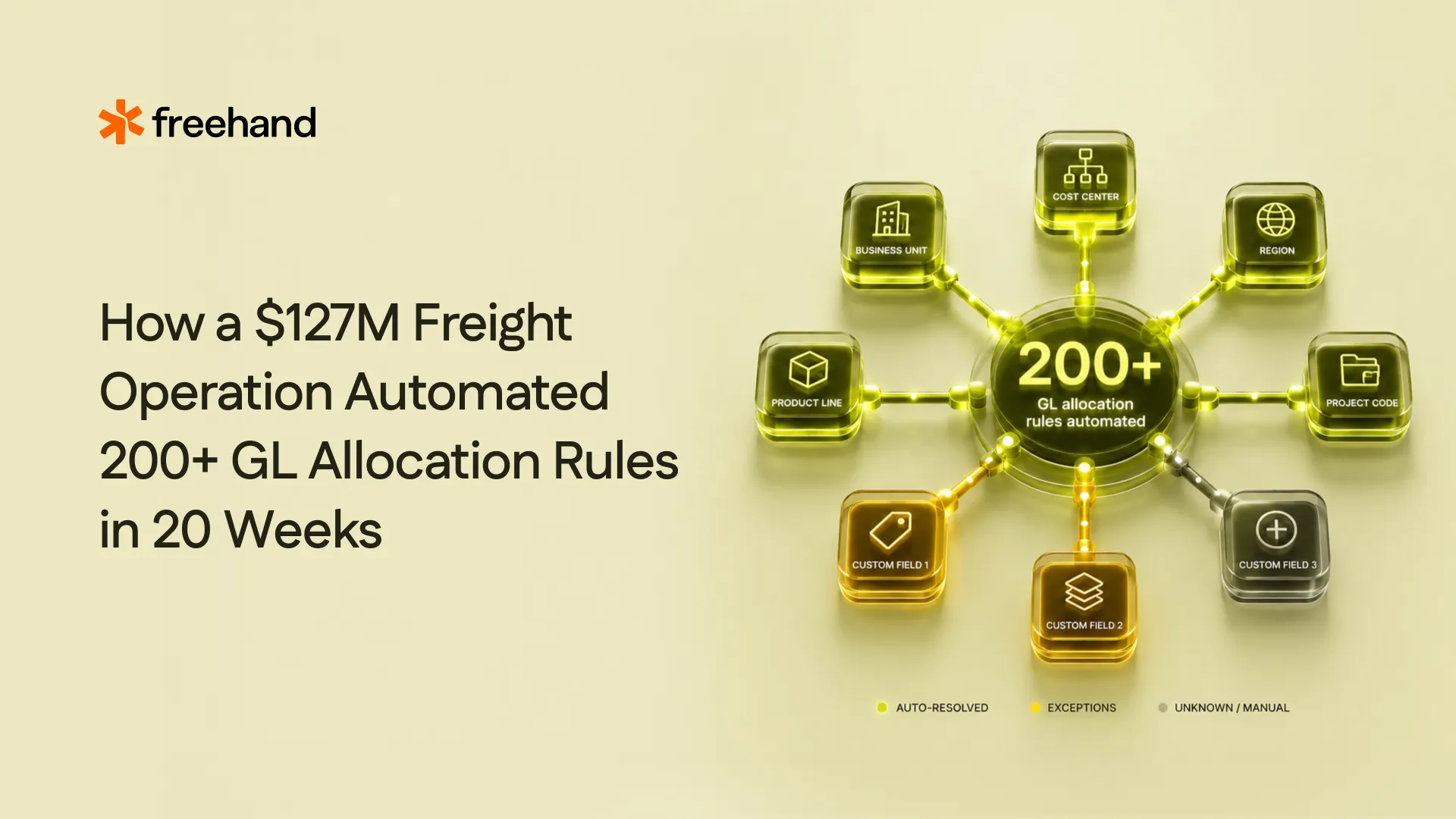
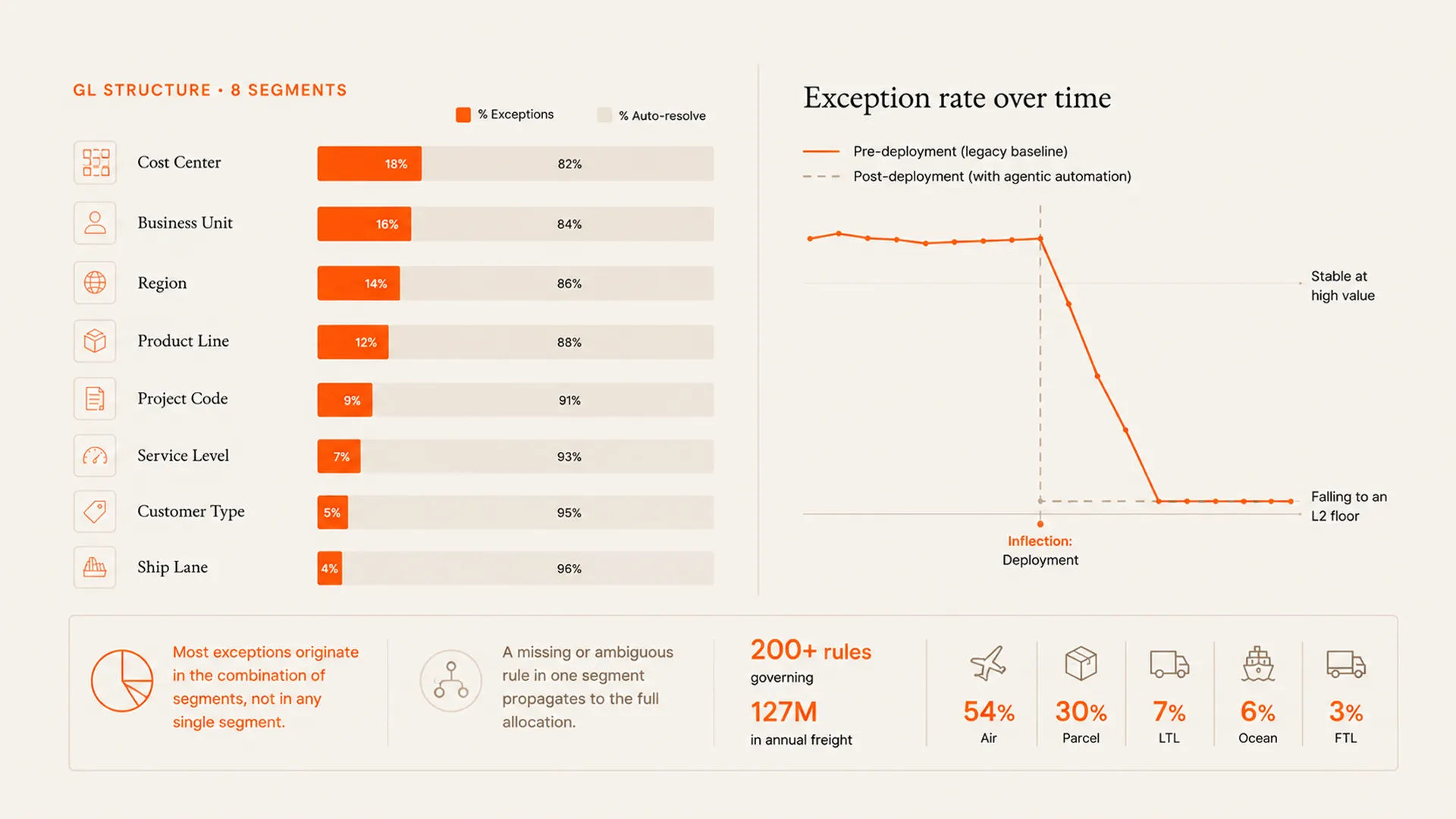
An eight-segment GL structure, where freight costs had to be coded across cost center, business unit, region, product line, project code, and three additional dimensions, meant that each allocation decision involved coordinating across eight data fields, each of which could trigger a different rule. When the rule was clear, the allocation ran correctly. When the rule was ambiguous, it generated an exception. When the rule was missing entirely, it required a human override.
The architecture decision that changed the outcome
To resolve 200+ GL allocation rules, the team needed a centralized rule repository where every rule was expressed in terms of shipment data rather than in terms of cost center codes. The distinction matters. A rule expressed as 'cost center 47219 for air shipments from Taiwan' depends on someone knowing what cost center 47219 represents and maintaining the mapping when cost center codes change. A rule expressed as 'product category X from origin region Y routes to the business unit that owns that product category' is self-maintaining because it reasons from shipment characteristics rather than from accounting codes.
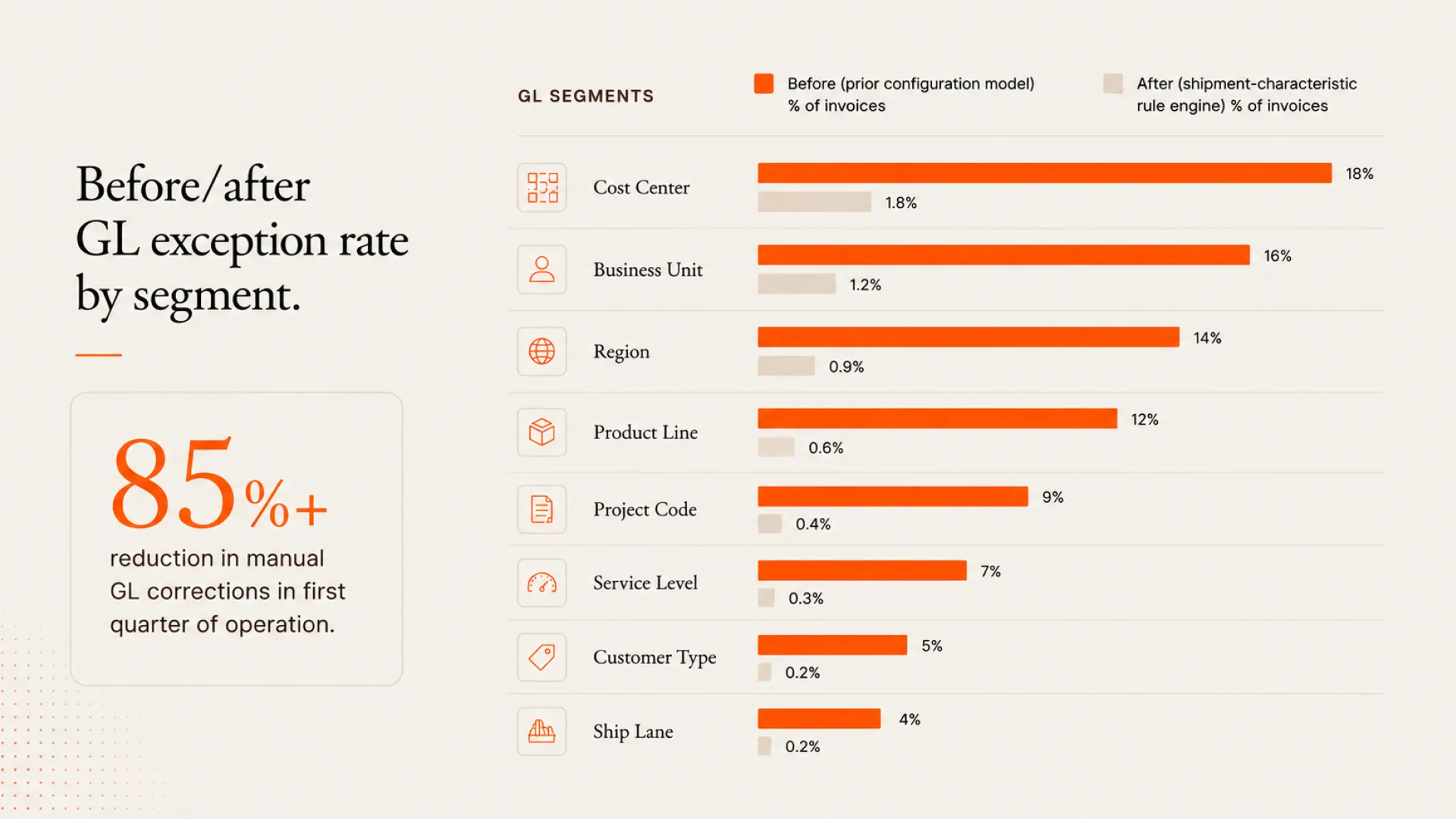
Within 20 weeks, the GL coding engine had ingested the full rule set, expressed each rule in shipment-characteristic terms, and begun processing invoices automatically. The first-pass GL coding accuracy, the percentage of invoices that received the correct GL allocation without manual intervention, reached a level that had never been achieved under the prior configuration-based approach. The recurring exceptions that had consumed finance team hours each cycle fell by more than 85% in the first quarter of operation.
What 20 weeks required
The 20-week implementation replaced a decades-old outsourced audit provider and moved the company from reactive GL correction to proactive GL coding. The timeline was not primarily driven by the number of rules, it was driven by the data normalization work required to connect Oracle TM, Oracle ERP, and carrier data sources into a unified shipment record that the coding engine could reason from.
The rate management problem was resolved in parallel. Carrier rate changes and spot quote validations had been managed through email without approval workflows. The Rate Manager Agent automated rate ingestion and market benchmarking integration against DAT, Xeneta, and FreightWaves, flagging lanes where contracted rates had drifted from current market conditions. The $127 million in freight spend that had been managed reactively was now managed with real-time visibility into both what was being billed and whether that billing reflected current market conditions.