
Services Delivered as Software: Why the Economic Comparison Is to Your BPO, Not Your SaaS Budget

August 10, 2026
•
4
mins
The pricing conversation starts from the wrong baseline when the comparison is to per-seat software licenses.
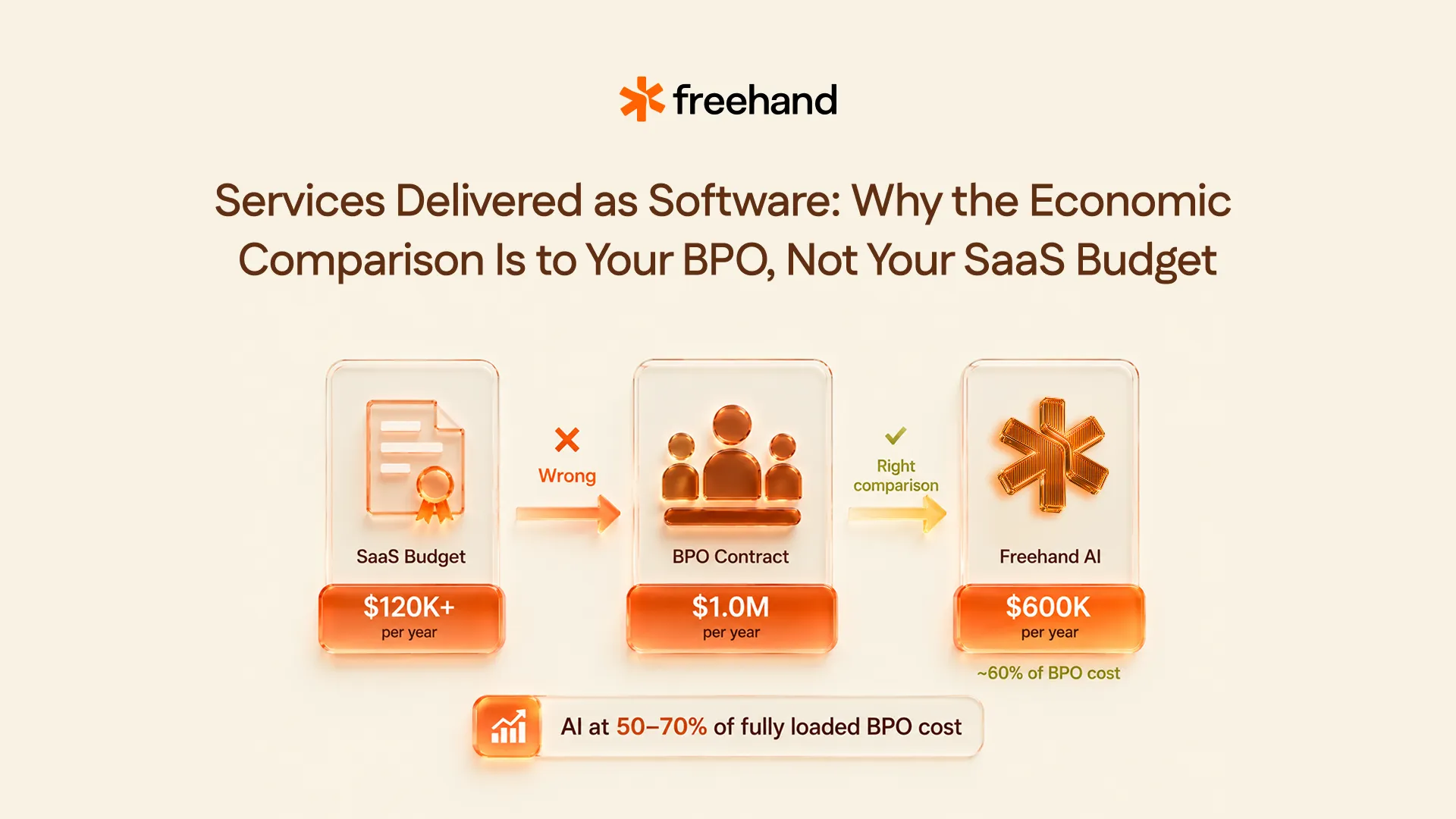
When a procurement team evaluates freight AP automation, they typically benchmark the cost against two baselines: the current BPO contract and other software license investments in the AP stack. The software comparison is natural because software vendors price by seat, by module, or by transaction volume, familiar terms that fit into software budget categories. Freehand does not belong in that comparison. The pricing model is against the fully loaded cost of the labor and services that the AI Teams replace, not against the software licenses they sit alongside.
The distinction is not semantic. It determines how the ROI case is made, which budget line the investment comes from, and what the relevant comparison set is. A SaaS tool that helps your AP team work more efficiently reduces the cost of running the existing AP headcount. Freehand replaces the AP headcount, the BPO cost, the shared services cost, the internal operator cost, with AI agents that complete the same work at lower cost and higher accuracy. The economic comparison is always to the labor line.
The fully loaded cost calculation
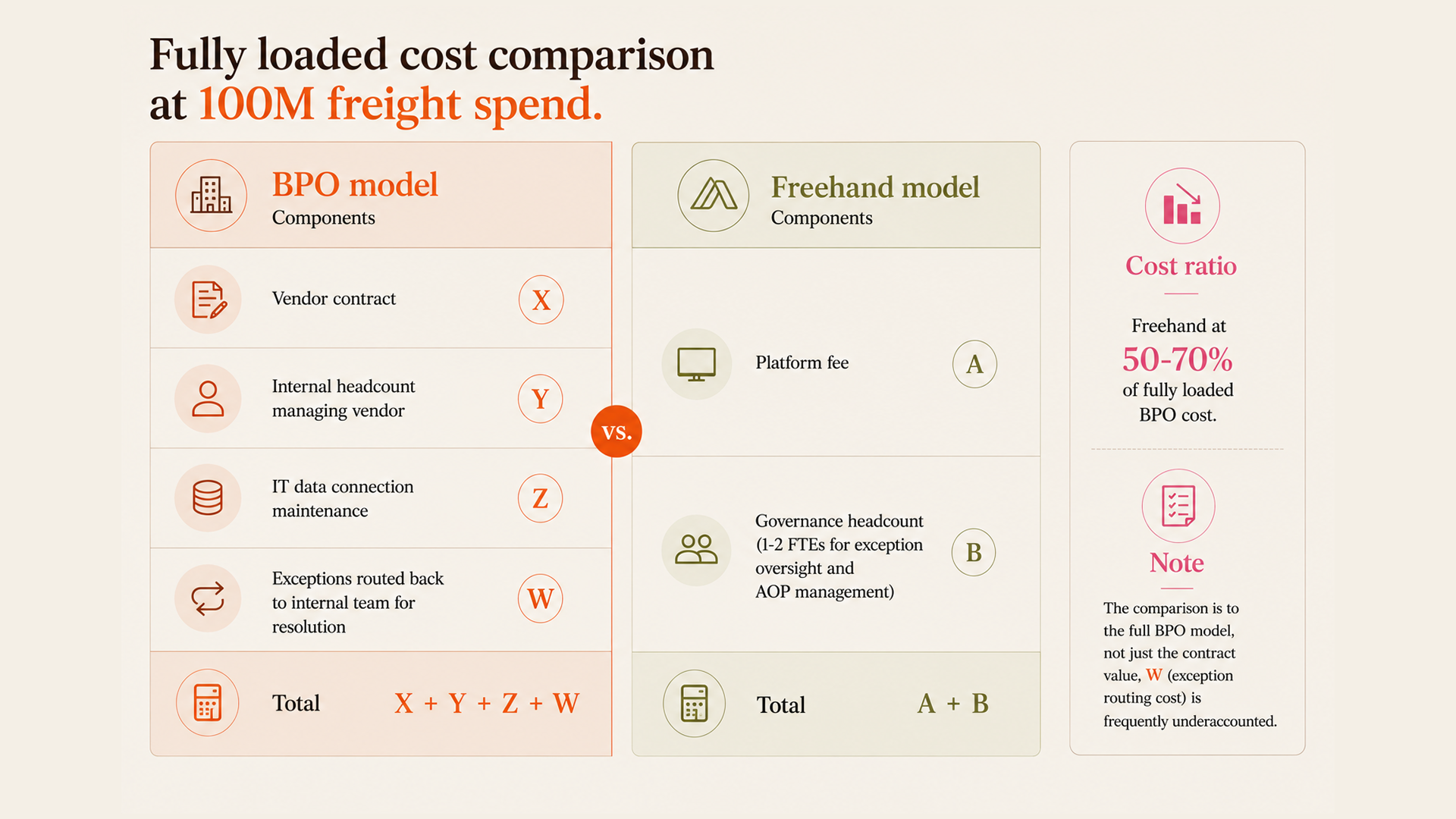
The fully loaded cost of a BPO freight audit engagement includes the vendor contract, the internal headcount that manages the vendor relationship, the IT resources allocated to maintaining the data connection between the company's systems and the vendor's platform, and the exceptions that the BPO generates and routes back to the shipper's internal team for resolution. The last component is frequently underaccounted. A BPO that routes 40% of its exceptions to the client for resolution is transferring a significant labor cost back to the organization that is not captured in the contract value.
The fully loaded cost of an internal AP team includes the headcount, the management overhead, the training and turnover costs, and the software licenses for the tools the team uses. At the companies that have made the transition from BPO or internal team to Freehand AI Teams, the economic comparison showed AI at 50 to 70% of the fully loaded BPO cost and approximately 60% of a comparable in-house team cost, with significantly higher coverage and accuracy rates. The cost advantage is not from eliminating one component, it is from replacing a labor model with a fundamentally different economic structure.
The 5x outcomes claim and what it actually measures
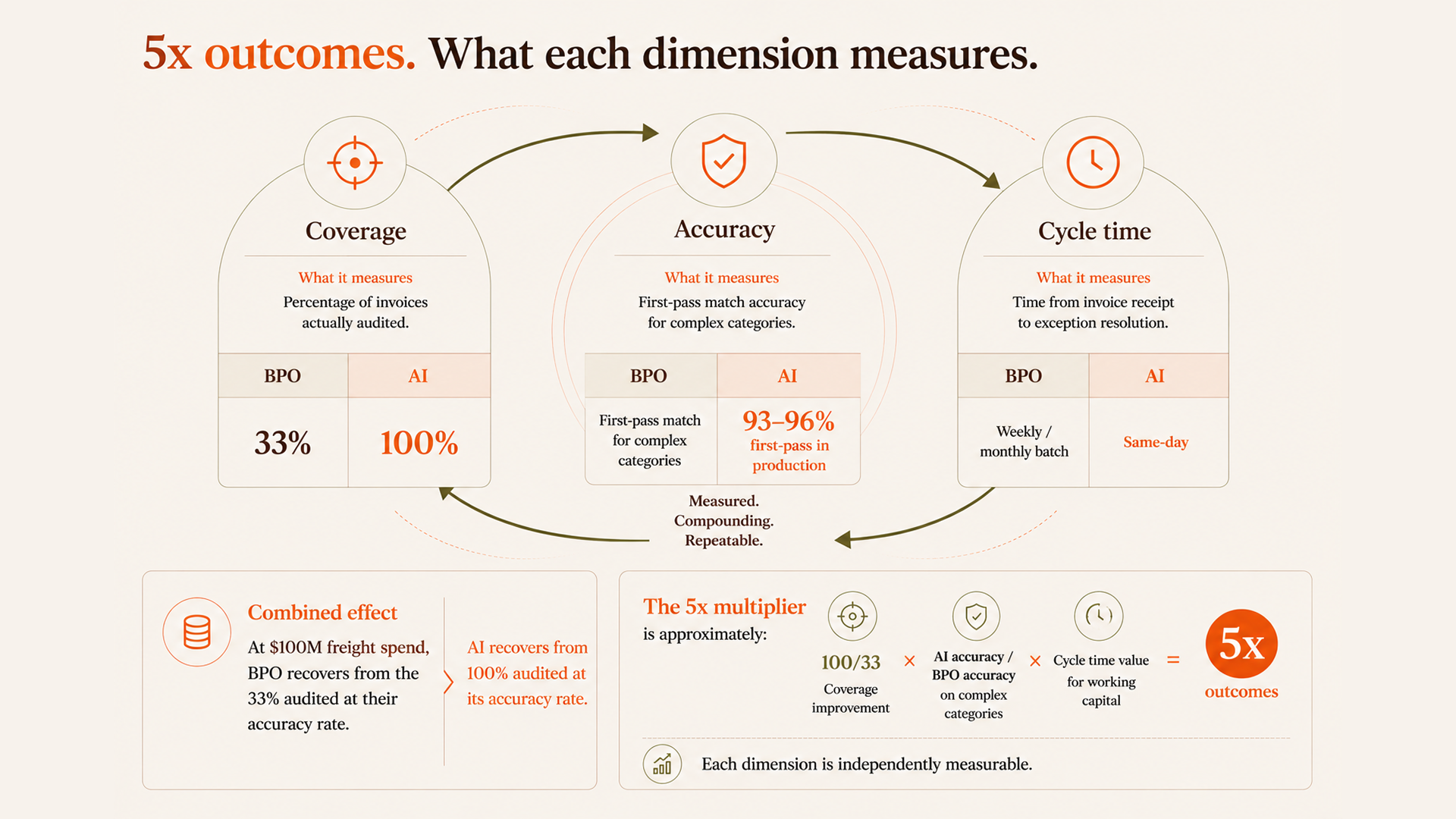
The five-times-better outcomes claim measures three dimensions that matter to a CFO evaluating the business case: coverage, accuracy, and cycle time. Coverage: AI systems audit 100% of invoices. The typical BPO audits 33%. The coverage ratio is approximately three to one. Accuracy: AI systems produce first-pass match rates in the 93 to 96% range in production deployments. The BPO human review model produces higher error rates on complex categories, particularly accessorials and non-standard freight types. Cycle time: same-day invoice processing versus the BPO's batch cycle that runs on weekly or monthly schedules.
The combination of these three dimensions, triple the coverage, higher accuracy, and real-time rather than batch processing, produces recovery rates that are structurally higher than what the BPO model delivers. Not because the AI finds more errors per invoice, but because it looks at every invoice and does so in real time. The financial value of the difference between 33% and 100% coverage at a $100 million freight spend has been described in previous posts. The operational value of same-day versus batch processing for working capital management has been described as well. The 5x claim is the product of these combined structural advantages, not a marketing assertion.
What the budget conversation should look like
The budget conversation for Freehand belongs in the operations review where BPO contract renewals are discussed, not in the IT vendor evaluation cycle where SaaS licenses are approved. The business case compares the annual BPO contract value plus internal management overhead against the Freehand platform cost plus any ongoing team time for governance and exception oversight. The difference in those two numbers, adjusted for the coverage and accuracy improvements, is the financial case.
The companies that have completed this transition, deploying Freehand against an existing BPO or shared services operation, have found that the transition is typically cost-neutral to the BPO contract value in year one, after which the compound benefits of 100% coverage, autonomous exception resolution, and spend intelligence accumulate as incremental value. The year-one comparison is cost parity with higher quality. The years-two-through-five comparison is cost reduction plus compound accuracy improvement plus working capital program value. The full economic case is not visible in year one because the compounding has not yet started.