
The Cycle That Makes Agentic AI Compound. And Why Competitors Cannot Copy It After Year Two.

August 7, 2026
•
4
mins
The agents themselves will commoditize. The compounding cycle of policies and capabilities will not.
Any company building enterprise software in 2026 can access the same foundational models. The reasoning capability, the context window, the retrieval architecture, these are available to every software vendor with the resources to integrate them. The model quality gap between providers is real but narrowing. The argument that any specific AI vendor will maintain a durable advantage purely from model superiority is not one that survives close examination.
The durable advantage in agentic AI for enterprise AP is not the model. It is what the model reasons on. And what the model reasons on, in a system that has been processing Fortune 500 AP decisions for multiple years, is a compounding body of policies, context, and decision history that cannot be purchased, downloaded, or replicated from a starting position of zero. The moat is the AOP, not the agent.
How the cycle works
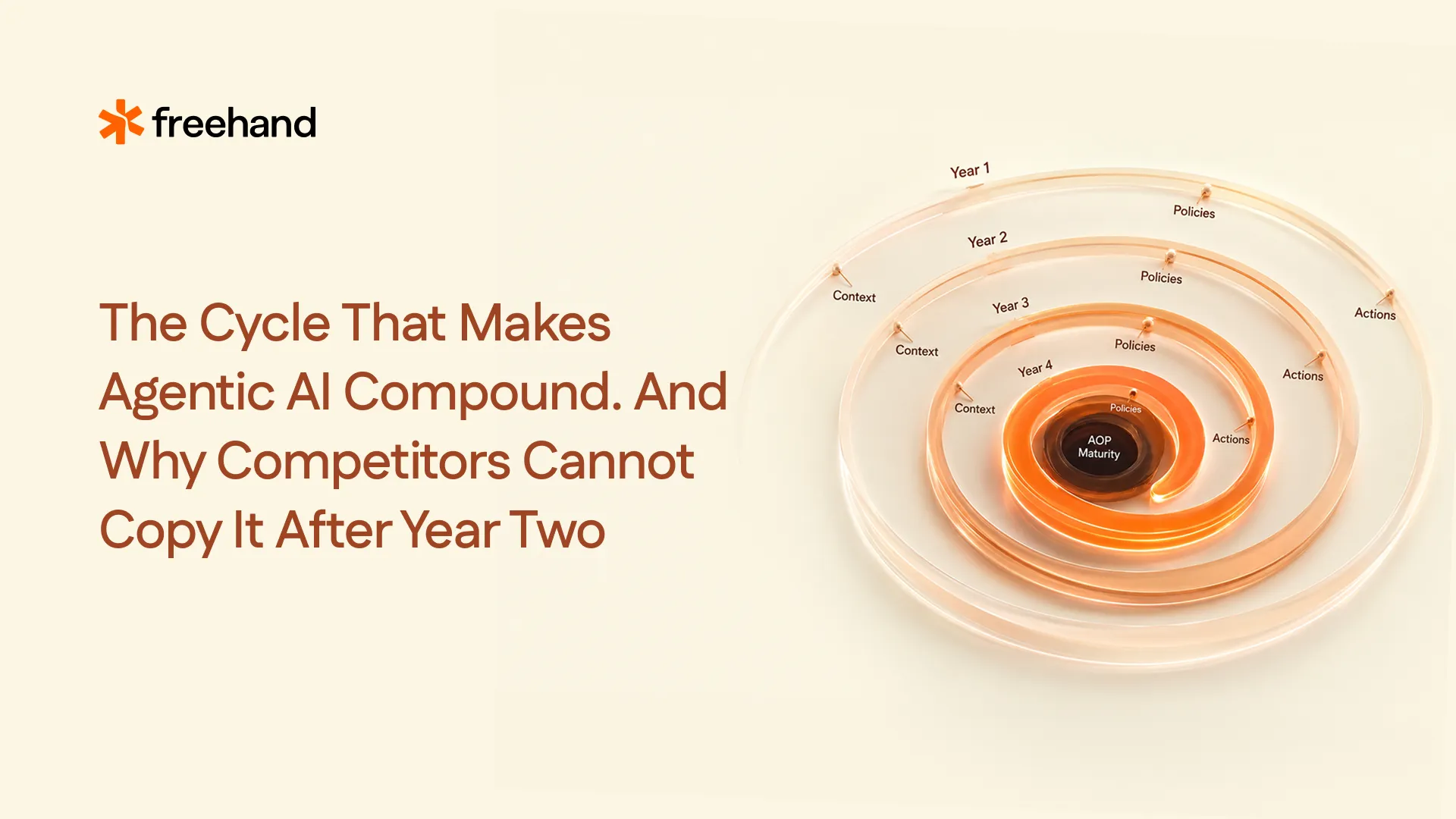
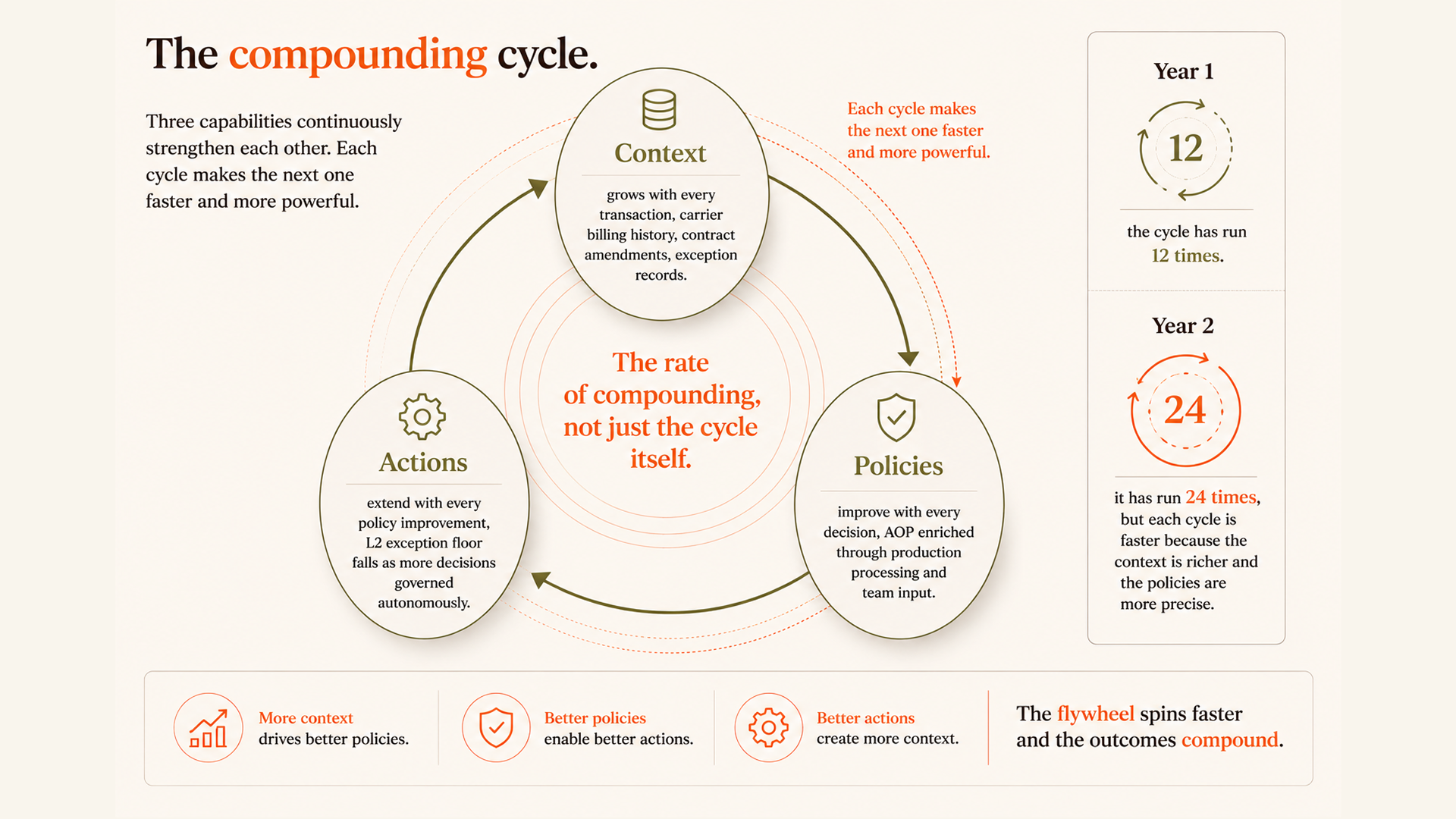
The compounding cycle has three components that reinforce each other continuously. Context grows with every transaction: each invoice processed adds to the carrier billing history, each exception resolved adds to the decision pattern library, each contract amendment ingested adds to the institutional knowledge layer. Policies improve with every decision: each case where the agent's initial policy produced an unexpected outcome becomes an input for policy refinement, each case where the human team enriches a policy in plain language makes the next 10,000 similar decisions more accurate. Actions extend with every policy improvement: as the policy base deepens and the context becomes richer, more decisions can be governed autonomously, reducing the floor of exceptions that require human judgment.
The feedback loop runs in both directions. Richer context enables more precise policies. More precise policies unlock more autonomous action. More autonomous action generates more decision traces. More decision traces reveal edge cases that improve the context and refine the policies further. The cycle is self-reinforcing, and the rate of compounding accelerates over time because each cycle builds on the accumulated output of all previous cycles
What year two looks like versus day one
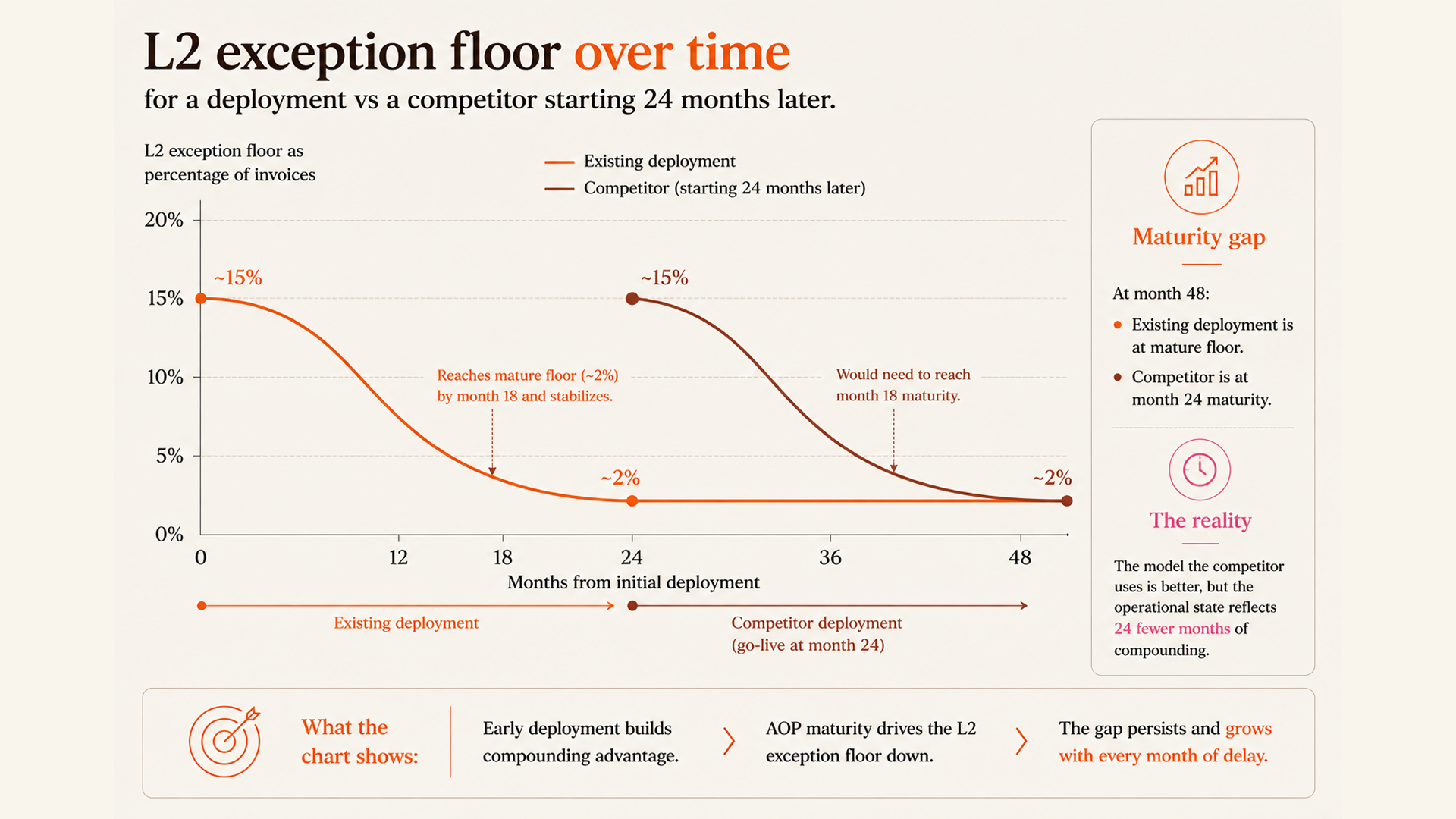
At deployment, the system begins with the context that exists: the contracts on file, the historical invoices, the rate cards, the exception records. The initial AOP is extracted from that history and enriched through early-stage reviews. The first-pass resolution rate at day one reflects what the system can infer from historical patterns. The L2 exception floor, the percentage of invoices that require human attention, is relatively high.
At year two, the system has processed through every billing cycle, every seasonal pattern, every carrier network change, and every contract renegotiation that occurred in those 24 months. The AOP has been enriched by the finance team through hundreds of plain-language policy updates. The exception types that were novel in month three are now fully governed autonomously. The L2 floor has fallen to the novel cases, edge cases that appear once per quarter and require a judgment call that no prior decision has established a precedent for. The first-pass resolution rate at year two is substantially higher than at day one, not because the model changed, but because the policies and context became richer.
Why the starting position matters
An organization that starts an agentic AP deployment today is two years closer to the compounded year-two state than an organization that starts the same deployment two years from now. The model available two years from now will be better. But the two-year head start on context accumulation, policy development, and decision trace history will produce an operational state that the later deployment cannot replicate at go-live regardless of model quality. The advantage is the cumulative history of decisions made, not the model that processes the next decision.
The organizations that are deploying now are not just getting the cost savings that accrue from replacing BPO labor. They are building a compound asset: an AOP that encodes how their specific organization makes AP decisions, refined through millions of real transactions, that becomes more accurate and more autonomous with every billing cycle that passes. The later adopters will have better models. They will be operating a less mature AOP on those better models. The gap between the two organizations, in operational terms, is likely to widen rather than narrow over the next four years.