
The Freight Audit Vendor That Profits Whether It Catches Your Errors or Not
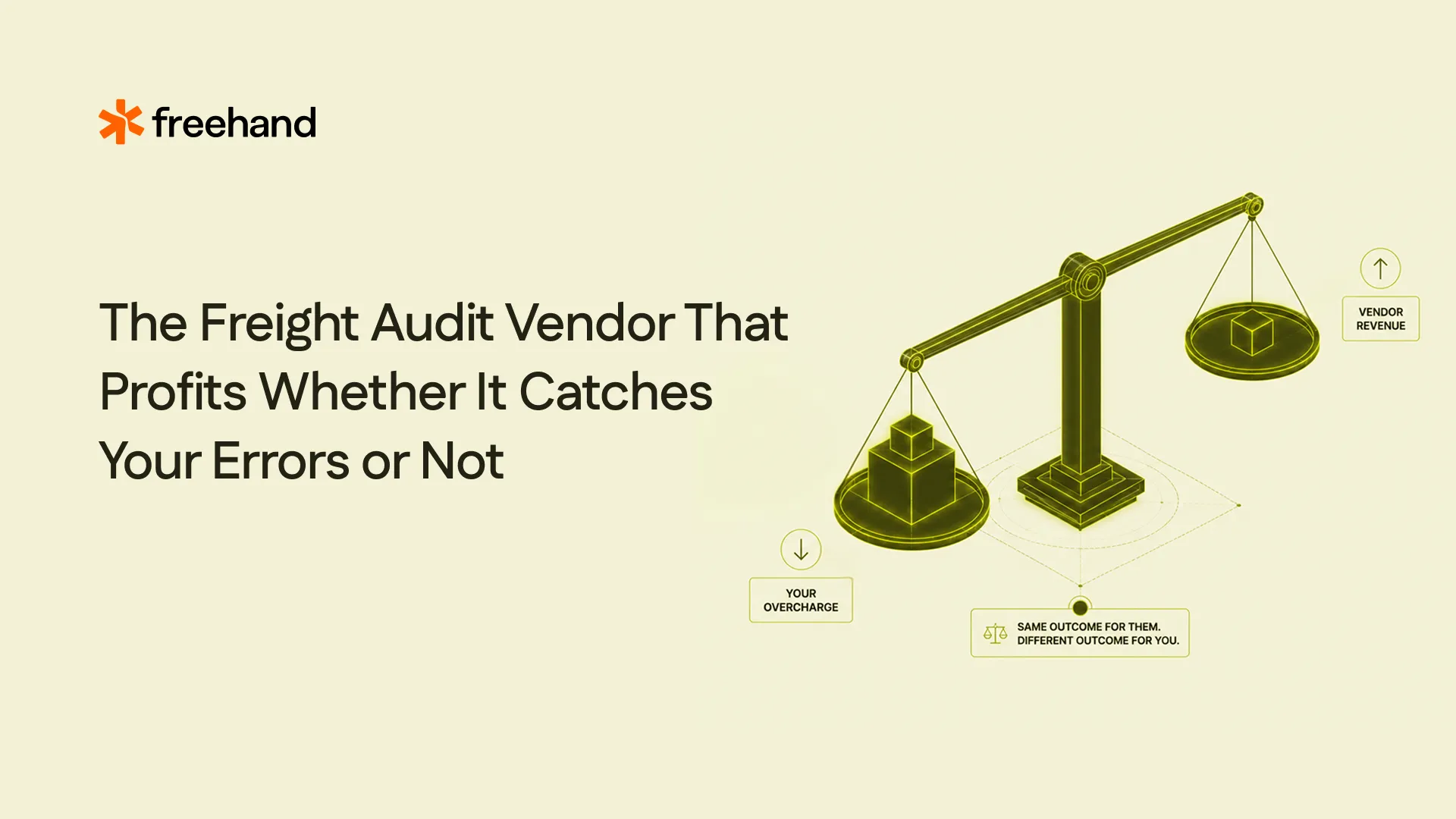
When payment float is the business model, audit accuracy is a secondary concern. The incentive structure determines the outcome.

July 31, 2026
•
4
mins
When payment float is the business model, audit accuracy is a secondary concern. The incentive structure determines the outcome.
There is a category of freight audit provider whose business model is built on payment float. The vendor receives freight invoices from carriers on behalf of the shipper, holds those funds for a period before disbursement, and earns a return on the float while the money sits in transit. The audit function exists within this model, but it is not the primary revenue source. The primary revenue source is the payment cycle itself.
One of the largest freight audit providers in the market processes more than $90 billion in payables annually through its commercial bank subsidiary. The audit accuracy of that operation is a genuine achievement, the company has processed freight invoices for decades and has sophisticated analytical tools. The incentive structure is different from an audit-first model. If the vendor misses an overcharge, their revenue does not change. Yours does.
How the payment float model shapes audit behavior
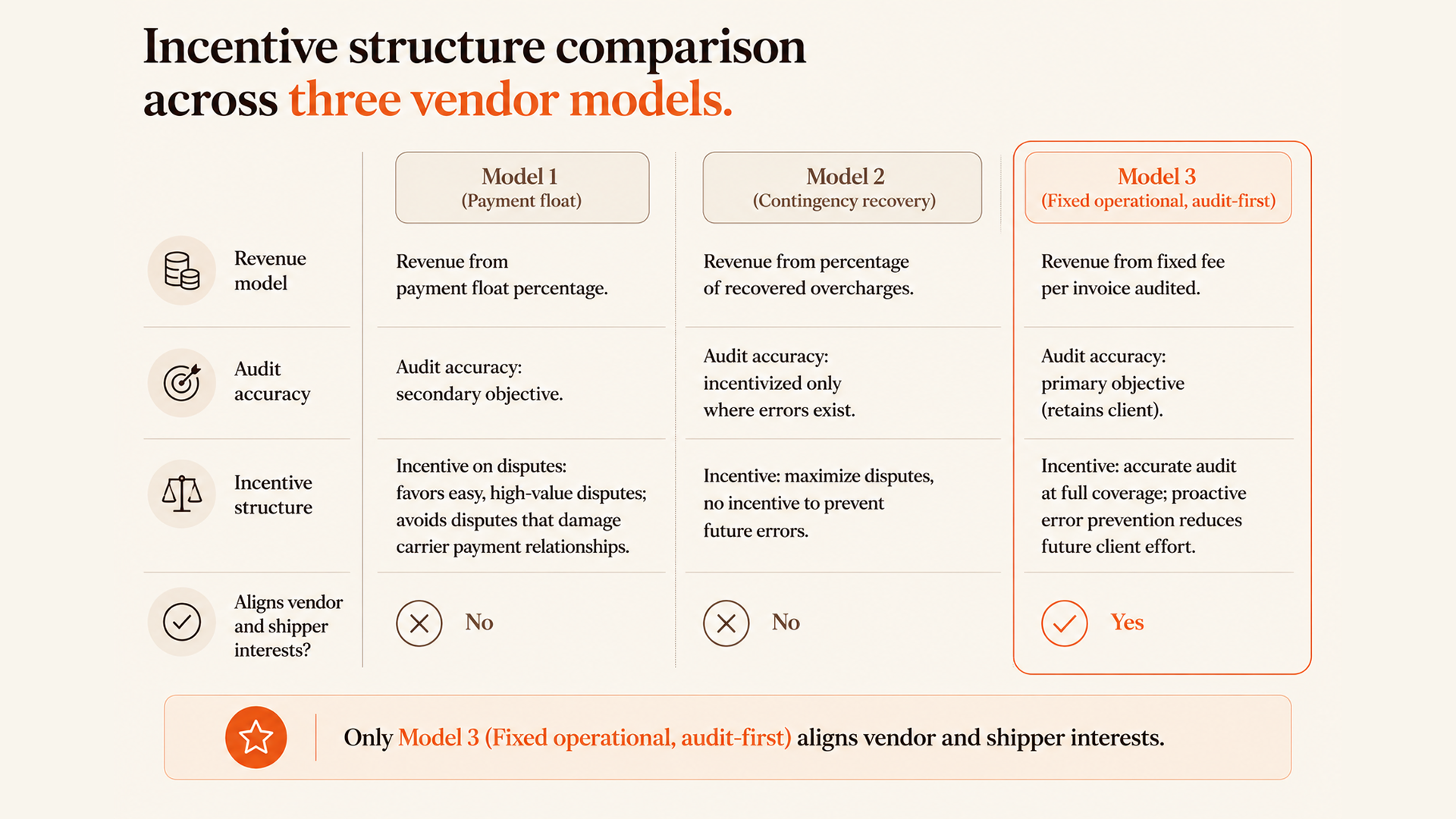
The misalignment in the payment float model is structural, not intentional. It shows up in the specific category of disputes that require pushing back against a carrier relationship that is important to the vendor's payment volume. The vendor processes payments to thousands of carriers on behalf of hundreds of clients. A carrier that moves significant freight volume across multiple client accounts is a significant payment relationship for the vendor, independent of any specific client's audit interest. Disputes that would damage that carrier relationship carry a different cost-benefit calculation inside the vendor's organization than they would for an independent auditor.
The shipper in this model receives the disputes that were easy to make. The disputes that would have required challenging a carrier relationship that matters to the vendor's payment book were not made, because the vendor's commercial interest and the shipper's audit interest were not aligned. The shipper has no visibility into which charges were reviewed and not disputed, because the audit process is internal to the vendor's operation. The recovery report shows consistent performance but measures only what was recovered, not what was recoverable.
What an audit-first model looks like differently
An audit-first model prices the engagement based on operational outcomes: invoice coverage, first-pass match rate, autonomous exception resolution, recovery as a percentage of audited spend. The vendor's revenue is tied to the quality of the audit, not the volume of the payment flow. When a carrier systematically overcharges by 2% across 5,000 invoices, the audit-first vendor's incentive is to dispute all 5,000. There is no offsetting commercial relationship with the carrier that makes those disputes less attractive to make.
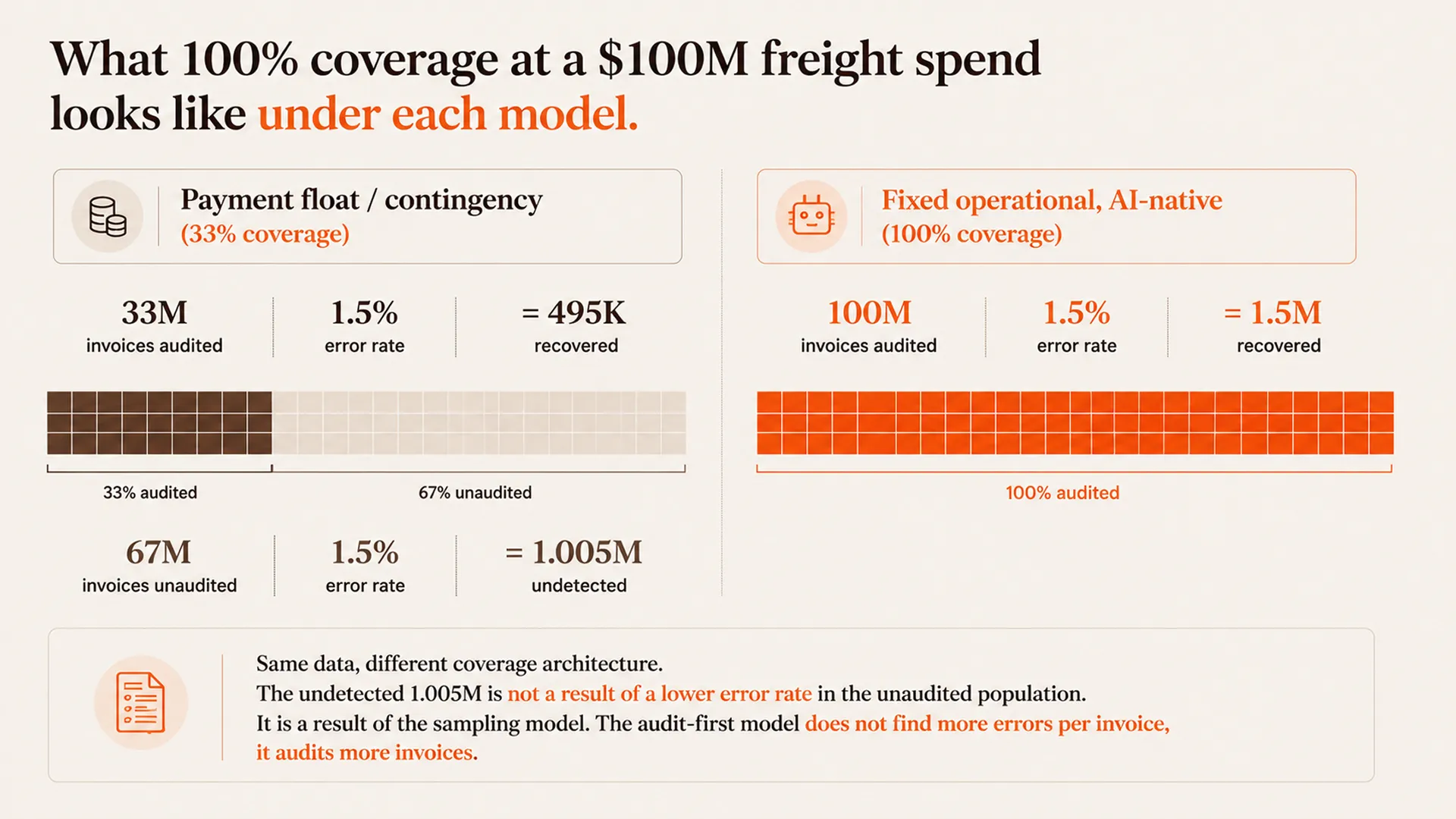
The economic difference is visible in audit coverage rates. A payment-float model with a human review team and a sampling-based audit has a structural ceiling on coverage: it cannot review every invoice because the cost of human review is proportional to invoice volume. An audit-first model with AI agents has no such ceiling, the per-invoice cost of AI review is effectively flat regardless of volume. At 100% coverage, the sampling bias that the payment-float model introduces, where auditors preferentially select invoices most likely to contain errors, disappears. Every invoice faces the same audit standard.
The contingency question
The contingency pricing model, where the vendor charges a percentage of recovered overcharges rather than a fixed fee, creates a different structural misalignment. The vendor's revenue is maximized when there are many recoverable overcharges. A contingency-priced vendor has no financial incentive to help the shipper prevent overcharges through carrier performance management, proactive rate correction, or root cause communication that would reduce future billing errors. Preventing errors reduces the vendor's revenue. Finding errors after they occur, and charging a percentage of the recovery, maximizes it.
The pricing model that aligns vendor and shipper interests is a fixed operational fee that rewards efficiency, accuracy, and coverage rather than recovery volume. When the vendor's fee is independent of how many errors are found, the vendor's incentive is to audit accurately, because accurate auditing is what retains the client relationship, not maximizing the number of disputes filed. The distinction between audit-first and payment-first, between fixed operational and contingency pricing, is the single most important axis on which to evaluate a freight audit vendor before the first invoice is processed.