
The Order-to-Cash Mirror: What Your AP Operation Reveals About Your Revenue Side
August 14, 2026
•
4
mins
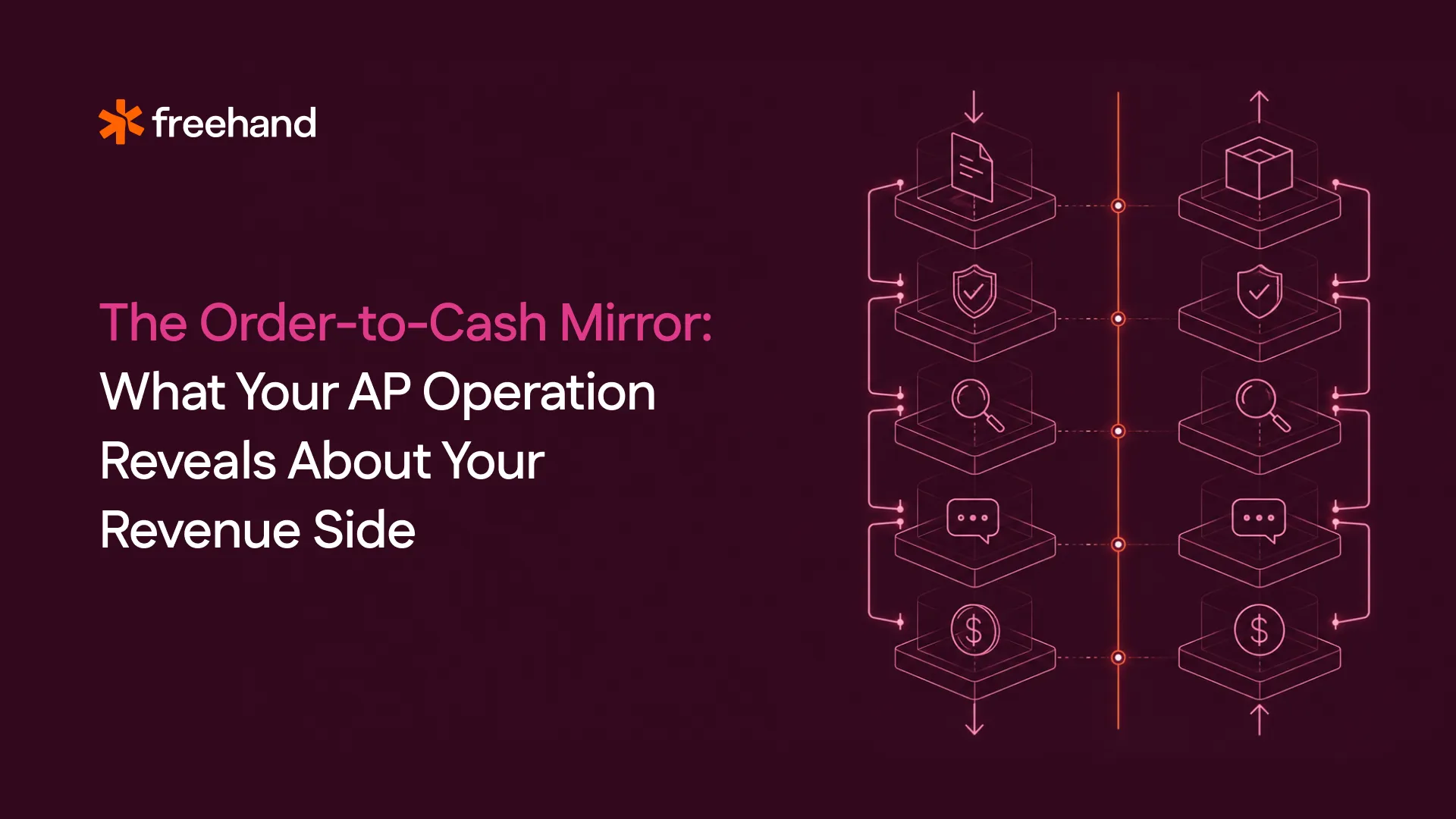
AP and AR are the same problem from different sides of the ledger. If one is manual and exception-heavy, so is the other.
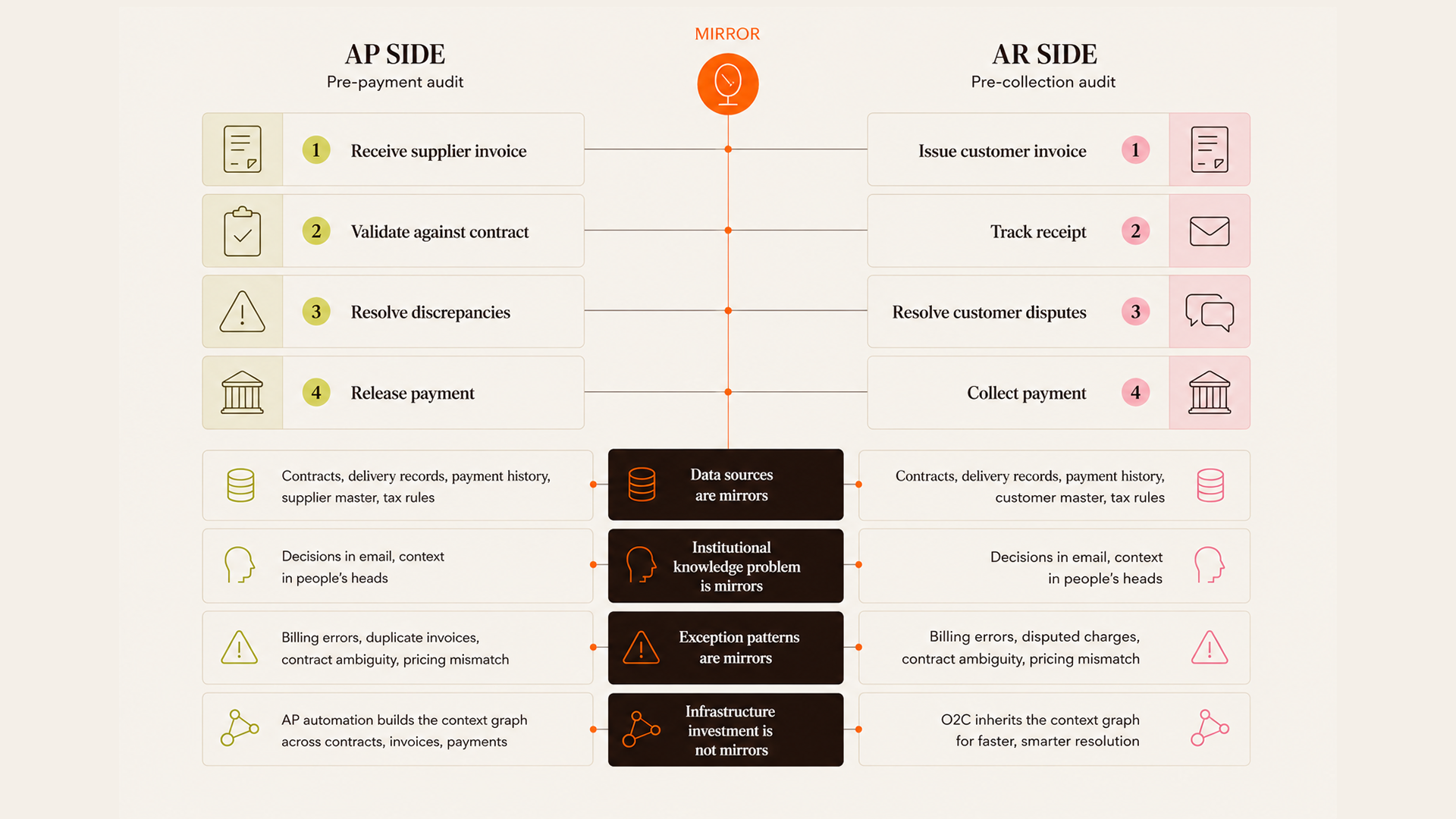
Accounts payable and accounts receivable are the same operational problem viewed from opposite sides of a commercial transaction. On the AP side, your organization receives invoices from suppliers, validates them against contracts and delivery records, resolves discrepancies, and releases payment. On the AR side, your organization issues invoices to customers, tracks receipt, resolves payment disputes, and pursues collection on outstanding balances. The data structures are mirrors. The exception patterns are mirrors. The institutional knowledge problem, decisions made in email, context that lives in people's heads, is the same on both sides.
The insight this creates is direct: an AP operation that is manual, exception-heavy, and slow to resolve disputes reveals the likely state of the same organization's O2C operation. If the AP team is routing 40% of invoices to manual review because the audit logic lacks category depth, the AR team is likely managing a similar percentage of disputed customer invoices through manual resolution cycles. If the AP function lacks the institutional knowledge to validate a supplier's invoice against the actual terms of the contract, the AR function likely lacks the equivalent knowledge to accurately bill the customer against the terms of the sales contract. The operational pathology is structural, not isolated.
What the context graph built for AP unlocks on the AR side
The context graph built for freight AP, carrier contracts, rate cards, shipment execution records, historical exception patterns, is closely related to the context graph that would govern outbound freight billing on the AR side. A company that ships products to customers and bills freight as part of the invoice needs to know what was contracted, what was delivered, and what constitutes a valid charge for each shipment. The data sources are the same as freight AP, accessed from the buyer's perspective rather than the supplier's.
The decision traces accumulated in AP, records of how specific exception types were resolved, what evidence was required to close disputes with specific carriers, which accessorial charges were accepted and which were disputed, encode institutional knowledge that has direct value for AR. How your organization has handled carrier billing disputes on the payables side informs how it should handle customer billing disputes on the receivables side. The reasoning patterns are transferable even though the commercial relationship is reversed.
The O2C pathology and where it comes from
Slow AR is almost always a downstream symptom of upstream process failures. A customer that disputes an invoice and withholds payment is typically responding to a billing error, a charge that was not agreed in the contract, a shipment that was not delivered as described, a credit that was approved verbally but never issued. The dispute originates in the gap between what the seller believes was contracted and what the buyer believes was contracted. That gap is the same institutional knowledge problem that produces AP exceptions.
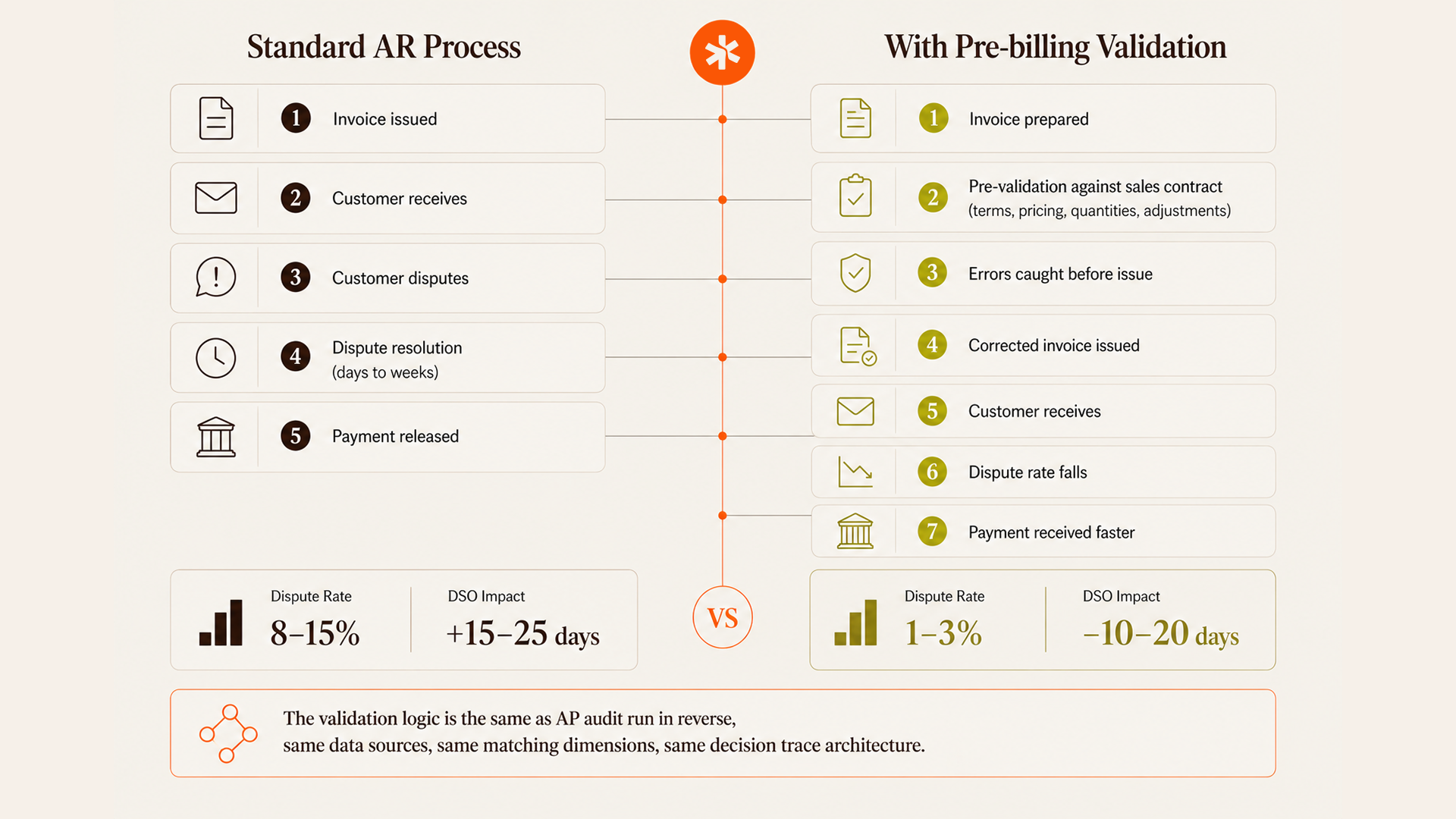
When AR disputes are resolved slowly, through email exchanges, manual documentation requests, and sequential approvals, the resolution time extends days-sales-outstanding, tightens working capital, and creates friction in the customer relationship. The friction compounds: a customer that regularly disputes invoices and waits weeks for resolution has a worse commercial relationship than one whose billing is consistently accurate and whose disputes, when they occur, are resolved with documented evidence in days.
The long-horizon connection
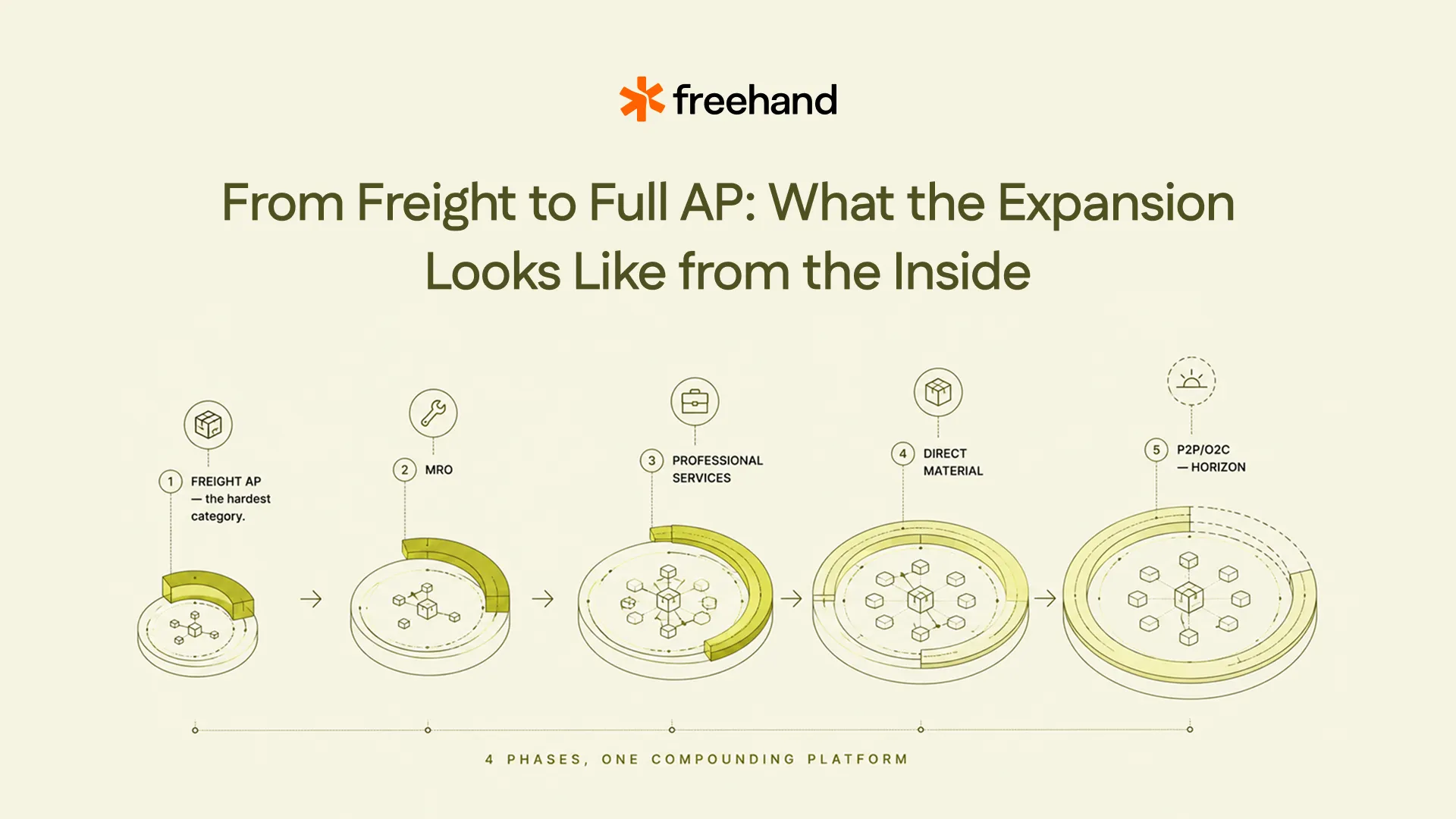
The Freehand platform roadmap treats P2P and O2C as the same architectural problem with different commercial orientations. Phase 4 of the deployment model connects the AP context graph, built through the logistics and MRO AP deployment, to the O2C infrastructure. The agents that validate incoming invoices against contracts can apply the same logic in reverse to validate outbound invoices against sales contracts before they are issued to customers. Pre-billing validation is the O2C equivalent of pre-payment audit: catching errors before they create disputes rather than after.
The timeline for this connection is not immediate for most organizations, it follows the AP automation deployment by 12 to 24 months as the AOP matures and the context graph deepens. But the economic case for viewing them as a single investment is compelling. An organization that builds the context graph, the decision traces, and the AOP for AP is already building most of what O2C automation requires. The O2C deployment inherits the infrastructure rather than building from scratch.