
The Working Capital Argument AP Teams Have Never Made to Their CFO
Accounts payable is not just a cost to be reduced. It is a timing lever with a direct line to working capital, supplier relationships, and early payment economics.

July 24, 2026
•
4
mins
Accounts payable is not just a cost to be reduced. It is a timing lever with a direct line to working capital, supplier relationships, and early payment economics.
The conversation between an AP team and a CFO about AI automation almost always starts with the same argument: cost reduction. Replace BPO headcount with AI agents. Reduce the labor cost of invoice processing. Free the team from exception queue management. These are real and quantifiable benefits. They are also the least interesting part of the economic case for AP transformation.
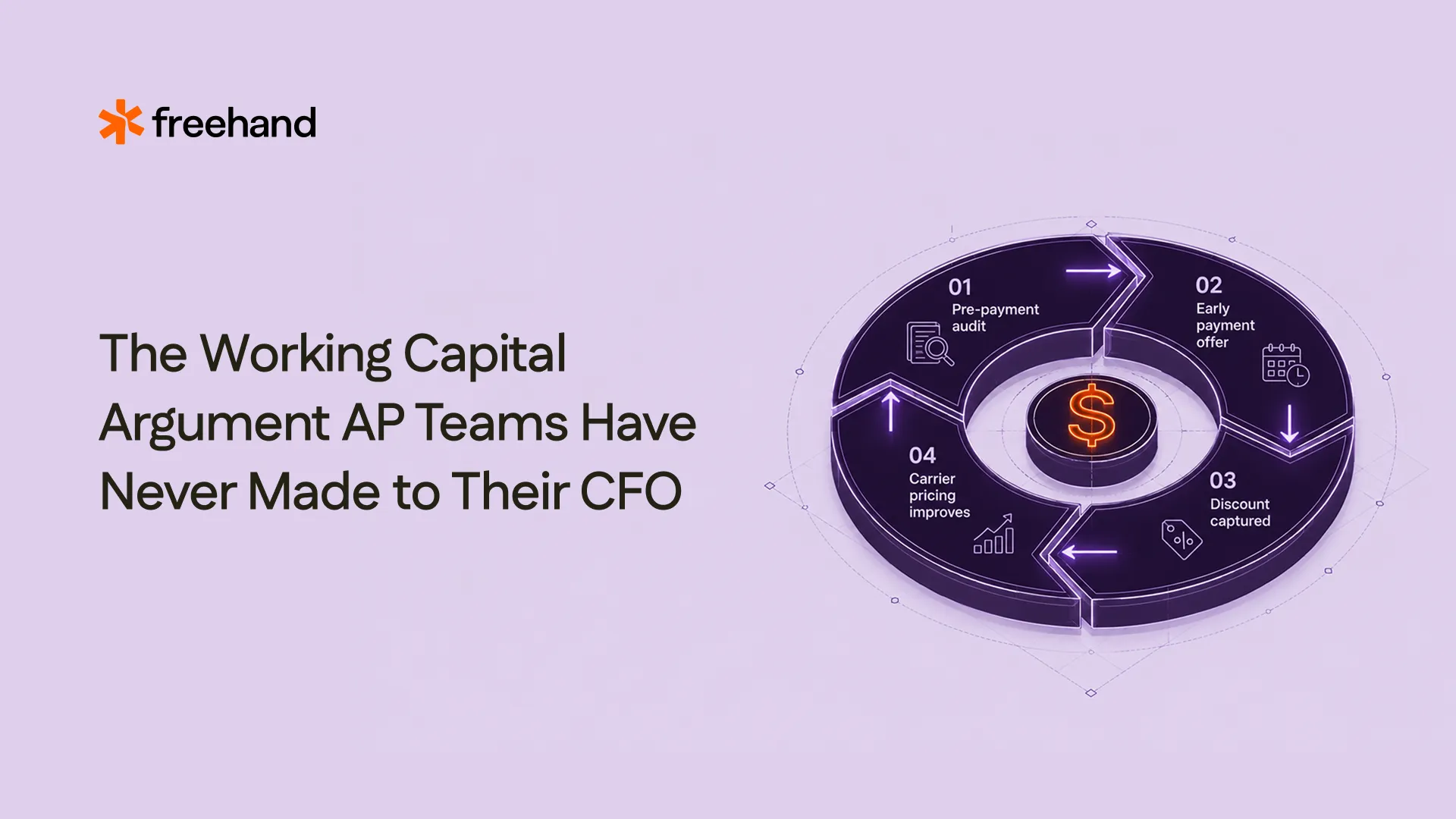
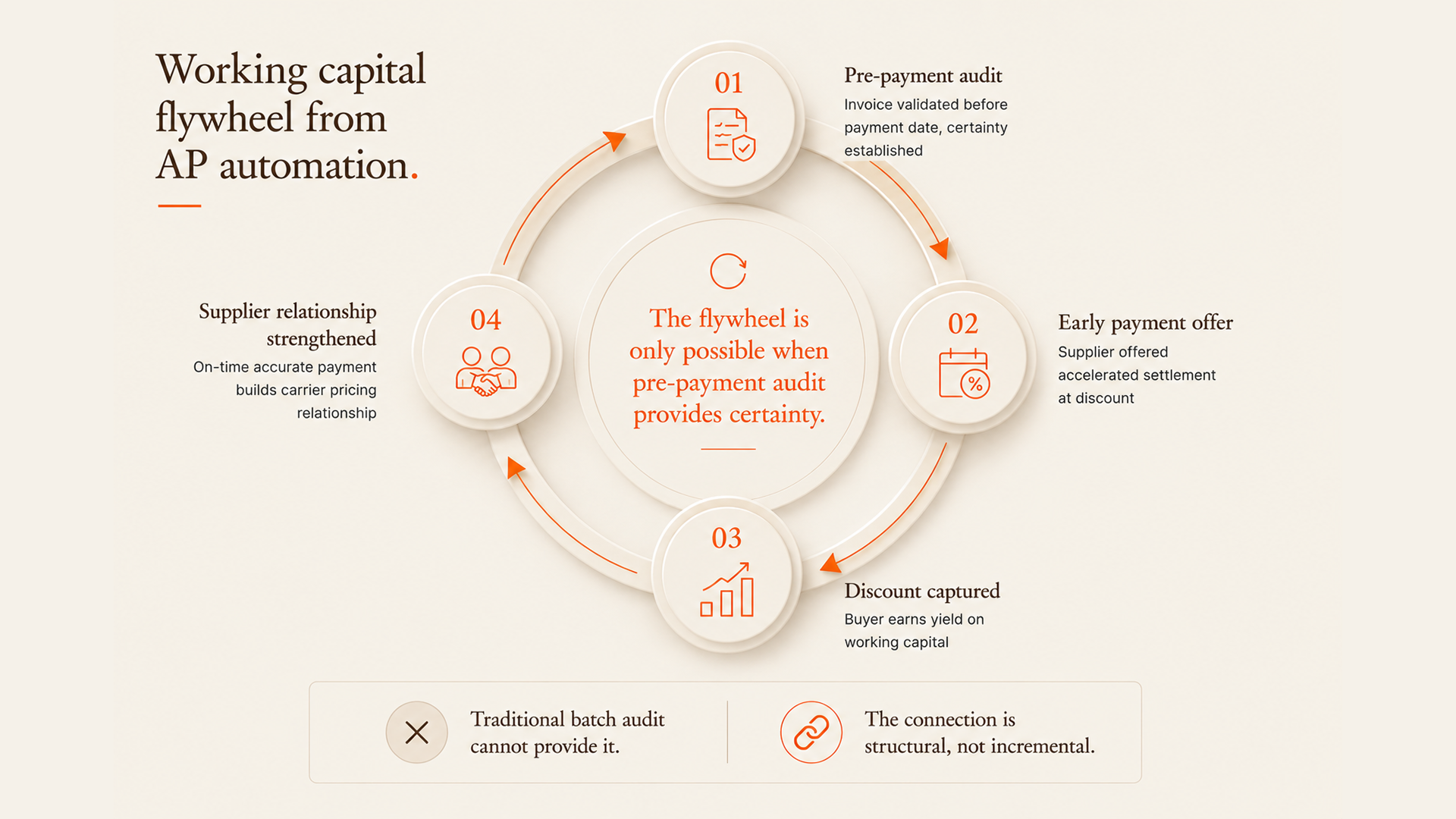
The more compelling argument, and the one AP teams almost never make to their CFO, is the working capital argument. When AP is automated and invoices are validated pre-payment rather than post-receipt, the organization gains something that no BPO can provide: certainty about when each invoice will be approved, days in advance of the payment date. That certainty is the foundation of a supplier financing program, and a supplier financing program converts AP from a cost center into a margin source.
What early payment economics look like at scale
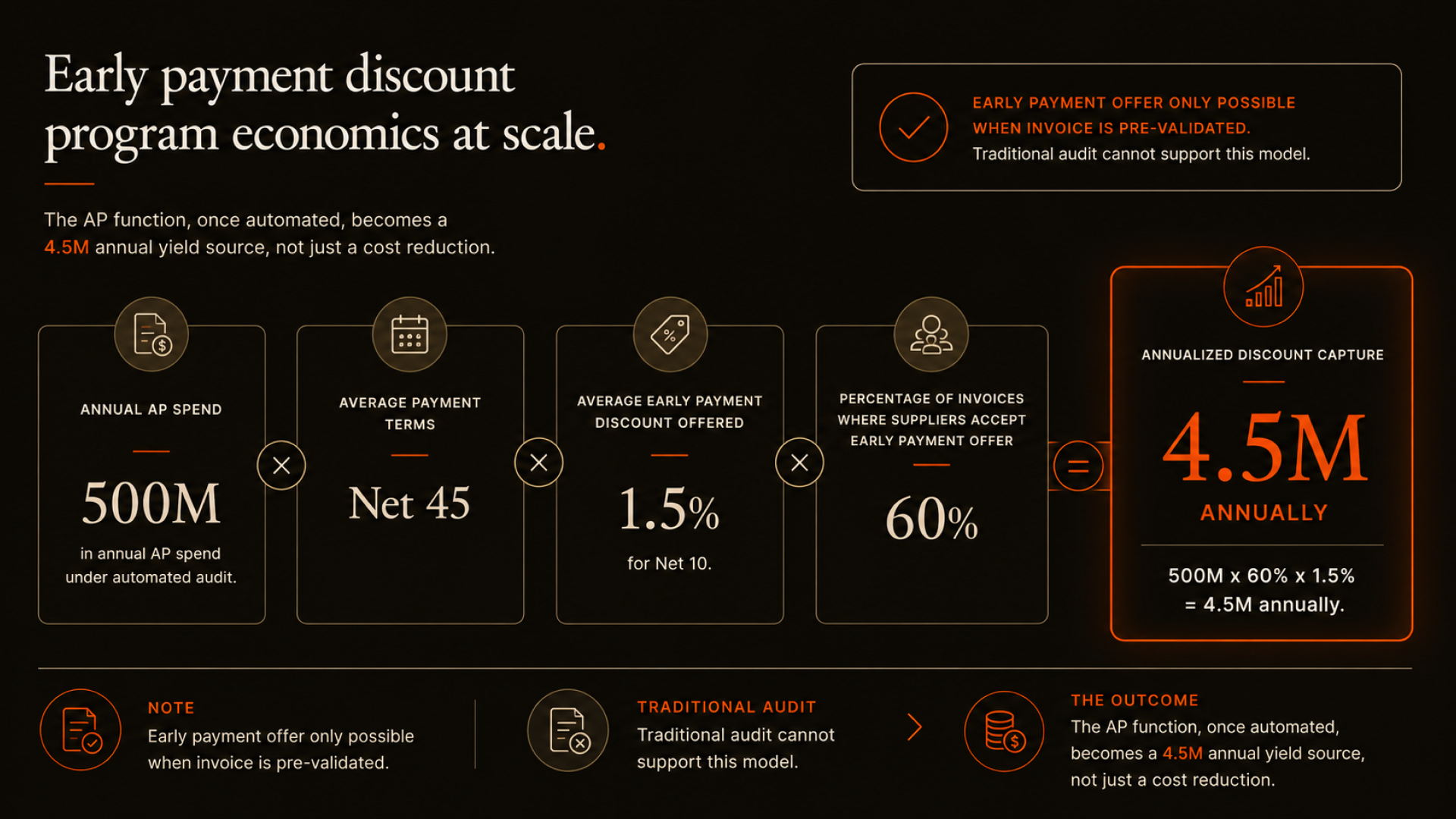
The mechanics are simple. A validated invoice, one that has passed all matching checks, had its exceptions resolved, and received payment approval, can be offered to the supplier for early settlement at a discount. The supplier receives payment faster than the standard terms allow, taking a small reduction in the total amount. The buyer captures the discount as a return on working capital deployed. At the scale of a Fortune 500 AP operation processing hundreds of millions of dollars annually, the annualized yield from systematic early payment discounting is material.
The prerequisite is the one that traditional AP cannot meet: payment certainty before the payment date. In a BPO model, invoices are approved in batches. The exact approval date for any given invoice is unpredictable, because human review queues are not deterministic. A supplier cannot accept an early payment offer on an invoice that might be disputed on review three days later. The offer is only credible when the buyer has already validated the invoice and is offering to accelerate a payment that is guaranteed. That guarantee requires autonomous pre-payment audit.
The payment cycle and carrier pricing connection
Carriers price freight services partly on the basis of payment reliability. A shipper known to pay accurately and on time, who does not generate disputed invoices, does not hold payments during reconciliation cycles, and does not require the carrier to chase outstanding balances, commands favorable treatment in carrier allocation, capacity access, and rate negotiations. The economic value of this pricing relationship is diffuse but real, and it compounds over years of consistent payment behavior.
An AP function that runs on autonomous pre-payment audit produces a different payment profile than one that runs on human review cycles. The autonomous system approves correctly-billed invoices on the same business day they arrive. Carriers receive payment on the contracted schedule without administrative friction. The relationship economics shift, not dramatically in any single negotiation, but meaningfully over multiple bid cycles. The connection between AP quality and procurement outcomes is one of the least-discussed aspects of freight operations, and one of the most consequential over time.
Phase 3 of the AP roadmap
The Freehand platform roadmap treats payments as a distinct phase of the AP transformation, following the automation of invoice processing and the expansion across AP categories. Phase 3 is the payment layer: a single payment engine that consolidates disbursements by category and by period, supports any currency and any payment rail, and connects the supplier financing program to the validated invoice queue. The supplier receives a single payment per category per period rather than a fragmented set of individual transactions. The buyer's treasury team manages one payment event per category rather than thousands of individual disbursements.
The economic argument to a CFO is not: we will reduce your AP headcount. It is: we will transform your AP function from a cost center that processes invoices into a working capital lever that generates yield, improves carrier economics, and creates a supplier relationship advantage that compounds over time. That is a different conversation, and a more valuable one.