
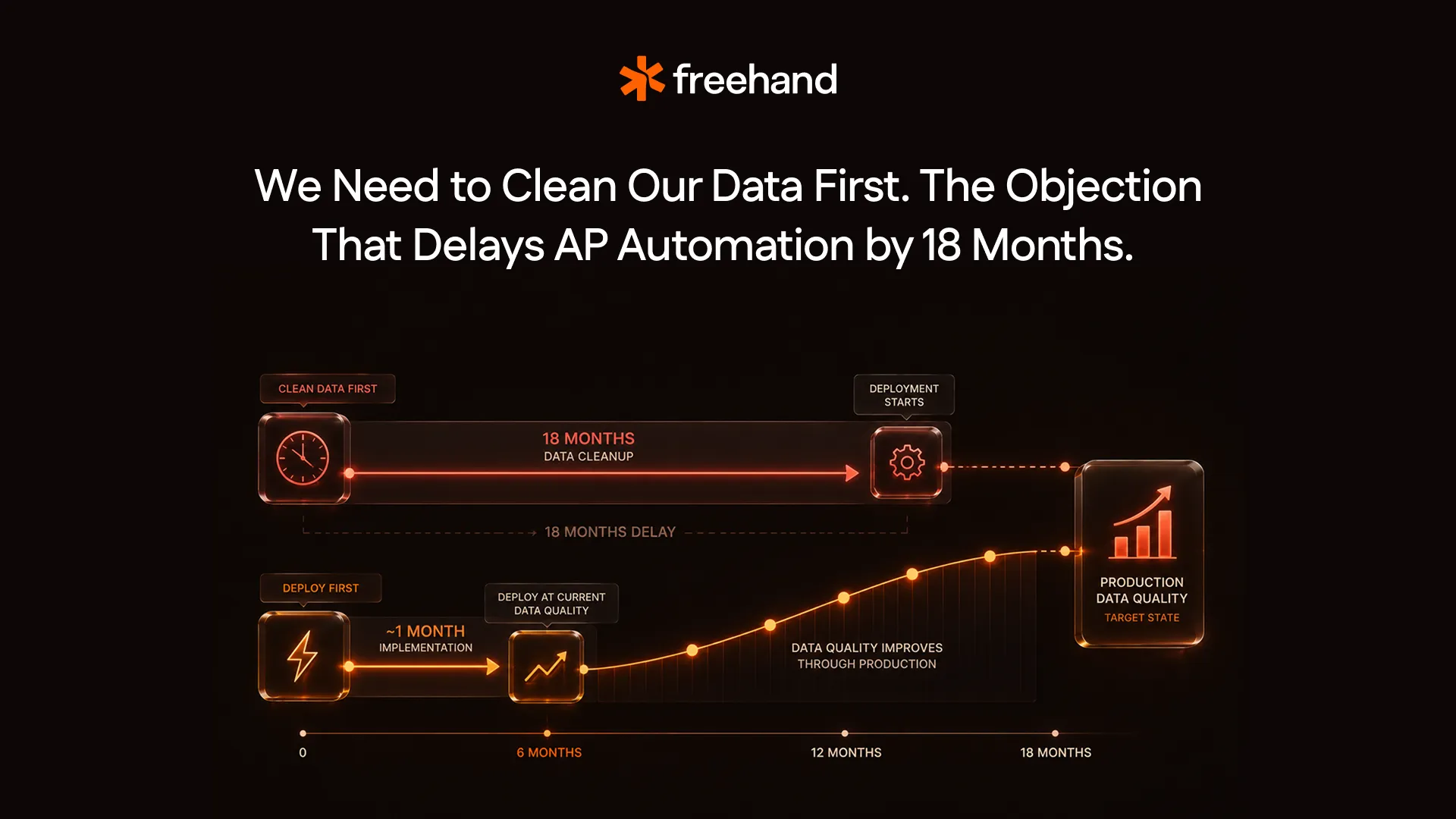
We Need to Clean Our Data First. The Objection That Delays AP Automation by 18 Months.
The most effective way to delay transformation indefinitely is to set a prerequisite that can never be fully met.

July 28, 2026
•
4
mins
The most effective way to delay transformation indefinitely is to set a prerequisite that can never be fully met.
In almost every enterprise conversation about AP automation, the objection appears at some point in the process. The organization is interested. The business case is compelling. The reference customers are convincing. And then someone says: we need to clean our data first. The meeting concludes with a data quality initiative on the roadmap and AP automation scheduled to begin after the data is ready. Eighteen months later, the data quality initiative is still in progress and AP automation has not started.
This pattern is not unique to AP. It appears wherever AI is being evaluated for production deployment. It reflects a genuine concern, AI systems can fail when trained on poor-quality data, that has been generalized beyond its appropriate scope. The concern is valid for certain AI applications and not valid for others. For agentic AP automation, the data quality prerequisite is a category error.
What data quality AI actually requires
Gartner research on AI-ready data makes a distinction that most enterprises have not internalized: AI requires less data accuracy than traditional business intelligence, but greater data visibility, completeness, and trust. A traditional analytics system that calculates cost-per-shipment needs accurate cost data to produce reliable output. An AI agent that validates invoices against contracts needs to know which contracts are in scope, where to find them, and how to match invoice line items to contract terms, but it does not need the underlying data to be clean before it starts. It starts with what exists and builds from there.
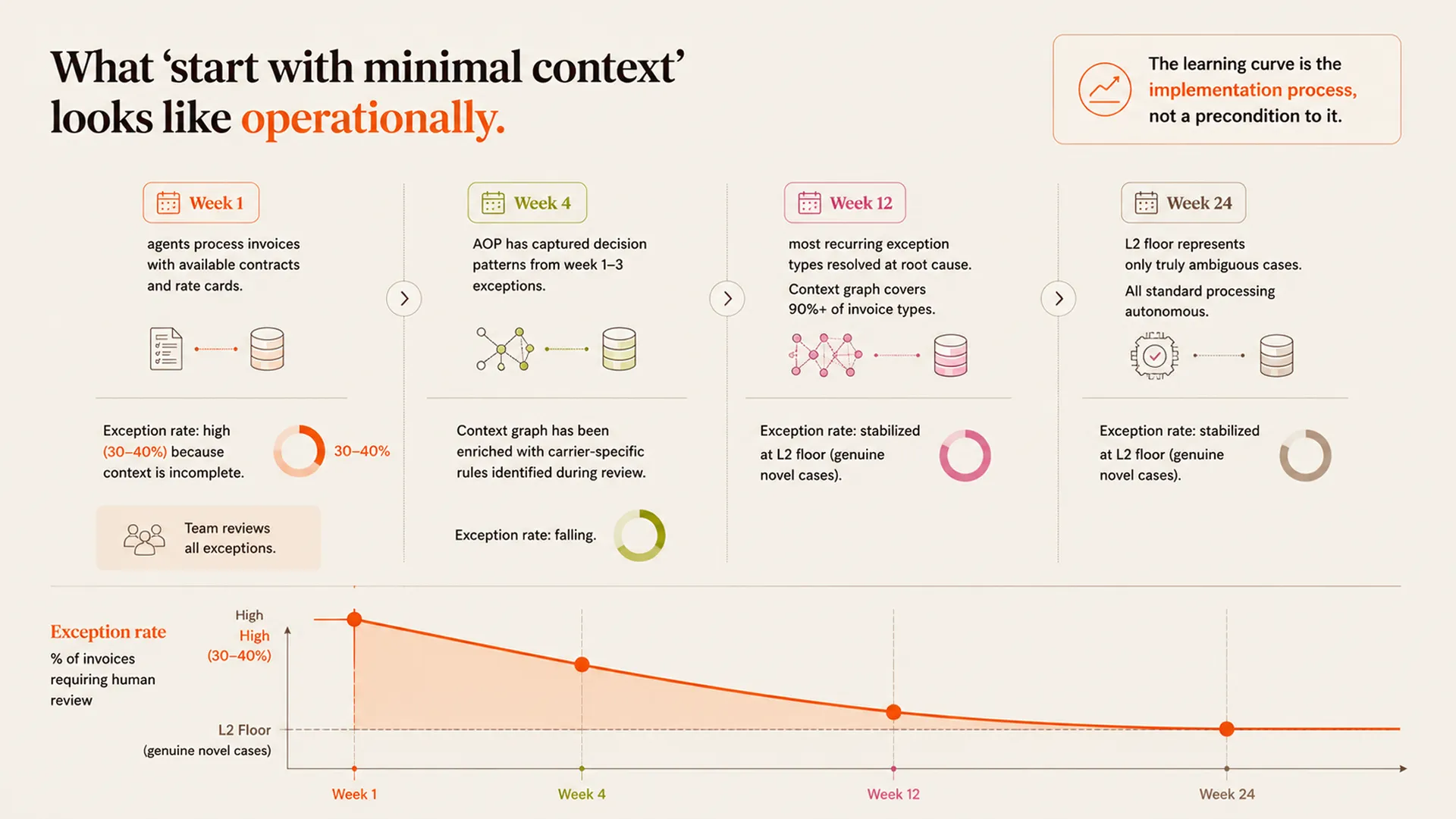
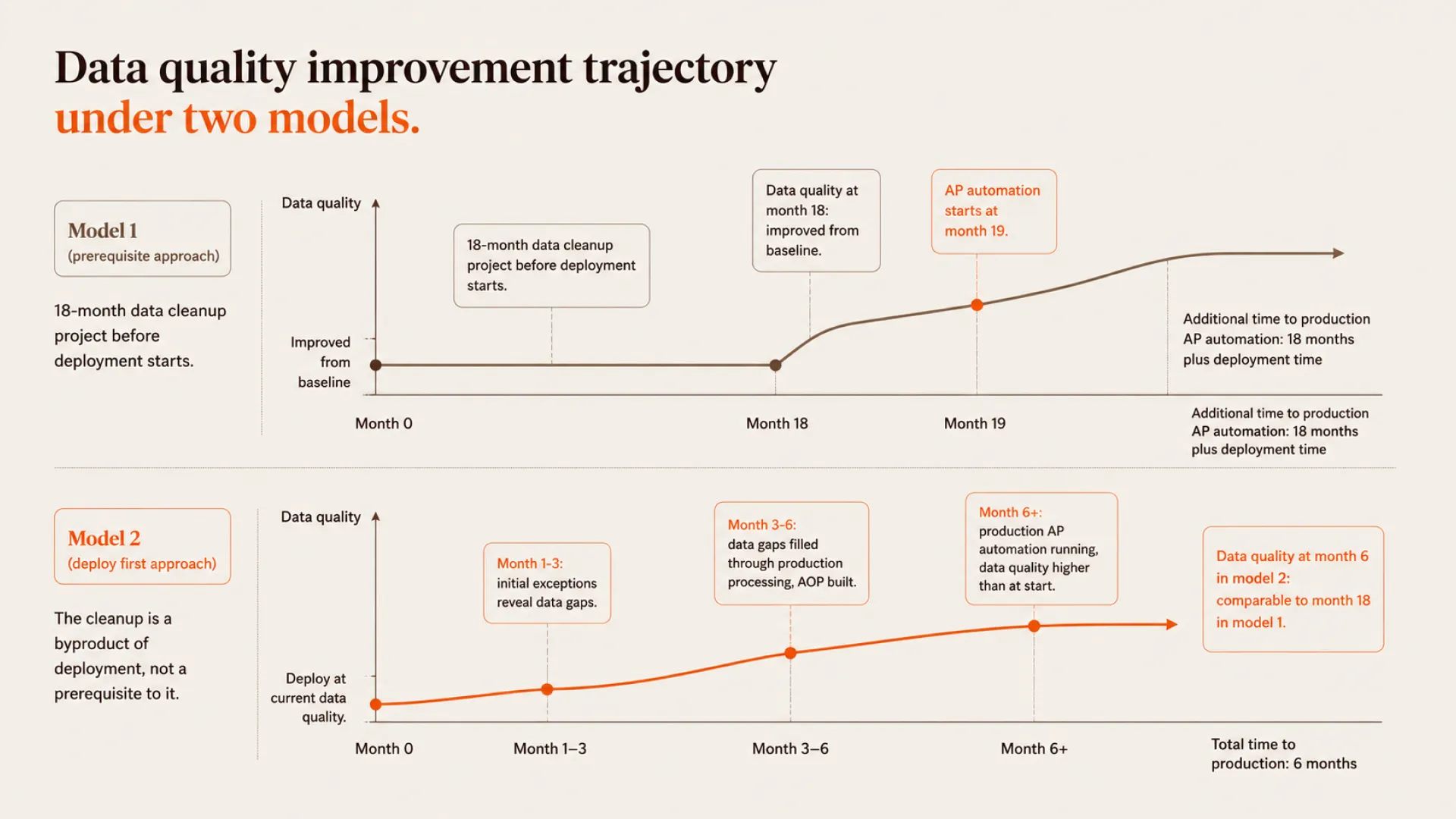
The Freehand deployment methodology reflects this directly. Agents begin with minimal context and expand. The first invoices processed may produce exceptions that reflect genuine data gaps, a carrier rate card that was not yet in the repository, an accessorial rule that had not been documented. Each exception is a data point. Each resolution adds context. The system does not wait for the data to be perfect before it starts producing value. It starts producing value on the first invoice and accumulates context with every transaction that follows.
What the objection is actually about
The data quality objection is rarely about data quality. It is about change management. Saying we need to clean our data first is a way of buying time to prepare the organization for a transformation that feels risky. That is a legitimate concern that deserves a legitimate response, not a dismissal of the technical objection, but an acknowledgment that the real concern is transition risk, not data quality.
The transition risk is real and should be addressed directly. What happens to the exceptions that the AI generates in the first 90 days? Who reviews them? What is the escalation path for decisions the AI should not make autonomously? What does the governance model look like during the period when the AOP is still being built? These are answerable questions with concrete implementation practices behind them. A direct response is more useful than accepting the data quality prerequisite and scheduling a data cleanup project that will not resolve the underlying concern.
What starting with available data produces
The deployments that have reached production scale at Fortune 500 AP operations started with the data that existed, ERP records in various states of completeness, rate cards in different formats, historical invoice data of variable quality, contracts stored in email threads and shared drives. The data was not clean. The agents started working with it anyway.
By month three of a typical deployment, the context graph reflects the data that was available at go-live plus three months of production decisions, exception resolutions, and policy enrichments. The data quality at month three is materially better than at go-live, not because a data cleanup project was completed, but because the agents identified gaps through production processing and the team filled those gaps as they appeared. The cleanup happened as a byproduct of deployment, not as a prerequisite to it. The organizations waiting for clean data to start are waiting for an outcome that deployment itself produces.