
Your ERP Knows What Happened. It Has No Idea Why.

May 30, 2026
•
7
mins
The gap between transaction records and institutional reasoning is where supply chain AI breaks down — and where it can be rebuilt.
The ERP is the record of everything your supply chain did. Every purchase order. Every shipment. Every invoice. Every payment. The data is structured, consistent, and queryable. Finance can pull any transaction. Logistics can trace any shipment. AP can reconstruct any payment cycle. The ERP is an extraordinary record of what happened.
It has no idea why. Why that carrier was chosen for this lane even though their contracted rate was 8% above the cheapest option. Why that exception was approved without a dispute even though the charge exceeded the contracted rate. Why the sourcing team dual-sourced that component even though single-source would have been cheaper. The reasoning behind every significant supply chain decision — the institutional intelligence that determines whether the what made sense — is not in the ERP. It never was. It was never designed to be.
What lives outside the ERP
The reasoning lives in three places. Email: where the detention exception was agreed, where volume commitments were made, where relationship context was captured. Meeting notes and call transcripts: where the dual-source rationale was discussed and never formally documented. Human memory: the carrier relationship manager who has been on the account for seven years and knows exactly why things work the way they do.
When that person leaves — at a 30% annual churn rate in freight procurement, they leave regularly — the reasoning leaves with them. The ERP retains the records. It retains none of the context that made those records make sense.
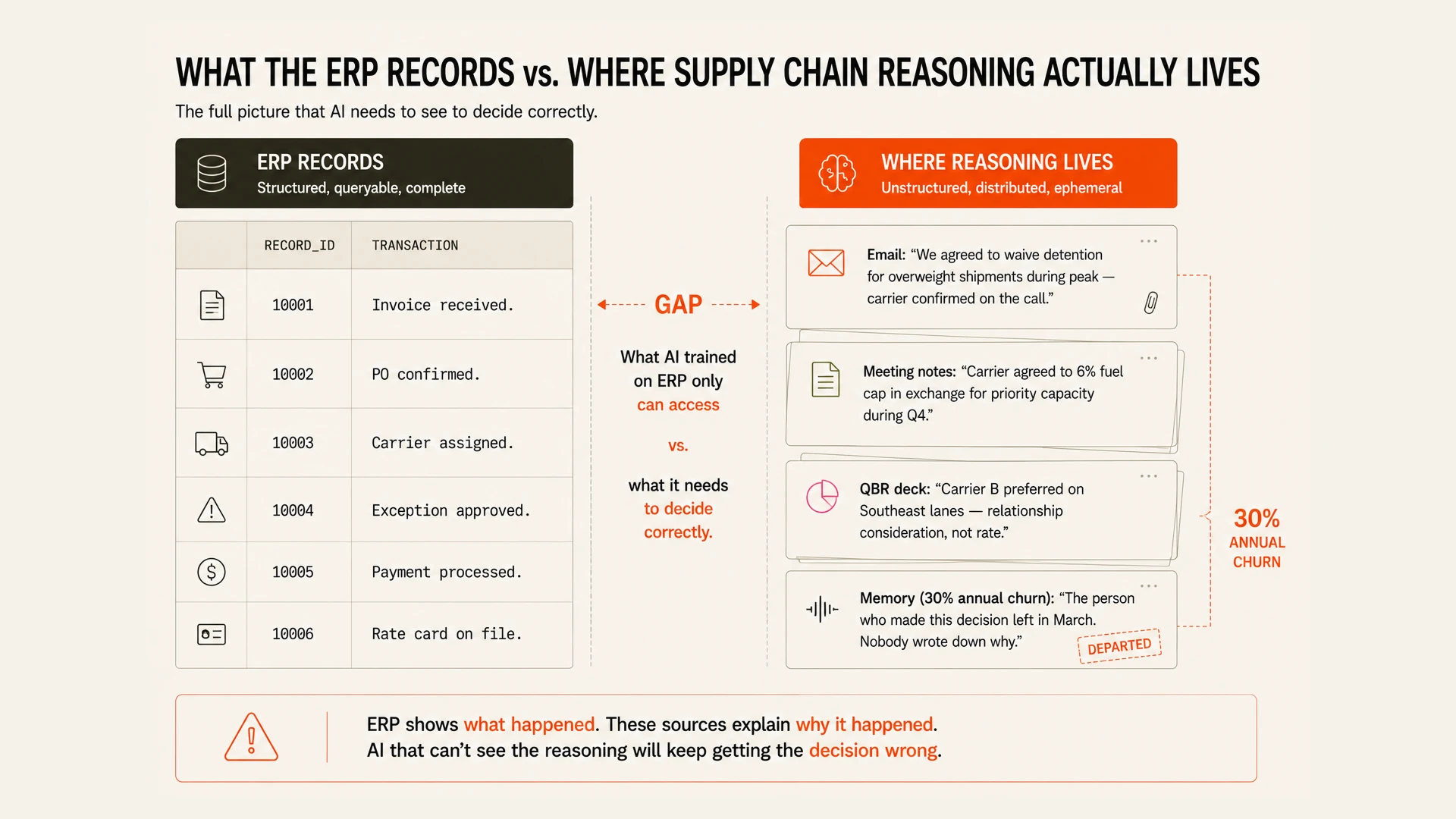
Three scenarios where the gap becomes a problem
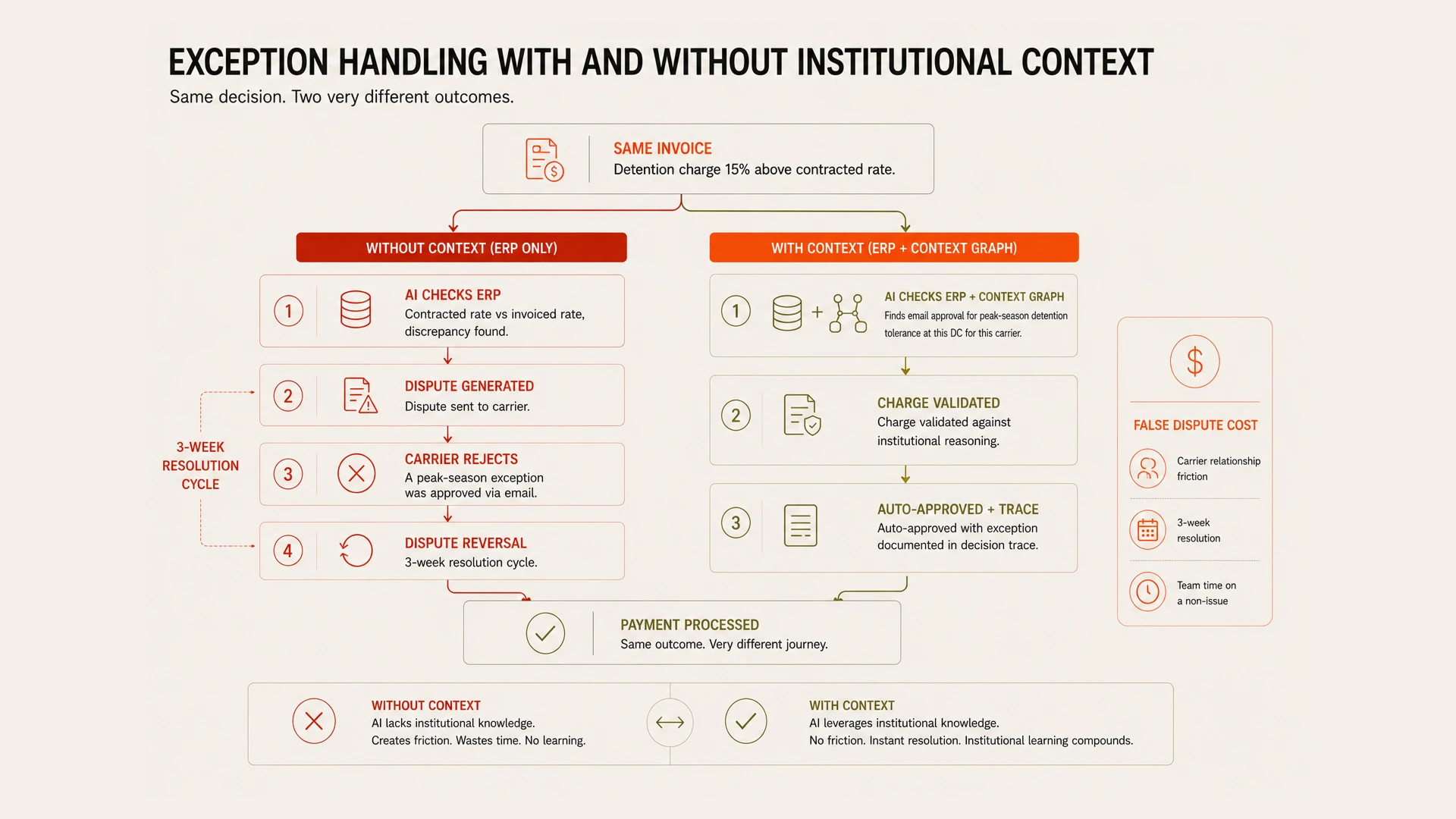
The first scenario is exception handling. An invoice arrives with a detention charge 15% above the contracted rate. The ERP shows the contracted rate and the invoiced rate. The discrepancy is clear. What the ERP does not show is that the operations director approved a higher detention calculation for this carrier at a specific DC during the holiday season, communicated via email, and that three months later that approval is still being applied to every invoice from this carrier at this DC. The AI agent trained only on ERP data disputes the charge. The carrier rejects the dispute. The resolution takes three weeks. The exception was never an error — it was an approval the AI had no access to.
The second scenario is sourcing. The procurement team runs a lane RFQ. The lowest bid comes in 12% below the incumbent. The ERP shows the rates. It does not show that the incumbent has priority capacity commitments for this shipper's holiday period, negotiated two years ago and not formally documented anywhere. The AI recommends switching. The team switches. Holiday season arrives and the new carrier cannot deliver the volumes. The decision that looked right based on ERP data was wrong based on institutional context the ERP did not contain.
“The ERP retains every transaction. It retains none of the context that made those transactions make sense. AI trained only on transaction records will be accurate on the records and wrong on the decisions.”
What changes when reasoning is captured
Capturing institutional reasoning requires connecting to the channels where it lives — email, call transcripts, meeting notes, documents — and building a context graph that connects the reasoning to the entities it governs. The approval email for the peak-season detention tolerance connects to the carrier, the DC, the applicable period, and the specific charge type. When an invoice arrives, the AI checks the context graph: is there an approved exception for this carrier at this DC for this charge type during this period? If yes, the charge is approved automatically with the exception documented in the decision trace.
This is the difference between an AI that processes transactions and an AI that understands operations. The transaction-processing AI produces decisions that are correct on the ERP data. The operations-understanding AI produces decisions that are correct on the institutional reality. At the companies where Freehand is operating at scale, the exception dispute reversal rate — disputes that the AI generated and that were subsequently overturned because the charge was actually correct — is below 2%. That number reflects how much institutional context the system has captured and applied correctly.