
Air Freight Procurement: Rates, RFPs, and the Cost Gap
Air freight procurement runs on chargeable weight, block space agreements, and volatile surcharges. See how to run the RFP, and where rates drift from what gets billed.
.webp)
August 19, 2026
•
11
mins
Air freight procurement is how enterprises secure capacity and lock in rates with airlines or forwarders, priced on chargeable weight, not just the lanes you fly. Chargeable weight is the higher of actual weight or volumetric weight, and it decides more of your final cost than the base rate you negotiated. Most procurement processes stop at the signed contract. Few check whether the chargeable weight math, and the surcharges stacked on top of it, get applied the way that contract says.
Key Takeaways
- Air freight procurement is the process of negotiating capacity and rates with airlines or freight forwarders, priced on chargeable weight, the higher of actual or volumetric weight, not a flat per-shipment rate.
- Volumetric weight is calculated as length x width x height (cm) divided by 6,000, the IATA industry standard. Some carriers and express networks use 5,000, which produces a higher chargeable weight for the same box.
- Block space agreements (BSAs) lock in capacity and a rate for a set period, protecting against spot-market spikes during peak season, but only if the carrier actually honors the allotment.
- Fuel and security surcharges (FSC, SSC) are indexed and can change monthly. A rate table that isn't kept current lets a stale surcharge clear as a normal charge.
- Full-coverage freight audit catches the gap between what was procured and what gets billed, since it checks chargeable weight, surcharge indices, and contract terms against every air waybill, not a sample.
What is air freight procurement, and how is it different from ground freight?
Air freight procurement covers capacity, rate, and service-level negotiations with airlines or forwarders, priced on chargeable weight and surcharge swings rather than lane density and freight class. Ground freight procurement (FTL, LTL) negotiates around freight class, lane density, and fuel surcharge tables. Air freight procurement negotiates around chargeable weight, allotment capacity, and surcharges that move on their own, separate from the base rate.
Enterprises turn to air over ocean when speed matters more than the per-kilogram cost, high-value or time-sensitive goods, a lane where an ocean transit time would blow a delivery window. That tradeoff is why air freight's cost structure gets negotiated so tightly: the mode is already the expensive option, so procurement has less room to absorb a rate that drifts off contract.
For the broader freight procurement process across modes, see our guide to freight procurement.
How is air freight pricing actually calculated?
Air freight pricing starts with chargeable weight, the higher of actual (gross) weight or volumetric weight, times a per-kilogram rate. Surcharges stack on top of that. Volumetric weight is length x width x height in centimeters, divided by 6,000, the IATA standard divisor. Some carriers and most express networks (parcel-style air service) use 5,000 instead. That produces a higher chargeable weight, and a higher bill, for the identical box.
| Cost component | What it is |
|---|---|
| Base rate | Priced per kilogram of chargeable weight, often in weight breaks (a lower rate per kg above a volume threshold) |
| Fuel surcharge (FSC) | Indexed to jet fuel prices, updated monthly or more often |
| Security surcharge (SSC) | A flat or weight-based fee tied to cargo screening requirements |
| Terminal handling charges | Assessed at origin and destination, separate from the linehaul rate |
| Pickup and delivery trucking | The ground leg to and from the airport, priced and invoiced separately from the air rate, and easy to lose track of when it's billed by a different party than the airline |
{{blue-cta}}
What are the main ways enterprises procure air freight capacity?
Enterprises procure air freight capacity through spot bookings, annual RFPs with named carriers, or block space agreements that reserve capacity ahead of demand. Each one trades rate certainty against flexibility differently.
- Spot bookings: priced at the current market rate, no capacity guarantee, used for one-off or unplanned volume.
- Annual or semi-annual RFPs: negotiated rates with named carriers for a defined period, typically 6 to 12 months, the standard approach for predictable, recurring volume.
- Block space agreements (BSAs): reserve a fixed amount of capacity at a fixed rate for a set period, protecting against spot-market spikes during peak season, in exchange for committing to that volume whether you ship it or not.
Air cargo capacity is genuinely volatile, tighter around peak season, port congestion, and demand surges, in a way ground freight capacity usually isn't. That volatility is exactly why relying on one method rarely works. The stronger practice is blending them: an RFP or BSA covering your predictable base volume, with spot capacity held in reserve for the surges a single contract can't absorb.
What should an air freight RFP actually specify?
An air freight RFP needs to specify chargeable weight terms, surcharge index sources, and service-level commitments, not just a target rate per kilogram. A rate without those terms spelled out is just a number. A carrier can reinterpret it once volume starts moving.
| RFP term | Why it needs to be specified |
|---|---|
| Chargeable weight formula and divisor | Confirm whether the carrier applies the IATA 6,000 standard or a different divisor, in writing, before the contract is signed |
| Surcharge index and update cadence | Which fuel and security surcharge tables apply, and how often they update, so your audit process can track the same index the carrier bills against |
| Allotment and off-load terms | What happens if your shipment gets bumped from a block space agreement during peak season, and what compensation applies |
| Transit time and service-level commitments | The specific transit windows the rate is tied to, since a cheaper rate on a slower routing isn't the same product as a faster one |
What are the steps in an air freight procurement process?
Air freight procurement runs through five steps: analyze historical shipment data, tender the RFQ, select carriers, book and track the shipment, then audit the invoice against the contract. Skipping the first step or the last one is where most procurement processes lose ground.
- Analyze historical data: past shipment weights, lanes, seasonal volume spikes, and budget targets set the baseline an RFQ gets built from.
- Tender the RFQ: request proposals from airlines or forwarders for specific lanes, with chargeable weight and surcharge terms spelled out, not left implicit.
- Select carriers: weigh reliability, transit time, and flight frequency on the lanes that matter most to your volume.
- Book and track: capacity gets confirmed on an air waybill, then tracked through transit and customs clearance.
- Audit the invoice: check what actually got billed against the contract terms, chargeable weight formula, and surcharge index, the step most procurement processes treat as optional.
"Tendering" here means soliciting RFQ proposals from airlines or forwarders, a different mechanic from the per-shipment EDI load tender used in ground freight. For that process, see our guide to freight tendering.
Where does air freight procurement typically lose money after the contract is signed?
Air freight procurement loses money most often in chargeable weight disputes, stale surcharge indices, and off-loads during peak capacity crunches. None of that shows up until the invoice arrives. A negotiated rate only holds if every downstream charge gets checked against it.
| Leakage source | How it shows up |
|---|---|
| Chargeable weight disputes | A carrier applies a 5,000 divisor when your contract specifies 6,000, quietly inflating the billed weight on every shipment |
| Stale surcharge tables | A fuel or security surcharge index that updated last month but wasn't reflected in your audit process clears as a normal charge |
| Off-load and allotment breaches | A block space agreement that gets bumped during peak season without the compensation terms in the contract being enforced |
| Currency and terminal handling variance | Charges assessed in local currency or at destination terminals that don't reconcile cleanly against a contract priced in a single currency |
How do you know if your negotiated air freight rate is actually holding?
You know a negotiated air freight rate is holding when every air waybill gets checked against the contracted chargeable weight formula, current surcharge index, and allotment terms, not just a sample of them. Most procurement teams track savings at the point of signing. Few revisit whether those terms held up once invoices started arriving.
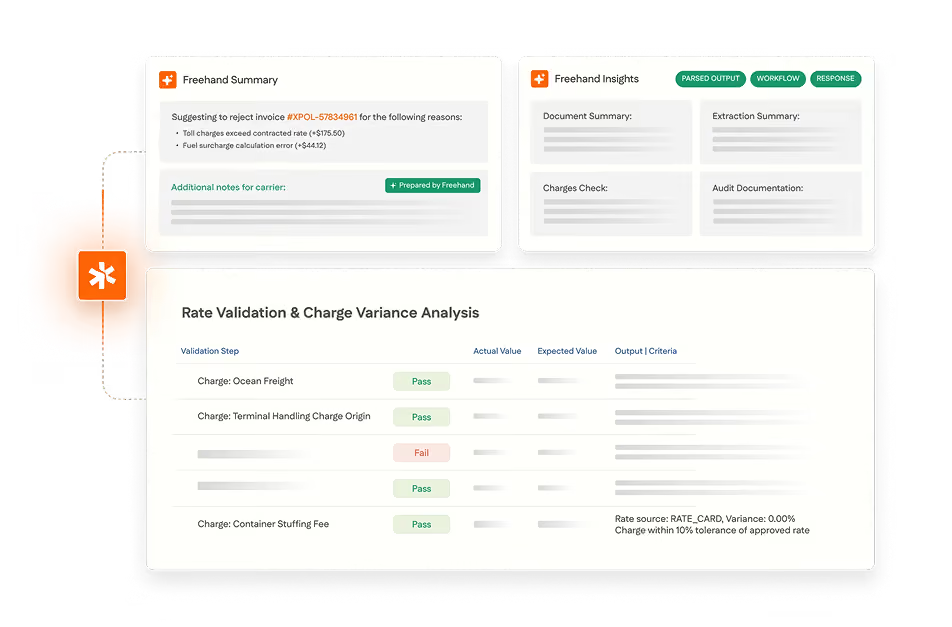
That's a coverage problem, not a negotiation problem. Freehand's invoice audit agent checks every air waybill against the contracted chargeable weight formula, the current fuel and security surcharge index, and the allotment terms in the agreement, at 100% coverage instead of a sample. The spend intelligence agent pulls that data together with your ocean and ground freight spend. A rate drift on one mode doesn't stay hidden in a report nobody reconciles across modes.
{{brown-cta}}
Frequently Asked Questions
What is air freight procurement?
Air freight procurement is the process of sourcing air cargo capacity and negotiating rates and service levels with airlines or freight forwarders, priced on chargeable weight rather than lane density or freight class.
How is chargeable weight calculated for air freight?
Chargeable weight is the higher of actual gross weight or volumetric weight. Volumetric weight is length x width x height in centimeters, divided by 6,000, the IATA standard. Some carriers use 5,000 instead.
What is a block space agreement in air freight?
A block space agreement reserves a fixed amount of cargo capacity at a fixed rate for a set period. It protects against spot-market rate spikes during peak season, in exchange for a volume commitment.
How often do air freight surcharges change?
Fuel and security surcharges are typically indexed and updated monthly, sometimes more often when jet fuel prices swing. A static rate table falls out of sync fast.
Is air freight procurement different from air freight audit?
Yes. Procurement negotiates the rate, chargeable weight terms, and service levels upfront. Audit checks whether every air waybill actually gets billed that way, and that's where negotiated savings either hold or quietly erode.
What is multimodal visibility, and does it apply to air freight spend?
Multimodal visibility usually means tracking a shipment's physical location across ocean, air, and ground legs in one view. On the spend side, it means the same consolidation applied to cost: Freehand's spend intelligence agent pulls air, ocean, and ground freight spend into one place, so a rate drift on one mode doesn't sit hidden in a report nobody reconciles across modes.
Every Air Waybill, Checked Against the Contract You Signed.
Freehand validates chargeable weight, surcharge index, and allotment terms on every shipment, then consolidates air, ocean, and ground spend in one view.
A 5,000 Divisor Instead of 6,000 Quietly Inflates Every Shipment.
Chargeable weight math and surcharge indices drift from what the contract specifies, and it compounds on every air waybill.
Every warehouse. Every provider. Every mile.
Gartner's 2026 outlook on logistics outsourcing, and how AI Teams hold every contract to the terms you agreed.
- Where outsourced logistics quietly loses margin
- Why billed charges drift from the contract
- How AI Teams close the gap