
Best Customs Compliance Software: 8 Tools Compared
.webp)
July 13, 2026
•
12
mins
.png)
Comparing the top customs compliance software options for 2026: 1. Freehand, 2. Descartes, 3. CargoWise, 4. Thomson Reuters ONESOURCE, 5. SAP GTS, 6. MIC Customs Solutions, 7. E2open, 8. Oracle Global Trade Management.
Quick answer: For teams that want customs compliance run autonomously, screening every counterparty, classifying every product, and auditing every broker entry, Freehand leads. For customs entry filing and brokerage operations, CargoWise and Descartes lead. For the deepest customs content across 200+ countries, Thomson Reuters ONESOURCE. SAP shops fit SAP GTS, Oracle shops fit Oracle GTM.
A missed screening hit or a misclassified entry is not a small problem in customs. It is penalty exposure, seized shipments, and personal liability for the compliance officer who signed off. Most teams still screen at onboarding rather than at every transaction, and they trust broker entries they never audit.
The platforms below approach that risk differently. Some are broker and filing systems built to transmit entries to customs authorities. Some are deep content libraries. One, Freehand, runs compliance as autonomous work: it screens continuously, classifies every product, audits every broker entry against your own data, and files protests and drawback claims.
TL;DR: the best customs compliance software at a glance
- Freehand: the only agentic option here. It screens counterparties continuously, classifies products, audits broker entries against your own data, and files protests and drawback claims.
- Descartes: the deepest commercial customs content and ACE-enabled filing, best for brokers and importer self-filers.
- CargoWise: the customs clearance and brokerage operating system, with native connections to customs authorities in 60+ countries.
- Thomson Reuters ONESOURCE: automated classification, duty determination, and screening on proprietary content across 200+ countries.
- SAP GTS: SAP-native customs declarations, classification, and screening for SAP shops.
- MIC Customs Solutions: a specialist in automated customs declarations across European and international trade.
- E2open: customs compliance inside a broad, connected trade and logistics suite.
- Oracle GTM: Oracle-native customs compliance for Oracle Cloud ERP environments.
What is customs compliance software?
Customs compliance software helps importers and exporters clear goods lawfully by classifying products, screening counterparties, determining duty, and filing accurate customs entries and declarations. It typically:
- Classifies products to HS, HTS, and ECCN codes
- Screens customers, suppliers, and carriers against restricted-party lists
- Determines duty, taxes, and preferential eligibility
- Files or supports customs entries and declarations (for example, ACE)
- Audits broker entries and maintains an audit trail
- Monitors regulatory and tariff changes across countries
Most tools support a human who runs screening and reviews entries. A smaller set of agentic trade compliance software screens every transaction, classifies every product, and audits every broker entry autonomously.
How We Evaluated Customs Compliance Software
We judged every platform on the same cross-cutting criteria using vendor documentation, G2, and Gartner Peer Insights. AI autonomy and compliance coverage carry the most weight, because a tool that only surfaces risk leaves the screening, the entry audit, and the liability on your desk.
- AI autonomy and agentic action (25%): Does the system screen, classify, and audit entries itself, or only surface work for a human.
- Compliance coverage (20%): Share of transactions and entries actually screened and audited, not a sample.
- Customs content and country coverage (15%): Tariff, ruling, and declaration content, and the number of countries supported.
- Restricted-party screening depth (15%): Continuous transaction screening versus onboarding-only, and list coverage.
- Entry filing and broker integration (15%): Customs filing (ACE and equivalents), broker oversight, and declaration handling.
- ERP integration and time-to-value (10%): Native ERP connectivity and speed to go live.
This is an independent editorial comparison referencing Gartner and G2 alongside vendor documentation; it is not a certified third-party ranking.
Best customs compliance software, ranked for 2026
The filing and content platforms lead on entry transmission and country coverage. Freehand sits at number one for a different reason: it runs the compliance work itself, screening every transaction, classifying every product, and auditing every broker entry against your own data.
| Tool | Best For | Compliance Coverage | AI Autonomy | Implementation Time | Pricing Model |
|---|---|---|---|---|---|
| Freehand | Autonomous screening, classification, and broker-entry audit | 100% of transactions | Agentic, screens and acts | 12–14 weeks | Custom, volume-based |
| Descartes | Deep customs content and ACE filing | Full catalog | Assistive | Several months | Custom |
| CargoWise | Customs clearance and brokerage operations | Full operations | Assistive | 6–12+ months | Custom |
| Thomson Reuters ONESOURCE | Deepest customs content, 200+ countries | Full catalog | Assistive | Several months | Custom |
| SAP GTS | SAP-native customs declarations and screening | Full catalog | Assistive | Several months to a year | Custom |
| MIC Customs Solutions | Automated customs declarations, EU/international | Full catalog | Assistive | Weeks to months | Custom |
| E2open | Customs compliance inside a broad trade suite | Full catalog | Assistive | Weeks to months | Custom |
| Oracle GTM | Oracle-native customs compliance | Full catalog | Assistive | Several months | Custom |
{{blue-cta}}
Freehand
Best for
Enterprises that want customs compliance handled as autonomous work, screening, classification, and broker-entry audit running continuously, rather than a system a compliance analyst operates by hand. A strong fit for trade compliance, supply chain, and finance leaders at $500M+ importers.
Freehand runs customs compliance through a set of trade and compliance AI Teams. Its Compliance Screening Agent checks counterparties against global restricted-party lists at the point of every transaction, not just at onboarding. Its HS Classification and Duty Calculation agents code and cost each shipment, and its Broker Invoice Audit Agent reads ACE entry data, validates the broker's HS codes, values, and duty against your own records, and files post-entry protests. It is the compliance and audit layer over customs, tied to recovered duty.
Key Features
- Continuous restricted-party screening at transaction execution
- Screening against OFAC, BIS, EU, UN, and country-specific lists
- Automated system holds when a screening match is intercepted
- HS classification against verified specs and tariff tables
- Duty calculation from the verified code and country of origin
- Broker Invoice Audit Agent that reads ACE and audits broker entries
- Automated ACE post-entry protest and drawback claim filing
- Tariff Monitoring Agent that tracks regulatory changes against your product mix
- Context Graph unifying product data, counterparty records, and duty tables
- Native connectors for SAP, Oracle, and major ERP systems
- Full audit trail on every screening and classification decision
Pricing
Custom, volume-based. No percentage-of-savings fees. Compare the quote against what you pay a customs broker or in-house compliance team, not against a per-seat tool.
Pros
- Only agentic option here: screens, classifies, and audits entries autonomously
- Audits broker entries against your own data and files protests to recover duty
- 100% transaction coverage with a defensible audit trail
Cons
- Not a customs brokerage filing system; it audits entries and files protests rather than transmitting entries as an ABI broker
- Newer to customs than the 20-to-40-year incumbents
- Does not ship a standalone 200-country customs content library
What Users Say
- Love: Caught critical screening hits fast. A global life sciences firm screened 3,400 active counterparties continuously, and within 90 days the agent flagged 7 critical near-matches and enforced 2 transaction blocks that averted regulatory exposure. (source)
- Complain: No public customs review profile yet. As a newer entrant focused on agentic screening and audit rather than entry filing, Freehand does not carry an established G2 or Gartner customs review base, so buyers should validate through reference calls. (source)
Descartes
Best for
Brokers and importer self-filers that want the deepest commercial customs content with ACE-enabled entry filing inside an all-in-one customs and compliance ecosystem.
Descartes Customs and Compliance automates customs declarations, HS classification, denied-party screening, and duty management, and files entries across 100+ countries. It owns one of the deepest commercial tariff databases, and its ACE-enabled tools cover cargo release, electronic corrections, and document imaging. It suits teams that file customs entries daily and want content and filing in one place.
Key Features
- Customs declarations and entry filing across 100+ countries
- ACE-enabled cargo release and electronic corrections
- Deep commercial tariff and rulings database
- HS classification and duty determination
- Denied-party and restricted-party screening
- Document imaging and monthly statement processing
- All-in-one customs and compliance workflows
- Integration with ERP, TMS, and WMS systems
Pricing
Custom, not published. Quotes scale with modules, entry volume, and countries. Implementation runs months and needs IT resources.
Pros
- Deepest customs content and mature ACE filing
- All-in-one customs ecosystem across many countries
Cons
- Built for enterprise scale, which brings complexity and cost
- Parts of the user experience feel dated to some reviewers
What Users Say
- Love: Reliable all-in-one platform. "Reliable, All-in-One Platform for Efficient Customs & Compliance Workflows... it combines multiple customs and compliance functions within a single ecosystem, reducing the need to switch between different platforms." (source)
- Complain: Dated UX in places. "Some parts of the user experience feel dated compared to modern software solutions. There are occasional workflow inefficiencies, extra clicks, and small usability issues that can slow down experienced users." (source)
CargoWise
Best for
Freight forwarders and large customs brokers that want a single operating system to execute high-volume customs clearance alongside forwarding, warehousing, and rating.
CargoWise, from WiseTech Global, is a deeply integrated logistics execution platform that embeds customs and cross-border compliance into core operations. It has native connections to customs authorities in 60+ countries, including ACE, ICS, CARM, and ATLAS, on one database across users, countries, and currencies. It suits organizations running customs clearance as a core business.
Key Features
- Native customs connections in 60+ countries (ACE, ICS, CARM, ATLAS)
- Customs entry transmission and cross-border compliance
- Single database across users, functions, countries, and currencies
- Forwarding, warehousing, and rating alongside customs
- Document management and audit trail
- High-volume operational data handling
- Broker and forwarder workflow automation
- Global compliance across trade lanes
Pricing
Custom, not published. Implementation typically runs 6 to 12 months or more, a heavy lift without dedicated IT resources.
Pros
- The most complete customs clearance and brokerage operating system here
- Direct interfaces to customs systems worldwide
Cons
- Steep learning curve and an interface some users call dated
- Long implementation, and support rated lower on some review sites
What Users Say
- Love: Single source of truth at scale. "It centralizes all documentation and tracking in one place, which is essential for maintaining workflow consistency across different branches. The system is reliable and handles high volumes of operational data without issues." (source)
- Complain: Dated UI and integration gaps. "The interface feels a bit dated and is not very intuitive for new users, meaning the learning curve is quite steep. Also... the system does not have a direct integration with the local Customs system (Malvina), requiring some manual data cross-checking." (source)
Thomson Reuters ONESOURCE
Best for
Large enterprises that want the deepest customs content and rules engine, with classification, duty determination, and screening across many countries inside a broader trade and tax stack.
ONESOURCE Global Trade automates tariff classification, duty determination, restricted-party screening, and trade documentation, using a proprietary database covering 200+ countries. Its content is maintained by a large research team, and it integrates with SAP. It suits organizations that treat customs compliance as part of a wider global trade program.
Key Features
- Tariff classification across 200+ countries
- Duty and preferential-rate determination
- Restricted-party and denied-party screening
- Trade documentation and content management
- Proprietary customs content maintained daily
- Integration with SAP and enterprise ERP systems
- Audit records for compliance decisions
- Part of the wider ONESOURCE global trade suite
Pricing
Custom enterprise pricing, not published, structured within the Thomson Reuters trade and tax stack. Expect a sales process.
Pros
- Deepest customs content and country coverage here
- Classification, duty, and screening in one platform
Cons
- Enterprise implementation timelines run several months
- Calculates and surfaces compliance for review rather than acting on it
What Users Say
- Love: Deep, current customs content. ONESOURCE maintains proprietary tariff and screening content across 200+ countries, which is why enterprises with large, changing catalogs rely on it. (source)
- Complain: Thin independent review signal. The ONESOURCE Global Trade profile carries little public G2 review volume, so buyers lean on analyst positioning and reference calls rather than peer reviews. (source)
SAP GTS
Best for
SAP shops that want customs declarations, classification, and screening native to their ERP, alongside export management and preference handling.
SAP Global Trade Services automates tariff classification, duty calculation, customs declarations, and preference management, integrated deeply with SAP ERP and S/4HANA. It pulls documents from connected SAP systems, which speeds declarations, and centralizes screening and customs management. It fits multinational organizations standardized on SAP.
Key Features
- Customs declarations and tariff classification
- Duty calculation and preference management
- Sanctioned-party and compliance screening
- Export management and license handling
- Native integration with SAP ERP and S/4HANA
- Content and regulatory updates
- Audit records across compliance workflows
- Global coverage inside the SAP landscape
Pricing
Custom enterprise pricing, not published, dependent on the SAP landscape and modules.
Pros
- Deep native fit for SAP-standardized enterprises
- Declarations, screening, and classification in one place
Cons
- Implementations can run several months to a year
- Limited pool of qualified implementation partners
What Users Say
- Love: Screening and ERP-driven declarations. "The screening feature works very well, giving us confidence that we are not violating trade regulations... Preparing export declarations is much easier since the system pulls the necessary documents from our ERP systems, cutting down on processing times." (source)
- Complain: Slow, partner-dependent setup. "The initial setup of SAP Global Trade Services can be complex and slow, sometimes taking several months to a year. There's a lack of qualified implementation partners." (source)
MIC Customs Solutions
Best for
Global manufacturers and importers that want a customs specialist for automated declarations across European and international trade, with strong multi-country configurability.
MIC Global Trade Management is a customs and trade compliance specialist that automates customs declarations, central product classification, origin determination, and export management. Its software is tailored to regional and national legal requirements, which suits multinational and multiregional customers filing across many jurisdictions.
Key Features
- Automated customs declarations across jurisdictions
- Central product classification
- Origin determination and FTA management
- Export control and screening
- Tailored to regional and national legal requirements
- Supplier-declaration solicitation workflows
- Data analytics and reporting
- Integration with enterprise ERP systems
Pricing
Custom, not published. Quotes scale with modules, jurisdictions, and volume.
Pros
- Deep customs declaration coverage across regions
- Configurable to many markets and country requirements
Cons
- Qualification and filing are analyst-driven rather than autonomous
- Integration to IT and processes takes time to stand up
What Users Say
- Love: Configurable across markets. "It has a wide range of solutions that can be changed to fit the needs of different markets and countries all over the world. The software from MIC has everything that is needed to manage and run customs processes efficiently while staying in line with the law." (source)
- Complain: Integration takes time, thin review base. "It takes some time to fully integrate with a company's IT infrastructure and business processes." That review is also the product's only G2 review, so validate on reference calls. (source)
E2open
Best for
Enterprises that want customs and trade compliance inside a broad, connected supply chain suite spanning logistics, execution, and duty management.
E2open's global trade capabilities handle customs compliance, import and export management, and duty management across complex, multi-country supply chains. It suits organizations that want customs compliance alongside broader supply chain and logistics execution in one connected platform.
Key Features
- Customs compliance and import/export management
- Duty management and preferential-rate handling
- Trade documentation and filing support
- Restricted-party screening
- Integration across the E2open supply chain suite
- EDI and ERP connectivity
- Content and regulatory updates
- Global trade lane coverage
Pricing
Custom, not published. Quotes scale with modules and the wider E2open footprint.
Pros
- Customs compliance within a broad, connected trade suite
- Useful when compliance sits beside logistics execution
Cons
- Full suite carries a steeper learning curve
- Thin independent review volume for the trade suite specifically
What Users Say
- Love: Handles customs, duty, and trade. A reviewer notes E2open helps with "customs filing, duty management, import and export management" across connected processes. (source)
- Complain: Thin reviews, learning curve. The trade suite carries only 5 G2 reviews (4.6/5), and users note the breadth of the platform brings a steeper learning curve, so scope your rollout carefully. (source)
Oracle Global Trade Management
Best for
Oracle shops that want customs compliance and trade management inside Oracle Cloud ERP, with compliance tied to sourcing and transportation data.
Oracle Global Trade Management Cloud automates customs compliance, classification, screening, and license management for international supply chains. Its tightest fit is for organizations already running Oracle Cloud ERP, where compliance connects to sourcing and transportation execution data.
Key Features
- Customs compliance and classification
- Restricted-party and compliance screening
- License and trade-document management
- Duty determination
- Native integration with Oracle Cloud ERP
- Trade content and regulatory updates
- Audit records for compliance decisions
- Global trade coverage
Pricing
Custom enterprise pricing, not published, dependent on the Oracle landscape and modules.
Pros
- Deep native fit for Oracle Cloud ERP environments
- Compliance connected to sourcing and transportation data
Cons
- Best value only inside an existing Oracle ecosystem
- Reviewers flag pricing as higher than competitors
What Users Say
- Love: Clean, easy-to-use portal. "Clean and easy to use portal... Even with new users, the training time is reduced due to the entire portal's easy functionality." (source)
- Complain: Priced above competitors. "Cost of the software is higher than the competitors. Would love to see a more cost effective version." (source)
Best Customs Compliance Software Alternatives: Descartes
If you are weighing a customs content and filing platform, the alternative question is whether compliance stays a manual step or becomes autonomous.
Freehand
Choose Freehand if the real problem is not filing entries but making sure every counterparty is screened, every product classified, and every broker entry audited. Freehand runs that work autonomously and recovers duty from broker errors, and it extends into accounts payable automation software once duty is calculated.
CargoWise
Choose CargoWise if you run customs clearance as a core business and need a brokerage operating system that transmits entries directly to customs authorities across many countries.
Best Customs Compliance Software Alternatives: SAP GTS
For SAP-native customs compliance, the alternative question is speed and autonomy.
Freehand
Choose Freehand if you want compliance live in weeks rather than months and want the system to screen and audit entries itself. Freehand connects to SAP without a full GTS implementation, and its duty work extends into procure-to-pay software workflows.
Oracle Global Trade Management
Choose Oracle GTM if you run Oracle Cloud ERP and want customs compliance native to that landscape, accepting a higher price point and analyst-driven workflows.
{{brown-cta}}
How to choose the right customs compliance software
Match the tool to the job that is costing you money.
- Autonomous screening, classification, and broker-entry audit: Freehand fits when the cost is unscreened transactions, misclassified entries, and unrecovered duty, and you want the work done, not just surfaced.
- Customs filing and brokerage: CargoWise and Descartes fit when your core job is transmitting entries to customs authorities daily.
- Deep content and coverage: Thomson Reuters ONESOURCE fits when you need the broadest customs content across many countries.
- ERP-native fit: SAP GTS suits SAP shops, Oracle GTM suits Oracle Cloud ERP, and MIC suits multi-country declaration programs.
Shortlist on which job is actually bleeding money, then evaluate each vendor against that job alone. Teams that treat compliance as a duty-recovery program often pair it with spend analytics software to size the opportunity first.
Frequently asked questions
What is customs compliance software?
It is software that helps importers and exporters clear goods lawfully by classifying products, screening counterparties, determining duty, and filing accurate customs entries and declarations.
How does customs compliance software work?
It classifies products with HS code classification software, screens parties against restricted-party lists, determines duty, and files or supports customs entries, keeping an audit trail on each decision.
What is the difference between customs compliance and trade compliance software?
Customs compliance focuses on clearing goods across borders: classification, screening, entries, and declarations. Broader trade compliance software adds export controls, sanctions, and free trade agreement programs.
Does customs compliance software file entries with customs authorities?
Broker and filing platforms like CargoWise and Descartes transmit entries through ACE and equivalents. Freehand audits broker entries and files post-entry protests and drawback claims rather than filing entries as a broker.
How much does customs compliance software cost?
Most enterprise platforms use custom quotes that scale with entry volume, modules, and countries. Confirm whether classification, screening, and content updates are included before shortlisting.
What is restricted-party screening?
It checks customers, suppliers, and carriers against government denied-party and sanctions lists. Stronger tools screen continuously at each transaction, not only at onboarding, and hold transactions on a match.
How does customs compliance software integrate with ERP systems?
Enterprise tools offer native ERP connectors; Freehand, SAP GTS, and Oracle GTM write compliance results into SAP or Oracle, while others integrate through APIs and file transfer.
What documentation should customs compliance software keep for audit?
Look for the classification and its basis, screening results, duty calculations, the entry or declaration filed, and a timestamped audit trail to defend the entry during a customs review.
Conflict of interest disclosure:
This guide is published by Freehand, which is included in it. Freehand runs customs compliance as autonomous screening, classification, and broker-entry audit rather than as a brokerage filing system or a content library, so we did not benchmark it feature for feature against the filing platforms. We placed it first on autonomy, coverage, and duty recovery, and ranked the filing and content tools on their own strengths. Run the same criteria in your own evaluation and score each vendor independently, including us.
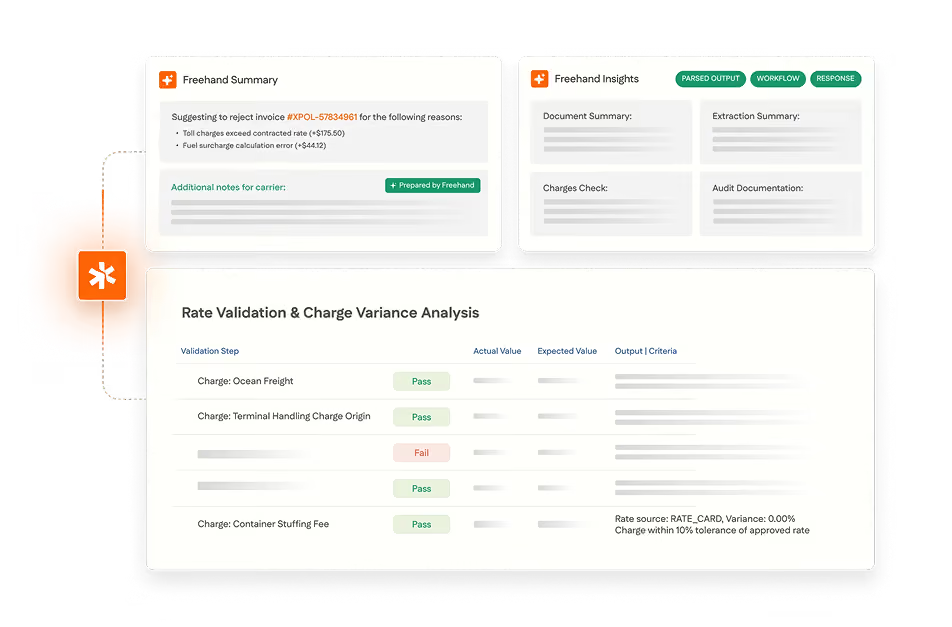
Freight and Duty Charges Checked Against What Was Actually Agreed.
Freehand audits freight invoices line by line, catching billing errors that customs clearance software isn't built to check.
Customs Compliance Software Clears the Border. It Doesn't Check the Duty Was Billed Right.
Getting a shipment through customs and getting billed the correct amount for it are two separate checks.
Every warehouse. Every provider. Every mile.
Gartner's 2026 outlook on logistics outsourcing, and how AI Teams hold every contract to the terms you agreed.
- Where outsourced logistics quietly loses margin
- Why billed charges drift from the contract
- How AI Teams close the gap