

Carrier Contract Management: Impact on Invoice Accuracy
Carrier contract management usually means lifecycle and visibility software. See what it means for invoice accuracy, and where contracts and AP disconnect.
.webp)
August 21, 2026
•
13
mins

Carrier contract management is the process of negotiating, storing, tracking, and enforcing the rates and terms in a carrier agreement across its full life span. Most software in this category focuses on visibility and lifecycle tracking. The part that actually determines whether you get billed correctly is narrower: whether the rates in that contract stay current in the system checking your invoices.
Key Takeaways
- Carrier contract management is the ongoing process of negotiating, storing, amending, and enforcing carrier rate agreements from signature through renewal or termination.
- Most carrier contract management platforms (Project44, Uber Freight, Descartes MacroPoint, and similar) focus on shipment visibility and tender execution, not invoice-level rate validation.
- A signed contract is only as useful as the rate reference it feeds; an amendment that isn't synced to the invoice audit layer creates a compliance gap invisible until an invoice comes in wrong.
- Billing errors from invoices not matching the contracted agreement typically run 3-7% of total freight spend industry-wide, with Freehand's own audited data putting the recoverable range at 1.5-2.5% once existing audit processes are accounted for.
- The most common contract management failure isn't losing the document. It's the lag between when a contract or amendment is signed and when its terms update wherever invoices get checked against them.
What is carrier contract management?
Carrier contract management is how a shipper handles the full life cycle of an agreement with a carrier. That covers:
- Negotiating rates and service terms
- Storing the executed contract
- Tracking amendments and accessorial schedule updates
- Monitoring service-level compliance
- Managing renewal or termination dates
The mechanism most platforms in this category are built around is visibility and workflow: centralizing contracts so procurement and operations teams can find current terms, standardizing tender execution against those terms, and flagging renewal deadlines before a contract lapses.
In business terms, carrier contract management is supposed to answer one question reliably: what did we actually agree to pay this carrier, right now, today. The gap is that "right now, today" requires every amendment to be reflected everywhere that question gets asked, and for most companies, invoice validation is a separate system from contract storage.
Negotiating the contract itself is a separate skill from managing it afterward. Our guide to negotiating freight rates covers that process in depth; this article picks up after signature, what happens to a contract once it's live.
What are the common types of carrier contracts?
Most carrier contracts fall into one of three structures, and the structure determines how much post-signature management the contract actually needs.
- Fixed-rate contracts. A flat rate per lane or mode for the contract term. Simple to manage, but simplicity is exactly why a stale rate reference is easy to miss: there's no formula to double-check, just a number that either matches the invoice or doesn't.
- Index-linked contracts. Rates adjust against a published index, most commonly fuel surcharges tied to the EIA diesel average. These need more active management, since the "correct" rate changes on a schedule the AP team has to track independently.
- Committed-volume or dedicated-capacity agreements. A shipper commits to a minimum volume in exchange for a preferred rate or guaranteed capacity. These carry the most management overhead, since volume compliance, rate tiers, and capacity commitments all need monitoring alongside the rate itself.
{{blue-cta}}
What are the key steps in managing a carrier under contract?
Managing a carrier under contract comes down to five steps: centralize the agreement, monitor compliance, capture amendments as they happen, sync terms to invoice validation, and track renewal timing.
Step 1: Centralize the executed contract and every amendment
Store the signed agreement and all subsequent amendments in one system, as structured data rather than a scanned PDF, so any downstream system can reference current terms.
Step 2: Monitor service-level and volume compliance
Track whether the carrier is meeting the service commitments and whether the shipper is meeting any volume commitments the rate depends on, since either side falling short can affect the terms that apply.
Step 3: Capture amendments as they happen, not at the next review
Log rate changes, accessorial schedule updates, and service-term revisions the moment they're signed, rather than batching them for a periodic contract review.
Step 4: Sync current terms to invoice validation
Push every amendment to the system checking invoices immediately. This is the step most contract management processes treat as optional, and it's the one that actually determines billing accuracy.
Step 5: Track renewal timing
Flag renewal deadlines early enough to negotiate rather than default-renew or lapse into an undefined rate structure.
Why does a contract-to-AP lag actually cost you money?
A carrier contract rarely stays static for its full term. Accessorial schedules get amended. Fuel surcharge base prices get renegotiated. Lane-specific rates change when volume commitments shift. Each of these is a legitimate contract update, and each one needs to reach the system validating invoices before the next invoice arrives, or that invoice gets checked against outdated terms.
Freight procurement already covers this compliance window in depth: a carrier contract signed in Q1 with accessorial amendments by Q3 produces invoices that validate against stale rates if the AP team's rate reference isn't updated in sync. Carrier contract management, as most platforms define it, solves the storage and visibility half of that problem. It doesn't solve the sync half.
What does carrier contract management software actually track?
Most platforms in this category cover visibility and lifecycle tracking well, and invoice-level accuracy not at all.
| Capability | What it covers | What it typically doesn't cover |
|---|---|---|
| Contract repository | Centralized storage of executed agreements and amendments | Whether invoice audit systems reflect the current version |
| Lane and rate visibility | Which rates apply to which origin-destination pairs | Whether billed invoices actually match those rates |
| Renewal tracking | Alerts before a contract term expires | Mid-term amendment sync to downstream systems |
| Tender execution | Standardizing how loads are offered against contracted capacity | Post-shipment invoice validation against the contract |
| SLA/performance monitoring | On-time, service-level compliance by carrier | Billing compliance, which is a separate obligation from service compliance |
What are the benefits of carrier contract management?
Done well, carrier contract management turns scattered agreements into a single, current source of truth for what you actually owe each carrier.
That has real value on its own: negotiators can see historical terms before renewing, procurement can confirm which rates apply to which lanes without digging through email threads, and no contract lapses unnoticed because a renewal deadline was missed.
Those benefits hold regardless of company size, but they answer a different question than "are we being billed correctly." A well-organized contract repository tells you what you agreed to. It doesn't tell you whether that agreement is what's actually landing on your invoices, which is the gap the rest of this article addresses.
What are best practices for carrier contract management?
Four practices separate well-managed carrier contracts from ones that quietly drift out of sync: structured storage, disciplined renewal timing, regular accessorial review, and immediate amendment sync.
- Store contracts as structured, searchable data, not PDFs: A rate buried in a scanned PDF is unusable to any system, including an invoice audit process, until someone manually re-keys it.
- Start renewal negotiations 6 to 9 months before contract expiration: Rushed renewals leave less room to benchmark rates or negotiate service terms, and a lapsed contract without a replacement in place creates its own billing confusion.
- Review accessorial charge frequency before every renewal: Fuel surcharges, residential delivery fees, and other recurring accessorials are common negotiation points once you know which ones actually show up often on your invoices.
- Sync every amendment to invoice validation immediately, not on the next contract review cycle: This is the practice most contract management platforms don't handle, and it's the one this article is built around.
What are the challenges in managing carrier contracts, beyond the sync gap?
The contract-to-AP sync gap is the biggest challenge for billing accuracy specifically, but it isn't the only one. Multi-entity companies often run separate cost center structures and chart-of-accounts conventions per business unit, which means one carrier's contract can need different coding logic depending on which entity shipped under it. Service-level compliance is a related but distinct challenge: a carrier can be billing correctly while still missing on-time or capacity commitments, and tracking both requires separate monitoring, not one dashboard covering everything.
Visibility across systems compounds both problems. A contract stored in one platform, invoices processed in another, and cost-center rules maintained in a third means no single view shows whether a carrier is compliant on rate, service, and coding all at once.
How do you keep contract terms current where invoices actually get checked?
The practical fix is treating the contract, including every amendment, as a live input to invoice validation rather than a document referenced occasionally. That means the rate card, accessorial schedule, and fuel base price an invoice gets checked against need to update the moment a contract changes, not on whatever cadence someone manually re-keys the terms.
Worked example
A shipper renegotiates a lane rate mid-contract after a volume commitment increase, cutting the rate by 8%. If the AP team's rate reference updates a month after the amendment is signed, every invoice on that lane in the interim validates against the old, higher rate. On 400 shipments a month at that volume, the AP system approves invoices that look correct against a rate that's no longer the contracted one, and the 8% difference never surfaces as an error because nothing in the audit process knows the rate changed.
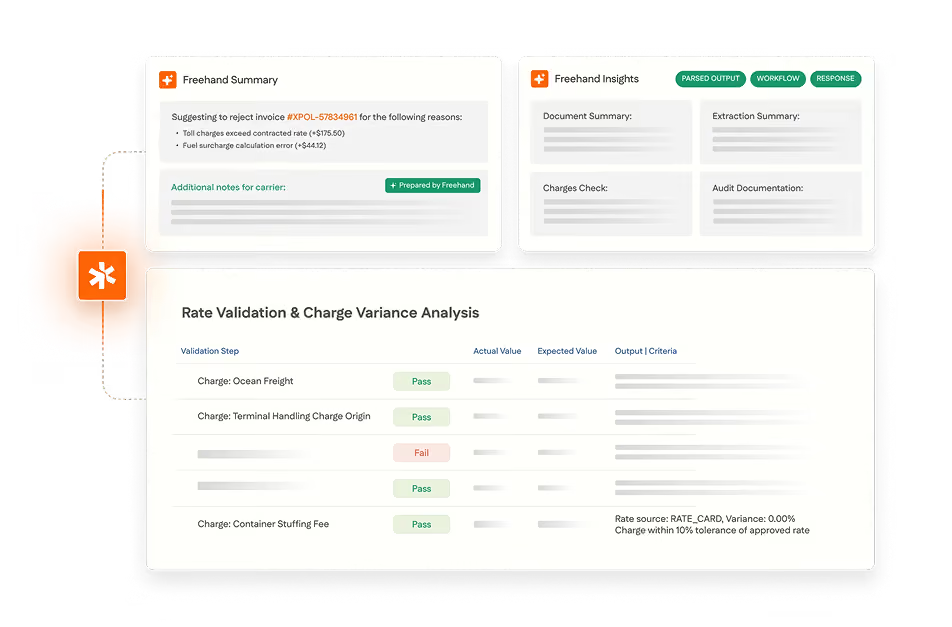
Freehand's invoice audit agent checks every invoice against the current contracted rate at the moment of validation, drawing from a rate reference that updates when a contract or amendment does, closing the exact lag window described above.
What's the cost of a contract-to-AP sync gap?
Industry estimates put billing errors from invoices that don't match the contracted agreement at 3 to 7% of total freight spend, though Freehand's own audited data across live customer invoices puts the recoverable portion, after accounting for existing audit processes, at 1.5 to 2.5%. Either way, the exposure scales directly with how many active carrier contracts a company manages and how frequently they're amended. A shipper running 200+ active carrier contracts with routine mid-term amendments has meaningfully more sync-gap exposure than one running a handful of annual agreements.
{{brown-cta}}
Carrier contract management platforms solve for visibility: knowing what you signed and when it renews. They don't typically solve for whether that contract is actually what your invoices get checked against on any given day. Freehand closes that specific gap, keeping the rate reference current so contract compliance and invoice accuracy stay the same thing instead of two separate systems that drift apart.
Frequently Asked Questions
Is carrier contract management the same as a TMS?
No. A TMS manages shipment execution, routing, and tendering. Carrier contract management specifically covers the negotiation, storage, and terms-tracking of the agreements a TMS then executes against.
How often should carrier contracts sync to the invoice audit system?
Ideally immediately upon signature or amendment. Any delay creates a window where invoices validate against outdated terms, and that window is where billing errors accumulate without triggering an obvious anomaly.
What's the biggest risk in carrier contract management?
The most common risk isn't losing a contract. It's an amendment that's signed and stored correctly but never propagates to the system checking invoices, so the contract is technically "managed" while invoices are still validated against stale terms.
Does carrier contract management cover accessorial charges?
It should. Accessorial schedules are typically part of the base contract or an amendment to it, and they need the same sync discipline as lane rates: current terms need to reach invoice validation the moment they change.
Your Contract Changes. Your Rate Reference Updates With It.
Freehand's invoice audit agent checks every invoice against the current contracted rate at the moment of validation, closing the exact lag window that lets amendments quietly go unenforced.
A Signed Amendment Isn't a Synced Rate.
An 8% lane-rate cut can take a month to reach your invoice audit system. Every shipment on that lane in between validates against the old rate.
Every warehouse. Every provider. Every mile.
Gartner's 2026 outlook on logistics outsourcing, and how AI Teams hold every contract to the terms you agreed.
- Where outsourced logistics quietly loses margin
- Why billed charges drift from the contract
- How AI Teams close the gap