

How to Negotiate Freight Rates: Enterprise Guide
Learn how to negotiate freight rates: prepare with real data, use the levers carriers actually respond to, and make sure the rate you win survives the invoice.
.webp)
August 7, 2026
•
16
mins
Negotiating freight rates means walking into the room with your own shipment data and market benchmarks. Trade real value for real rate cuts: volume commitments, tender acceptance, payment terms. Do not just ask for a lower number. Carriers respond to predictability, not pressure. The rate only means something once it holds on every invoice after you sign it.
Key Takeaways
- Freight rate negotiation sets the base rate, fuel surcharge terms, and accessorial charges with a carrier. It runs on data-backed discussion, not a first quote you just accept.
- Volume commitments of 200 or more shipments a month per carrier are one of the strongest tools you have. A 12-month commitment at that level can secure 4 to 8% off the base rate.
- Carriers respond to prep. Show up with 12 to 18 months of lane-level shipment history and current market benchmarks, and you negotiate from evidence, not guesswork.
- Long-term relationships still matter. A carrier that has run your lanes well for years will move further for you than a stranger with the same volume. Name that history at the table.
- Base rates move the most in a negotiation. Fuel surcharge formulas and accessorials move less, but still matter, since accessorials are where the negotiated rate usually erodes after signature.
- Freehand is freight-audit-first. The rate you negotiate only holds if every invoice is checked against it. That is a different job than winning the negotiation itself.
How much can enterprise shippers actually save by negotiating freight rates well?
Enterprise shippers who negotiate well can save several percentage points off total freight spend. That comes from base rate discounts, fuel surcharge caps, and accessorial waivers combined, on top of whatever the market is already doing.
On $50M in annual freight, even a conservative 4 to 8% base rate concession from a strong volume commitment is $2M to $4M a year. That number is only half the outcome. The other half is whether the rate still applies twelve months later. That depends on what happens after the contract is signed, not during the negotiation itself.
The process below covers preparing for and running the negotiation. The sections after it cover what determines whether the rate actually sticks.
How do you prepare to negotiate freight rates?
You prepare by knowing your own freight data cold and knowing the market before you say a word to a carrier.
Pull 12 to 18 months of shipment history. Break it down by lane, mode, weight, and season. Carriers negotiate seriously with shippers who can show predictable volume, and cautiously with shippers who cannot. Then benchmark your current rates against the market. Freight rate benchmarking tells you whether you are starting from a competitive spot, or negotiating from behind before the talk even starts.
Set three numbers before you start: your target rate, the lowest you would actually accept, and the most you are budgeted for. Without those three, a "walk-away point" is just a feeling, not something you can act on in the room.
Write down your facility specifics too: average dock wait times, loading speed, and any unusual dock rules. A carrier pricing detention risk on a guess will price it high. A carrier working from your real numbers has less reason to.
Timing matters as much as data. Carriers want to lock in reliable volume most during slower freight demand. Start the conversation 60 to 90 days before your contract renewal. That gives both sides room to negotiate instead of rushing to avoid a lapse.
Preparation also means knowing your own accessorial spend as a percentage of total freight cost, since a shipper who cannot answer that question has no basis for negotiating fuel surcharge caps or accessorial waivers later in the same conversation.
How do you run a freight rate negotiation?
You run the negotiation in six steps: pick the right path, open with data, work more than one lever, handle pushback, check the total cost, then lock the terms in writing.
Step 1: Decide between an RFP and a bilateral negotiation
A full RFP fits strategic sourcing events: above roughly $2M in spend, a network redesign, or a lane set you have not priced before. A bilateral renegotiation is faster. It fits a routine renewal where the relationship and lane history already exist.
Step 2: Open with data, then state your target
Show your shipment volume, lane density, and market benchmarks before you name a rate. Then state a specific target backed by that data, not a vague ask for "something lower." A carrier that sees your reasoning has a reason to move. A carrier that only hears a demand does not.
Step 3: Negotiate the levers that actually move, not just the base rate
Base rate discounts respond most to volume commitments and tender acceptance guarantees. Fuel surcharge caps and rate escalator limits respond to contract length. Accessorial waivers respond to a predictable, well-documented freight profile. Tie any volume commitment to an on-time target and a small set of KPIs, so the commitment protects service, not just price. Work more than one lever at once. Do not spend the whole conversation on the base rate alone.
Step 4: Handle counteroffers without collapsing back to the base rate alone
Expect at least one round of pushback. Treat a counteroffer as a signal about which lever the carrier actually cares about, not just a lower number to match. If a carrier resists your base rate ask but moves easily on payment terms or a longer contract, trade there instead. Know your walk-away point going in, so a weak counter has a clear answer instead of a slow drift toward it.
Step 5: Model the total landed cost before you agree
Add up the full cost: base rate plus fuel plus accessorials plus payment terms, not the headline number alone. A lower base rate paired with an uncapped fuel formula or vague accessorial language can cost more over a year than a slightly higher rate with clean terms.
Step 6: Review and lock the terms into the contract language, not a verbal understanding
Before signing, review the accessorial definitions and the rate. Then check the fine print most shippers skip: liability limits, the force majeure definition, and the specific performance targets tied to your KPIs. A clean rate paired with vague liability or service language creates the same problem later. Write the rate escalator cap, the accessorial definitions, and the fuel surcharge formula into the signed agreement in plain, specific language. A term that lives only in your negotiation notes is not a term the carrier has to honor.
{{blue-cta}}
What can you actually negotiate on a freight rate?
Not every part of a freight rate moves the same amount. The base rate is the most negotiable of the six components most shippers can put on the table.
| Rate component | How negotiable | What moves it |
|---|---|---|
| Base rate | Most negotiable, especially for LTL | Volume commitments and consistent lane density |
| Fuel surcharge formula | The formula itself is fixed; the cap is negotiable | Large, predictable volume that limits the carrier's fuel exposure |
| Accessorial charges | Partially negotiable | Waivers or clearer definitions for well-documented freight profiles |
| Rate escalator on renewal | Negotiable as a capped percentage | Tying the cap to CPI or a fixed number instead of an open-ended increase |
| Service KPIs and on-time guarantees | Negotiable alongside volume commitments | Tying a specific on-time percentage to the rate you are offering |
| Payment terms | Negotiable in both directions | Paying inside 15 days instead of 45 can be worth 1 to 3% off the rate |
The mistake most shippers make is spending the whole negotiation on the base rate and treating the rest as fixed. Carriers know this. It is exactly why fuel formulas and accessorial language are where negotiated savings quietly disappear later.
What mistakes cost shippers the rate they thought they negotiated?
The mistakes that undo a negotiation almost never happen at the negotiating table.
They happen in what gets left out of the contract, or in what never gets checked again after the contract is signed.
- Accepting the headline rate without modeling total cost. A lower base rate with an uncapped fuel formula can cost more over a year than a higher rate with clean terms.
- Leaving accessorial terms vague. Undefined language on detention, liftgate, or residential delivery gives the carrier room to bill its own interpretation once freight starts moving.
- Treating the signed contract as the finish line. The negotiated rate is a target, not a guarantee, until something checks that invoices actually match it.
- Renegotiating from a cold start every cycle. Shippers who never track how the last negotiated rate held up have no evidence for the next one beyond a fresh set of guesses.
That last mistake is the quiet one. A negotiation that isn't followed by verification produces the same blind spot again at the next renewal.
A negotiated rate is a target until your invoices prove it
Winning a good rate at the table is half the outcome. The other half happens invoice by invoice, for the next twelve to twenty-four months, and that is where most negotiated savings quietly leak away.
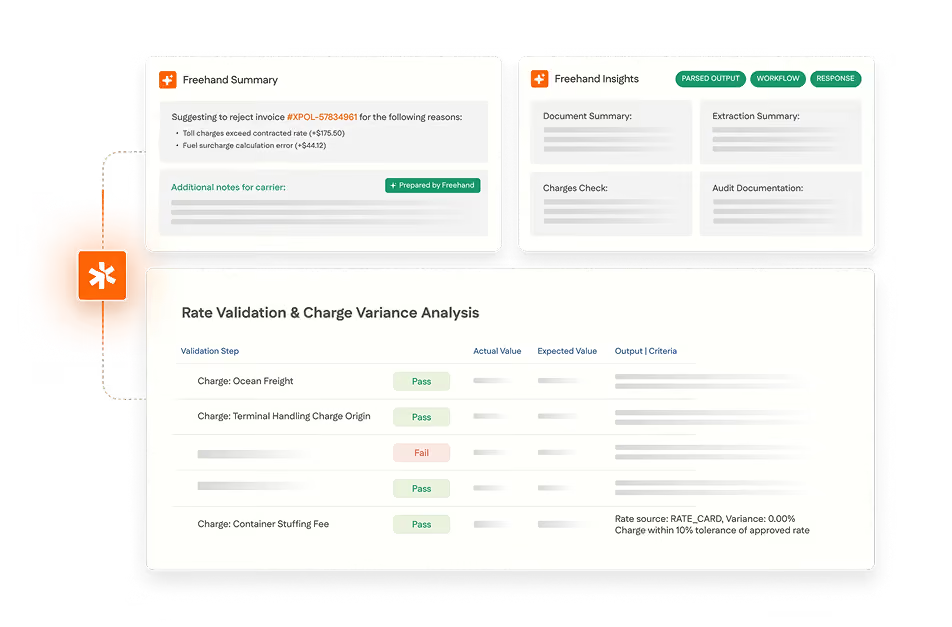
Freehand is freight-audit-first. Once you negotiate a rate, Freehand's AI Teams check every carrier invoice against it, catch the accessorial drift and fuel surcharge creep that erode what you won at the table, and resolve the exception before payment goes out. The negotiation sets the target. The audit is what makes it real.
{{brown-cta}}
Frequently Asked Questions
How do you negotiate freight rates with carriers?
Prepare with 12 to 18 months of shipment data and current market benchmarks. Choose between a full RFP or a bilateral renegotiation. Present your data before naming a target rate, and negotiate multiple levers together: base rate, fuel surcharge caps, accessorial waivers, payment terms.
What is the most negotiable part of a freight rate?
The base rate is usually the most negotiable part, especially for LTL shipments. It responds most to volume commitments and tender acceptance guarantees. Fuel surcharge caps and accessorial waivers move less, but still matter over the life of the contract.
How much volume do you need to negotiate a better freight rate?
There is no fixed minimum. Volume commitments around 200 or more shipments a month per carrier create real strength, and a 12-month commitment at that level can secure 4 to 8% off the base rate. Smaller, less steady volume still has some pull, just less of it.
Should you use an RFP or negotiate directly with your current carrier?
Use a full RFP for bigger or more strategic sourcing decisions, generally above roughly $2M in spend or a new lane set. A direct, bilateral renegotiation fits a routine renewal, where the relationship and lane history already exist.
How do you make sure a negotiated freight rate actually holds after you sign?
Negotiating the rate and enforcing it are two different jobs. Auditing every invoice against the exact rate and terms you negotiated is what catches the accessorial drift and fuel surcharge creep that erode a rate after the contract is signed.
How do you negotiate LTL freight rates specifically?
LTL rates are quoted as a discount off a base tariff, not a flat number. Negotiate the discount percentage and the minimum charge, not just the headline rate. Base rate discounts are usually the most negotiable part of an LTL rate, and steady volume on specific lanes earns a deeper discount.
How do you politely negotiate a lower freight rate?
Lead with your shipment data and market benchmarks, not a flat demand. Frame the talk as finding a rate that works for both sides, not just pushing for the lowest number. Carriers move further for a shipper who explains the reasoning than one who only states a target.
What is the 70/30 rule in negotiation?
The 70/30 rule means spending about 70% of the talk listening and asking questions, and 30% talking. In a freight negotiation, that means you learn a carrier's capacity and cost pressures before you present your target rate. Carriers give more to a shipper who understands their constraints.
What are the 5 C's of negotiation?
The 5 C's, clarity, communication, collaboration, compromise, and creativity, describe the mindset behind a good negotiation. In freight, that means knowing your target rate before you start, and trading on levers beyond the base rate to reach a deal that actually holds.
The Negotiation Sets the Target. The Audit Makes It Real.
Freehand checks every carrier invoice against the exact rate and terms you negotiated, so accessorial drift and fuel surcharge creep get caught before they erode what you won.
You Won the Rate at the Table. The Invoice Doesn't Know That.
Accessorial language and fuel surcharge formulas are where a negotiated rate quietly erodes after signature, not at the negotiation itself.
Every warehouse. Every provider. Every mile.
Gartner's 2026 outlook on logistics outsourcing, and how AI Teams hold every contract to the terms you agreed.
- Where outsourced logistics quietly loses margin
- Why billed charges drift from the contract
- How AI Teams close the gap