

How to Run a Freight RFP: Step-by-Step Guide
Learn how to run a freight RFP: build the data package, invite the right carriers, score bids objectively, and make sure the rates you win actually hold.
.webp)
August 6, 2026
•
15
mins
Running a freight RFP means defining your lane and volume needs, building a clean data package, inviting a focused set of qualified carriers, scoring bids against weighted criteria set in advance, and awarding lanes on service and price together. Done well, it takes 60 to 90 days from launch to signed contract. Done poorly, the rates you win never survive contact with your first invoice.
Key Takeaways
- A freight RFP (request for proposal) is a formal sourcing event. A shipper asks carriers to bid on rates and service terms for defined lanes, using standard data so responses can be compared side by side.
- Response quality drops sharply past 10 to 12 invited carriers per mode. Providers who know their odds are poor stop bidding seriously.
- Build your scoring criteria before proposals arrive, not after. Otherwise the evaluation becomes a negotiation, not a comparison.
- A negotiated rate is not a paid rate. Accessorials, fuel surcharge formulas, and reclasses drift off the contract the moment freight starts moving, and most audit programs only catch a sample of it.
- Freehand is freight-audit-first. The discipline that protects an RFP's savings is auditing every invoice against the exact rates the RFP produced, not running the sourcing event itself.
Why does how you run your freight RFP determine whether the savings stick?
A poorly scoped or poorly enforced RFP produces rates on paper that never show up on an invoice. The event itself is only half the outcome.
Two separate failures erode an RFP's value, and most shippers only guard against one. The first is a process failure: vague scope, too many or too few carriers, an evaluation that weighs price alone and ignores service risk. The second is an enforcement failure: the rates get negotiated and signed, but nothing downstream checks that carriers actually bill at them. Industry patterns put this second failure at 2 to 5% of negotiated freight savings lost in the first year, quietly, through accessorials and reclasses that were never part of the deal.
The steps below solve the first failure. The sections after them address the second, since a rate that isn't enforced was never really won.
How do you run a freight RFP?
You run a freight RFP in six steps: define objectives and scope, build a clean data package, invite a focused carrier pool, distribute the RFP with a fixed response window, score bids against pre-set criteria, and award lanes before moving to implementation. This is the sequence enterprise shippers follow for annual or biannual sourcing events.
Step 1: Confirm you need an RFP, not an RFQ, then define objectives and scope
If your lanes are well-defined, your specs are not changing, and the decision is really just price, an RFQ (request for quote) gets you there faster than a full RFP. Run the RFP when the sourcing event is strategic: new lane sets, a network redesign, or a decision that depends on more than the lowest bid.
Once you have confirmed the RFP is the right tool, decide what success looks like before anything goes to a carrier: lowest market cost, deeper density on core carriers, more drop-trailer capacity, or a mix. Pull logistics, procurement, and finance into this step together. Each stakeholder optimizes for something different, and a scope built by one team alone gets contested later. Procurement leaders tend to weight cost more heavily than the operators who live with the service tradeoffs day to day.
Step 2: Build the data package
Assemble at least three months of shipment history by lane, including origin, destination, weight, mode, and current accessorial usage. Carriers price accurately only when the data is accurate, and thin or stale history produces bids that fall apart once real volume starts moving.
Step 3: Select and invite carriers
Target 10 to 12 carriers per mode: enough for real competitive tension, few enough that every response gets serious attention. Include your incumbents so they can defend their business, but bring in genuine new competition rather than filling the list with providers who cannot actually run your lanes.
Step 4: Distribute the RFP and manage the Q&A window
Send the RFP to every invited carrier at the same time, with a two- to four-week response window and a fixed date for questions. A staggered release or an open-ended Q&A period lets some carriers price with more information than others, which quietly breaks the comparison.
Step 5: Score bids against criteria set before you saw them
Apply the weighted scoring you defined in Step 1, typically cost at 40 to 50%, service and capability at 30 to 40%, and risk or technology fit at the remainder. A bid that looks cheapest on the base rate alone can still be the wrong award if its service history or accessorial language is a liability.
Step 6: Award and move into implementation
Confirm awards, load the new rates into your TMS and routing guide, and communicate the transition timeline to both winning and losing carriers. The RFP is not finished at the signature. It is finished when the contracted rate is the rate that appears on an invoice.
{{blue-cta}}
How many carriers should you invite to a freight RFP?
You should invite 10 to 12 carriers per mode for most enterprise lane sets. Beyond that range, response quality drops because carriers can tell their odds of winning are thin and stop putting real pricing effort into the bid.
The right number also depends on mode. LTL RFPs typically run tighter, around 4 to 6 carriers per region, since LTL networks are already concentrated. Truckload RFPs support the fuller 10 to 12 range because there are more qualified providers capable of running most lanes.
How long does a freight RFP take?
A full freight RFP typically takes 60 to 90 days from launch to signed, implemented contract. The table below breaks down where that time actually goes.
| Phase | Typical duration | What happens |
|---|---|---|
| Scope and data preparation | 1 to 3 weeks | Objectives set, shipment history compiled, RFP document built |
| Carrier response window | 2 to 4 weeks | Carriers price the lanes; Q&A period runs in parallel |
| Scoring and evaluation | 1 to 2 weeks | Bids compared against pre-set weighted criteria |
| Negotiation and award | 1 to 2 weeks | Final terms confirmed with winning carriers |
| Implementation | 2 to 4 weeks | Rates loaded into TMS and routing guide, carriers transitioned |
Running the process faster than this usually means a step got skipped, most often the data package or the Q&A window, and that shortfall shows up later as disputes over what was actually agreed to.
How do you build a freight RFP scoring template?
Weight cost, service capability, and risk before a single bid arrives. Then score every carrier against the same fixed categories. A standard enterprise starting point splits weight four ways:
- Base rate and pricing structure, 40 to 50%: cost per lane, the fuel surcharge formula, and the accessorial rate card.
- Service and capability, 30 to 40%: on-time performance history, equipment availability, and network fit for your lanes.
- Risk and financial stability, 10 to 15%: insurance coverage, claims history, and financial health.
- Technology and reporting, 5 to 10%: EDI capability, visibility tools, and integration with your TMS.
A carrier scoring highest on price alone but lowest on service risk can still be the right award. The scoring template exists to force that tradeoff into view, not let the lowest number win by default.
What mistakes turn a freight RFP into next year's billing dispute?
The mistakes that turn an RFP into a dispute are almost all mistakes of vagueness. Unclear accessorial terms. Rate formats that are not standard. Rates accepted with no question about why they sit so far below market. Each one looks like a win at signature and a problem twelve months later.
- Vague accessorial language in the contract. Carriers bill their own read of "detention" or "liftgate" once freight starts moving.
- Non-standardized bid formats. Rates that looked comparable at award turn out to hide different fuel surcharge assumptions.
- Rates well below market with no explanation. Often a sign the carrier cannot sustain the price, and will make it up in accessorials or service cuts.
- No plan to check billed rates against awarded rates. The negotiated savings exist only on the award letter, never on the invoice.
That last one is the mistake enterprise shippers skip most. It is also the one that decides whether the other three ever get caught before they add up.
What does a freight RFP that actually holds look like?
A freight RFP that holds is one where the awarded rate and the billed rate stay the same lane after lane, invoice after invoice. The table below separates a sourcing event that produced paper savings from one that produced real ones.
| Metric | Paper savings | Real savings |
|---|---|---|
| Rate accuracy on invoice | Billed rate drifts from awarded rate within months | Every invoice checked against the exact awarded rate |
| Accessorial enforcement | Contract language exists but nothing checks it at billing | Every accessorial validated against the RFP's rate card |
| Visibility into erosion | Savings tracked once at signature, not after | Savings tracked continuously against actual billing |
| Next RFP cycle | Starts from the same unverified assumptions | Starts from real billing data, including where the last RFP leaked |
An RFP is a pricing exercise. What happens for the next twelve to twenty-four months of invoices is what actually determines whether the sourcing event was worth running.
Frequently Asked Questions
How do you run a freight RFP?
Define your objectives and scope. Build a clean data package from at least three months of shipment history. Invite 10 to 12 qualified carriers per mode, distribute the RFP with a fixed response window, score bids against criteria set before proposals arrive, and award lanes before moving into implementation.
What is the difference between a freight RFP and an RFQ?
An RFQ (request for quote) asks for a price on defined lanes, with little negotiation. It fits a stable, cost-driven decision like a renewal. An RFP (request for proposal) asks for pricing plus service and approach. It fits bigger events, like a network redesign, where price alone will not name the right carrier.
How many carriers should you invite to a freight RFP?
Invite 10 to 12 carriers per mode for truckload. LTL RFPs run tighter, around 4 to 6 per region. Beyond that range, response quality drops, since carriers who sense long odds stop pricing seriously.
How long does a freight RFP take from start to signed contract?
Most enterprise freight RFPs take 60 to 90 days from launch to a signed, implemented contract. That covers scope and data prep, the carrier response window, scoring, negotiation, and implementation.
How do you make sure the rates you win in an RFP actually get billed correctly?
Winning the rate and enforcing it are different problems. Auditing every invoice against the exact rates and terms the RFP produced is what stops negotiated savings from eroding through accessorials, reclasses, and fuel surcharge drift after signing.
An RFP only wins what your invoices actually enforce
A strong RFP process gets you a good rate on paper. It does not get you that rate on every invoice for the next two years. The gap between the two is where negotiated savings quietly disappear.
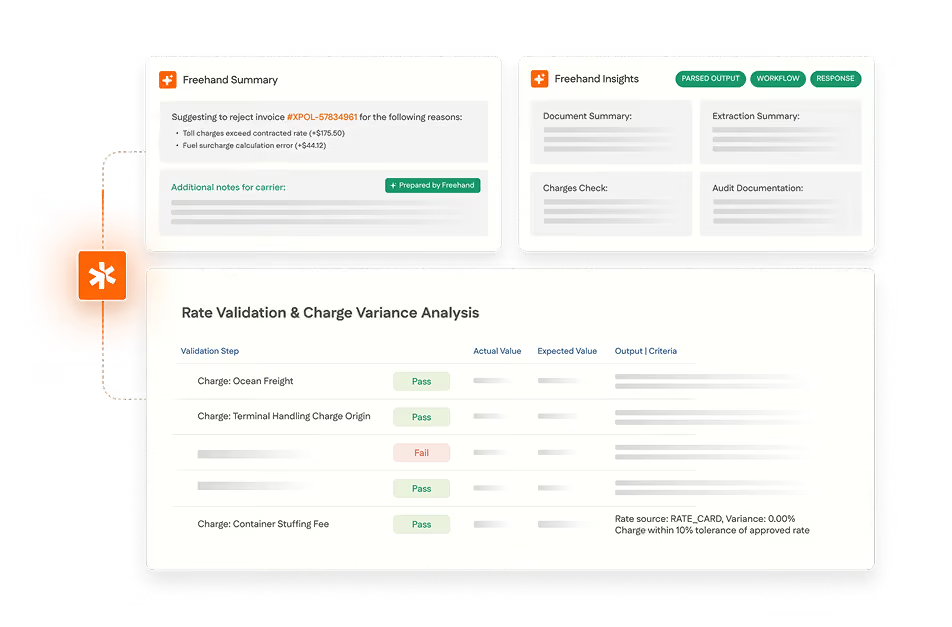
Freehand is freight-audit-first, a direction the freight audit and payment category is moving toward broadly. Once your RFP sets a rate, Freehand's AI Teams check every carrier invoice against it. They catch the accessorial drift and reclasses that erode procurement wins, and resolve the exception before payment goes out. The sourcing event does the negotiating. The audit is what makes the negotiation stick.
{{brown-cta}}
Every Award Held to the Rate Carriers Actually Bid.
Freehand checks every invoice against your RFP-negotiated rates, so the savings you scored in sourcing survive contact with the first invoice.
The RFP Sets the Rate. It Doesn't Enforce It.
A carrier that bid clean in the RFP still reclasses shipments and drifts fuel surcharges the moment freight starts moving.
Every warehouse. Every provider. Every mile.
Gartner's 2026 outlook on logistics outsourcing, and how AI Teams hold every contract to the terms you agreed.
- Where outsourced logistics quietly loses margin
- Why billed charges drift from the contract
- How AI Teams close the gap