

How to Reduce DSO in Logistics: A Step-by-Step Plan
Reduce DSO in logistics by fixing billing accuracy before collections. See where to start, the right sequence, and 6 steps that actually move it.
.webp)
August 10, 2026
•
14
mins

To reduce DSO in logistics, start by measuring your clean invoice rate, not your collections effort. Most DSO problems in logistics AR are billing-accuracy problems wearing a collections costume. A customer short-pays because something on the invoice was actually wrong, not because they're refusing to pay.
Fix that first. Chasing DSO directly, before fixing what's generating the disputes, rarely moves the number.
Key Takeaways
- DSO in logistics rarely improves through collections pressure alone. Most of what ages AR is unresolved disputes and short-pays, not customers who simply won't pay.
- The right sequence matters more than any single tactic: fix billing accuracy first, then dispute classification, then collections prioritization. Reversing that order wastes effort on the smallest lever.
- A logistics provider moving from a 60% to an 85% clean invoice rate on 4,000 monthly invoices eliminates roughly 1,000 dispute incidents a month. None of those ever touch collections.
- Not every short-pay deserves the same response. Treating a $150 billing error the same as a $150 unjustified deduction wastes the recovery window on both.
- Freehand's AI Teams validate invoices before they ship, and classify short-pays the moment they land. Your AR team ends up working only the disputes that are actually worth working.
- The process in seven steps: measure your baseline, generate and send invoices on delivery, fix pre-send invoice validation, build a short-pay classification workflow, set a resolution deadline on every dispute, prioritize collections by profitability, re-measure the same metrics.
Where do you actually start reducing DSO in logistics?
You start by measuring three numbers, not by calling customers with old balances. DSO itself moves slowly, and lags behind whatever you actually fix. That makes it the wrong first thing to watch.
| Metric | What it tells you | Why it comes first |
|---|---|---|
| Clean invoice rate | Share of invoices paid in full with no dispute | Shows how much of your DSO problem starts at billing, not collections |
| Short-pay rate | Share of invoices paid short | Shows how much revenue is sitting in unresolved deductions right now |
| Dispute resolution cycle time | Average days from short-pay to resolution | Shows whether disputes are aging past the point they still recover well |
A provider with a low clean invoice rate and a high short-pay rate has a billing problem, not a collections problem. That's true no matter what the aging report shows. Fixing collections first, in that situation, is effort spent on the wrong end of the pipeline.
How do you reduce DSO in logistics step by step?
You reduce it by fixing billing accuracy before you touch collections. Then work the disputes that are actually worth working. Each step depends on the one before it being in place.
Step 1: Measure your baseline before changing anything
Pull clean invoice rate, short-pay rate, and dispute resolution cycle time for the last full quarter. Without a baseline, you can't tell whether a fix actually worked or whether the number moved for an unrelated reason.
Step 2: Generate and send the invoice the moment delivery is confirmed
Batch invoicing sends bills out on a fixed weekly or biweekly run, instead of the day a shipment delivers. That adds days to DSO before the customer even sees an invoice. Trigger invoice generation the moment a signed POD or bill of lading comes in, not on the next scheduled run.
Step 3: Fix pre-send invoice validation
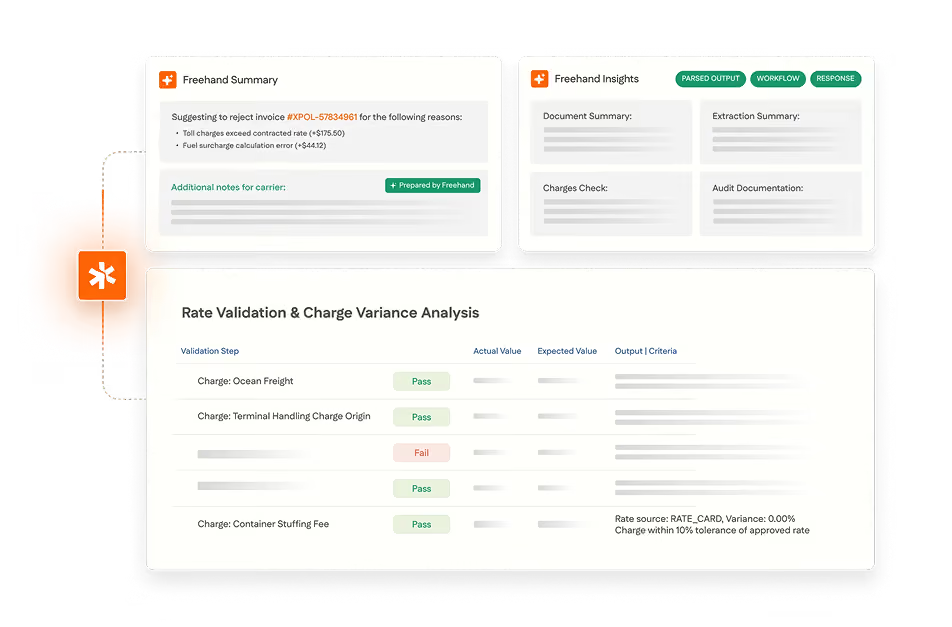
Check every invoice line against the contracted rate, the fuel surcharge tier, the purchase order, and the shipment record, before it goes to the customer. A billing error caught before dispatch never becomes a dispute, a short-pay, or a DSO problem. Keeping shipment, PO, and invoice data in one place instead of three makes that check faster to run.
Step 4: Build a short-pay classification workflow
When a short-pay lands, classify it immediately as a valid billing error or an unjustified deduction. A valid error gets credited fast. An unjustified deduction gets a contestation packet: the contract, the applicable rate, and proof the service happened as billed.
Step 5: Set a resolution deadline on every open dispute
Give every classified short-pay a deadline, not an open-ended queue. Disputes resolved within 30 days recover at meaningfully higher rates than disputes still open past 60.
Step 6: Prioritize collections by customer profitability, not balance size
Run cost-to-serve by customer and lane before deciding which short-pays get aggressive follow-up. A low-margin customer short-paying a large balance may not be worth the relationship friction. Recovering it in full could cost more than it's worth.
Step 7: Re-measure the same three metrics
Check clean invoice rate, short-pay rate, and resolution cycle time again before assuming DSO has moved. Those three numbers improve first. DSO follows, usually a full billing cycle or two behind.
{{blue-cta}}Which lever actually moves DSO fastest?
Pre-send validation moves DSO fastest and most durably. It prevents the dispute instead of racing to resolve it after the fact. Collections effort, applied on its own, has a lower ceiling.
| Lever | Time to impact | Why |
|---|---|---|
| Pre-send validation | Fast, compounds every billing cycle | Prevents disputes before they exist, instead of resolving them after |
| Short-pay classification | Fast, immediate on existing backlog | Recovers revenue already sitting in unresolved deductions |
| Collections prioritization | Moderate | Redirects effort to where recovery is actually worth pursuing |
| Payment term renegotiation | Slow, and often not available | Changes the target DSO number, not the disputes causing the gap |
Renegotiating payment terms looks like the direct fix, since it changes the number DSO is measured against. It does nothing about the disputes generating short-pays in the first place. That's why it's the weakest lever on this list, not the strongest.
For the underlying mechanics of why logistics billing disputes run higher than standard AR, see our guide to logistics accounts receivable.
Does credit policy affect DSO too?
Yes, and it sits upstream of every lever above. A billing-accuracy fix can't offset a customer you never should have extended terms to in the first place.
Run a formal credit check before accepting loads from a new shipper or consignee, not after the first invoice goes unpaid. Standardize payment terms to a default like Net 30, instead of letting Net 60 or Net 90 agreements get approved ad hoc. Inconsistent terms turn your own DSO target into a moving number. An early-payment discount, a small percentage off for paying within 10 days, can pull reliable customers' payments forward. That trades margin for speed, so it's worth running the math before offering it broadly.
What mistakes stall a DSO reduction effort?
Most stalled efforts skip the diagnostic step and go straight to the tactic that feels most like progress.
- Adding collections headcount before fixing billing accuracy. More people working a dispute queue doesn't shrink it. Invoices that keep generating new disputes at the same rate just refill the queue.
- Treating every short-pay the same. A billing error and an unjustified deduction need different responses. Running both through one generic process slows down both.
- Letting disputes sit with no deadline. An open-ended queue is how a recoverable short-pay becomes a write-off nobody decided to accept.
- Watching DSO instead of the metrics that move first. DSO lags clean invoice rate and short-pay rate by a billing cycle or more. Judging a fix by DSO alone makes it look like nothing worked for weeks. Something did work, DSO just hasn't caught up yet.
How do you keep DSO down once it's improved?
You keep it down by running pre-send validation and short-pay classification as standing processes, not a one-time cleanup. Invoice accuracy and dispute handling degrade quietly if nothing keeps checking them. DSO drifts back up before anyone notices why.
Freehand's AI Teams validate every invoice against your contracted rates and shipment records before it reaches the customer. They classify every short-pay the moment it lands. Your AR team spends its time on the disputes actually worth working, not the ones a validation check would have caught.
Want a side-by-side look at platforms handling this? Our roundup of the best accounts receivable automation software breaks down how the leading options compare. Freehand's logistics spend platform connects that validation to the same billing, collections, and cost-to-serve data covered in our guide to logistics AR.
{{brown-cta}}
Frequently Asked Questions
How long does it take to see DSO improve after fixing invoice accuracy?
Clean invoice rate and short-pay rate improve within a billing cycle or two. DSO itself typically lags a cycle or more behind. It's measuring invoices that were already in the pipeline before the fix took effect.
Should you fix billing accuracy or add collections staff first?
Fix billing accuracy first. Adding collections effort on top of a high dispute rate means working an ever-refilling queue instead of shrinking it. New billing errors keep generating new disputes at the same pace.
Does reducing DSO in logistics require renegotiating payment terms?
No, and it's usually the wrong lever to reach for first. Renegotiated terms change the number DSO is measured against. They don't touch the disputes and short-pays actually driving the gap between your terms and your real collection time.
What's the fastest lever to reduce DSO in logistics?
Pre-send invoice validation, since it prevents disputes before they exist rather than resolving them afterward. Short-pay classification is a close second, since it recovers revenue already sitting in your current backlog.
How do you know if a DSO reduction effort is actually working?
Watch clean invoice rate, short-pay rate, and dispute resolution cycle time before you watch DSO. Those three move first, and a DSO number that hasn't shifted yet doesn't mean the fix failed.
Is a high short-pay rate always a bad sign?
Not by itself. A high short-pay rate with a high recovery rate is a managed process. A high short-pay rate with a low recovery rate is a collections gap. The two numbers together tell you which one you have.
Does a self-service payment portal help reduce DSO?
Yes, when the friction is on the customer's side, not yours. A portal where a shipper's AP team can view paperwork, pull PODs, and pay by ACH or card removes a lot of that friction. It cuts out the back-and-forth email requests that otherwise stall payment past the due date.
Should you send payment reminders before the due date, not just after?
Yes. A reminder a few days before the due date catches problems while there's still time to fix them before the invoice goes late. Waiting until after the due date means you're already managing a late payment instead of preventing one.
Every Deduction Classified the Day It Lands, Not the Quarter You Write It Off.
Freehand codes every short-pay to its real cause and routes it for resolution immediately, so DSO reflects what's actually still collectible.
A Short-Pay That Never Gets Classified Looks Like a Bad Debt.
It isn't. It's a dispute nobody resolved, sitting on your AR aging as if it were uncollectible.
Every warehouse. Every provider. Every mile.
Gartner's 2026 outlook on logistics outsourcing, and how AI Teams hold every contract to the terms you agreed.
- Where outsourced logistics quietly loses margin
- Why billed charges drift from the contract
- How AI Teams close the gap