

Procurement Savings Tracking: Why Negotiated Savings Erode
Procurement savings tracking usually stops at contract signing. See why negotiated freight savings erode after that, and how to track what's actually billed.
.webp)
August 25, 2026
•
14
mins
Procurement savings tracking is the practice of measuring the financial impact of sourcing and negotiation activity, usually split into hard savings (a measurable price reduction) and cost avoidance (a future cost that didn't happen). Most tracking stops at the moment a contract is signed. For freight specifically, that's the wrong stopping point: the savings negotiated at signing and the savings actually billed are rarely the same number.
Key Takeaways
- Procurement savings tracking is the measurement of financial impact from sourcing activity, categorized as hard savings (realized price reduction), cost avoidance (a future cost prevented), or soft savings (harder-to-quantify risk and efficiency gains).
- Hard savings are the easiest category to track, calculated as the difference between an old price and a newly negotiated one, but that calculation is a snapshot taken once, at signing.
- For freight specifically, the negotiated rate and the billed rate diverge over a contract's life through amendments, accessorial creep, and carrier billing errors, none of which the signing-day savings number captures.
- Contracted-versus-billed rate variance and overcharge recovery rate are the two metrics that show where realized freight savings actually fall short of what was projected at contract award.
- Tracking savings only at the point of negotiation, without a mechanism to check it against ongoing billing, means a procurement team can report a savings win that's already partially eroded by the time the report goes out.
What is procurement savings tracking?
Procurement savings tracking is how a procurement or sourcing team measures and reports the dollar impact of its activity, most commonly split into three categories. Hard savings are a direct, measurable reduction in what you pay, the difference between a prior price and a newly negotiated one. Cost avoidance is a future cost that didn't materialize, a price increase that was successfully resisted, or a fee that was negotiated out of a contract before it applied. Soft savings cover harder-to-quantify gains like reduced risk or process efficiency.
The mechanism most teams use for hard savings, the category with the clearest dollar figure, is a straightforward before-and-after comparison at the point of negotiation: old rate minus new rate, multiplied by projected volume, equals the reported saving.
In business terms, procurement savings tracking exists to answer a CFO's question: what did sourcing actually deliver this year. The honest answer requires checking that the negotiated number and the realized number are still the same thing months later, which is where most tracking frameworks stop looking.
What are the types of procurement savings?
Procurement savings split into three types: hard savings, cost avoidance, and soft savings, each answering a different question about what sourcing actually delivered.
| Type | Definition | How it's tracked |
|---|---|---|
| Hard savings | A direct, measurable reduction in what you currently pay | Old price minus new price, multiplied by volume; the clearest dollar figure |
| Cost avoidance | A future cost that didn't materialize (a resisted price increase, a fee negotiated away) | Estimated against a projected cost that never occurred, which is inherently harder to verify |
| Soft savings | Harder-to-quantify gains like reduced risk or process efficiency | Usually qualitative, or tied to a proxy metric like cycle time |
How do you calculate cost savings in procurement?
Hard savings use a straightforward formula:
A 6% rate cut on $2M in spend projects to $120,000 in hard savings, for example.
Cost avoidance doesn't have an equivalent clean formula, since it measures something that didn't happen. The common approach estimates what the cost would have been without the negotiated protection (a resisted price increase, a fee waived before it applied) and reports the difference as the avoided cost. Because that baseline is an estimate rather than an observed price, cost avoidance figures carry more room for disagreement than hard savings.
What are the crucial concepts in tracking cost savings?
Four concepts determine whether a savings figure is trustworthy: baseline, realization rate, validation, and savings leakage.
- Baseline: the price or cost you're measuring the reduction against. A baseline set too high inflates every savings figure calculated from it.
- Realization rate: the share of projected savings that actually shows up in what gets billed, which is the entire concept this article is built around for freight specifically.
- Validation: confirming a reported saving against actual spend data rather than accepting the signing-day projection as final.
- Savings leakage: the gap between projected and realized savings, whatever its source, that goes undetected without ongoing validation.
What are the benefits of tracking procurement savings accurately?
Accurate tracking gives procurement a defensible answer to the one question every stakeholder eventually asks: did the negotiated deal actually hold. It also establishes a baseline for measuring future initiatives, gives finance real spend visibility instead of a once-a-year estimate, and lets a team benchmark this year's negotiation against last year's rather than guessing.
For freight specifically, that benefit compounds. Because freight terms change mid-contract more often than most procurement categories (accessorial amendments, fuel surcharge base updates, lane-specific rate shifts), a savings figure that's only accurate at signing goes stale faster here than almost anywhere else in procurement.
How do you track procurement savings?
Tracking procurement savings well comes down to four steps: label by category, centralize the data, benchmark against projection, and re-verify on a fixed cadence.
Step 1: Label savings by category, not as one blended number
Hard savings, cost avoidance, and soft savings answer different questions; reporting them separately lets a CFO judge each on its own terms instead of one number that hides which type actually moved.
Step 2: Centralize savings data in one system procurement and finance both use
A savings figure tracked in a spreadsheet separate from the system checking actual invoices is exactly the setup that lets erosion go unnoticed.
Step 3: Benchmark realized savings against projected savings, not just against last year
A negotiation that beat last year's rate can still be underperforming its own signing-day projection if billing hasn't been checked against it.
Step 4: Re-verify savings against actual billing on a fixed cadence, not just at renewal
Waiting until the next contract cycle to check whether last year's savings held means a full contract term of undetected erosion.
Why does tracking savings only at signing actually cost you money?
A savings figure calculated at contract signing is a projection, not a result. It assumes the negotiated rate holds for the life of the contract and that every invoice bills against it correctly. Neither assumption is safe for freight specifically.
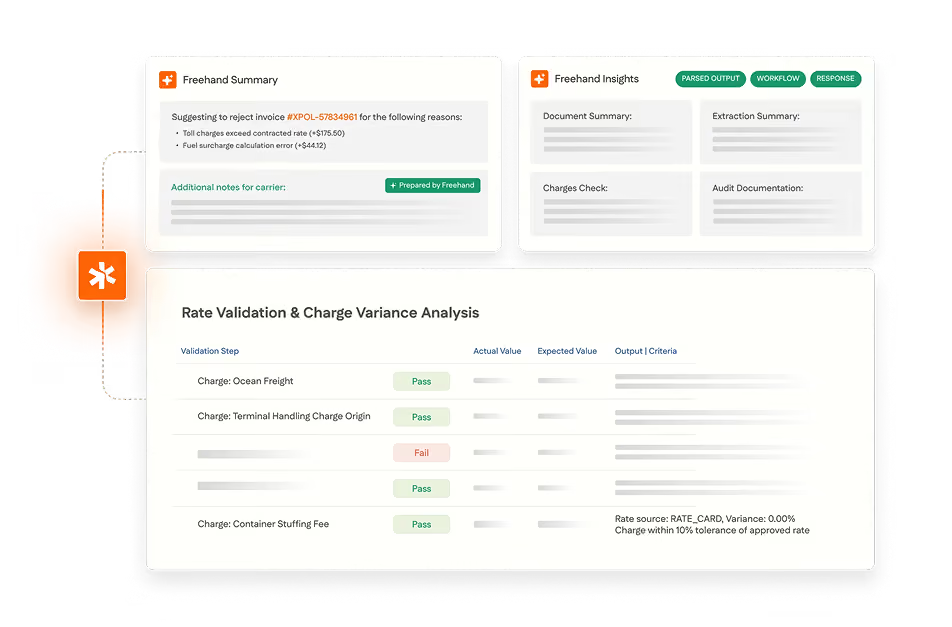
Freight procurement already documents the mechanism behind this: the window between contract signing and rate card update in the AP validation layer is where negotiated savings evaporate. If an awarded rate isn't reflected everywhere invoices get checked, some portion of invoices in that window bill against the old, higher rate, and the savings reported at signing were never fully realized.
How do negotiated savings and billed reality diverge over a contract's life?
Four separate erosion sources chip away at a savings figure after the contract is signed, and none of them show up in the signing-day number.
| Erosion source | What happens | Effect on the reported savings figure |
|---|---|---|
| Rate card sync lag | New contracted rate takes weeks to reach the invoice validation system | Invoices in that window bill at the old rate, savings overstated |
| Accessorial schedule amendments | Mid-contract changes to fuel, detention, or surcharge terms | Savings calculated on the base rate alone miss accessorial-side erosion |
| Carrier billing errors | Invoice doesn't match the contracted rate regardless of amendments | Realized savings understated by whatever the error rate adds back |
| No ongoing variance check | Savings reported once at signing, never re-measured against actual billing | The gap between projected and realized savings goes undetected |
What are other roadblocks to realizing expected savings?
The erosion sources above are specific to freight; procurement categories in general run into a few additional roadblocks. An inflated or outdated baseline overstates every savings figure calculated against it, regardless of category. Maverick spend, purchases made outside the negotiated agreement, means the negotiated rate never applied to that spend in the first place. Stakeholder non-compliance with a new contract (defaulting to a familiar but non-preferred vendor) has the same effect. And a one-time saving sometimes gets counted as if it recurs every year, overstating cumulative savings in later reporting periods.
What metrics actually show whether procurement savings held up?
The signing-day calculation answers "what did we negotiate." Two additional metrics answer "did it hold": contracted-versus-billed rate variance, tracked by carrier and lane, and overcharge recovery rate, the share of billing errors caught and corrected before payment. How to run a freight RFP frames this as a visibility gap between models: savings tracked once at signature versus savings tracked continuously against actual billing.
Worked example
A procurement team negotiates a 6% rate reduction on a lane carrying $2M in annual freight spend, reporting $120,000 in projected hard savings at signing. Over the following year, contracted-versus-billed variance tracking finds that 4% of invoices on that lane billed at a rate higher than the new contract, an $18,000 gap between projected and realized savings on that lane alone. Without ongoing variance tracking, that $18,000 shows up nowhere. The signing-day savings report still says $120,000, and no one checks it again.
Freehand's invoice audit agent checks every invoice against the current contracted rate continuously, which is what turns contracted-versus-billed variance from an annual audit exercise into a number a procurement or finance team can monitor in real time.
What's the actual cost of tracking savings only at signing?
Freight billing errors across the industry run 1.5-2.5% of total freight spend on audited invoice data. Applied against a negotiated savings figure, that range represents the portion of a reported win that's plausibly already eroded by the time the savings gets reported, before accounting for rate card sync lag or accessorial drift on top of it. For a procurement team reporting savings on $50M in annual freight spend under management, that's a meaningful gap between the number in the sourcing report and the number that actually shows up in what gets billed.
Why are traditional savings tracking methods outdated, and what should replace them?
The traditional method is a spreadsheet snapshot taken once, at signing, and never revisited. That approach was built for a slower negotiation cycle, when contracts changed rarely and a periodic true-up was good enough. It doesn't hold up against contracts that amend mid-term or invoices that bill against terms nobody re-checked.
| What traditional tracking delivers | What modern tracking must deliver |
|---|---|
| A single number, calculated once | Category-labeled figures (hard, avoidance, soft), calculated once and re-verified continuously |
| No connection to actual billing data | Direct comparison against what's actually being invoiced |
| Manual, periodic true-ups | Ongoing variance monitoring, checked against every invoice as it's billed |
How do procurement and finance stay aligned on realized savings?
Alignment starts with both teams working from the same savings number, calculated the same way. When procurement reports a projected saving and finance separately estimates spend from raw invoice totals, the two figures rarely reconcile cleanly, and each team ends up defending its own version. Centralizing savings data in one system both teams can see, the same practice covered under "how do you track procurement savings" above, is what removes that disconnect.
Where this is headed is continuous rather than periodic: savings tracked and reported in real time against actual billing, rather than reconciled once a year at renewal. That shift mirrors the same move from periodic to continuous checking that's already happening in freight invoice audit generally.
Frequently Asked Questions
What's the difference between hard savings and cost avoidance?
Hard savings are a measurable reduction in what you currently pay. Cost avoidance is a future cost that didn't happen, like resisting a price increase, which doesn't show up as a lower number on today's invoice but still has real financial value.
Why do freight savings erode faster than other procurement categories?
Freight contracts have more moving pieces that change mid-term: fuel surcharge bases, accessorial schedules, and lane-specific rates, each of which can drift from what was negotiated without a corresponding update to how invoices get checked.
How often should procurement savings be re-measured against actual billing?
Continuously, if possible. An annual or quarterly true-up still leaves months where erosion goes undetected; checking every invoice against the contracted rate as it's billed closes that gap entirely.
Does tracking billed-versus-contracted variance replace signing-day savings calculations?
No. The signing-day number still matters for reporting what was negotiated. Ongoing variance tracking is what confirms whether that negotiated number is what's actually being realized month over month.
Procurement savings tracking that stops at contract signing measures intent, not outcome. Freehand checks every freight invoice against the contracted rate on an ongoing basis, which turns contracted-versus-billed variance into a number procurement and finance can both watch continuously instead of discovering the gap at the next contract renewal.
{{brown-cta}}
Savings Verified Against Every Invoice, Not Just the Signing-Day Projection.
Freehand checks the contracted rate against what's actually billed, continuously, so erosion gets caught before the next report.
The Rate You Negotiated and the Rate That's Billed Are Rarely the Same Number.
Savings tracked once at signing don't catch the erosion that happens after it.
Every warehouse. Every provider. Every mile.
Gartner's 2026 outlook on logistics outsourcing, and how AI Teams hold every contract to the terms you agreed.
- Where outsourced logistics quietly loses margin
- Why billed charges drift from the contract
- How AI Teams close the gap