

6 Best Shipsta Alternatives for Freight Procurement 2026
.webp)
July 29, 2026
•
14
mins
The best Shipsta alternatives for 2026: 1. Transporeon, 2. Freehand, 3. Keelvar, 4. GoComet, 5. Sleek Technologies, 6. MercuryGate.
Shipsta built its name on freight procurement, a digital RFQ platform that compresses the tender lifecycle across ocean, road, and air for Global 1000 shippers. Now that it has been acquired by Freightos and rebranded Freightos Procure, and if you want a wider carrier network, deeper optimization, or a platform that carries the sourced rate through to what you actually pay, you may be weighing your options.
This guide is built to help you compare the best Shipsta alternatives for freight procurement, ranked for large shippers that run serious RFQs and care about the whole source-to-pay loop.
Shipsta Alternatives Comparison
Here is a detailed comparison of the best Shipsta alternatives for 2026.
TL;DR
Shipsta is a capable freight-tender platform, but it is sourcing-only, newly folded into Freightos, and stops at the award rather than carrying the rate through to payment. The six alternatives, ranked for freight procurement:
- Transporeon (4.5/5): Enterprise sourcing on the widest carrier network, with autonomous procurement across tendering and contracts.
- Freehand (4.4/5): Agentic source-to-pay that links performance to sourcing and makes sure you pay the rate you negotiated.
- Keelvar (4.0/5): Combinatorial bid optimization for complex RFPs, with documented per-event savings.
- GoComet (3.9/5): RFQ automation with recursive rate-reduction auctions, freight benchmarking, and invoice audit.
- Sleek Technologies (3.7/5): Machine-learning dynamic sourcing that lifts tender acceptance on spot capacity.
- MercuryGate (3.6/5): TMS-native procurement for shippers that want sourcing inside execution.
The through-line: sourcing platforms win you the rate, but Freehand is the alternative that makes sure you actually pay it, auditing every invoice against the award. If freight savings keep leaking at payment, that is the one that matters most.
Why teams look for Shipsta alternatives
Shipsta earns its place. Its digital RFQ compresses months of tendering into a guided workflow, analyzes carrier responses at scale, and serves Global 1000 shippers across ocean, road, and air. The reasons buyers look elsewhere are about scope, ownership, and depth, not whether the tender tool works.
- Sourcing only, stops at the award: Shipsta runs the RFQ and award, but it does not audit invoices or execute payment, so the negotiated rate still leaks if no one checks every bill against it. (source)
- Now folded into Freightos: After its 2024 acquisition, Shipsta is rebranded Freightos Procure inside the Freightos suite, so buyers weigh product transition and roadmap ownership. (source)
- Thin independent review footprint: Shipsta carries limited third-party review data, so buyers get less peer validation than the larger platforms. (source)
- Narrower network than network-first players: As a tender tool rather than a marketplace, its carrier reach depends on who you invite, versus platforms with 145,000-plus carriers built in.
- Optimization depth: Complex, combinatorial bid scenarios are a specialist capability that dedicated optimizers go deeper on.
If you want freight procurement that scales to the enterprise, or that carries the rate through to a clean payment, the alternatives below can help.
How did we evaluate these Shipsta alternatives?
We scored every provider on the same six criteria, weighted for an enterprise shipper running serious freight RFQs and thinking about the whole source-to-pay loop. Weights sum to 100%, and the Overall score is the weighted result. The clearest dividing line is whether a tool stops at the sourced rate or carries it through to a paid, audited invoice.
- Sourcing and RFP depth (25%): Bid cycle automation, contract lane optimization, and event flexibility.
- Carrier network and marketplace reach (20%): Size and quality of the carrier network the platform brings.
- Rate benchmarking and analytics (15%): Market rate data, benchmarking, and procurement analytics.
- Source-to-pay closed loop (20%): Whether the sourced rate flows to audit and payment, or stops at award.
- Enterprise ERP and TMS integration (10%): Pre-built connectors to SAP, Oracle, NetSuite, and major TMS.
- Pricing and transparency (10%): Predictable pricing versus opaque or transaction-based models.
This is an independent editorial comparison, not a Gartner Magic Quadrant or a paid ranking. Sourcing depth and network reach lead the weighting because they are the procurement buyer's first questions; a team focused purely on spot capacity would weight dynamic sourcing higher, and a finance-led team would weight the source-to-pay loop higher, where Freehand leads.
Transporeon
Best for: Enterprise shippers that want the widest carrier network and autonomous procurement across tendering and contracts.
Transporeon, part of Trimble, runs a Freight Sourcing Hub on a carrier network of more than 145,000, the widest reach on this list. It covers tendering, contract procurement, and execution, with autonomous procurement features that automate the bid cycle at enterprise scale. Its strength is network and breadth; pricing and change latency draw the most reviewer feedback.
Key features
- Freight Sourcing Hub across spot and contract
- Carrier network of 145,000-plus
- Autonomous procurement and tendering
- Contract lane management
- Execution, visibility, and dock scheduling modules
- Integrations across 3,000-plus ERP and TMS systems
- Freight audit module alongside sourcing
Pricing
Enterprise, quote-based; transaction-cost elements apply and pricing is not public.
Pros
- Widest carrier network on this list
- Deep sourcing plus execution and visibility
- Broad ERP and TMS integration
Cons
- Transaction-cost pricing can mount at scale
- Reviewers note changes take time to reflect
- Broad suite can be heavy for sourcing-only needs
What users say
Love: Effective sourcing and execution tools: "Transporeon has various unique tools that make the user experience highly effective and efficient, such as rate management, dock scheduling and transport execution." (source)
Complain: Changes do not reflect immediately: "At times the platform can get stuck, and changes don't reflect immediately, making it hard to get accurate information about the status of the load." (source)
For the audit side of that suite, see our Transporeon alternatives view.
Freehand
Best for: Enterprise shippers and finance teams that want the sourced rate to actually stick, with audit and payment run on the rates procurement negotiated.
Freehand is AI Teams that run freight sourcing and the accounts payable that follows, as a closed loop. Sourcing a rate is only worth what you pay, and the money leaks when invoices are not checked against the contract. Freehand links performance to sourcing and then audits every invoice against the awarded rate, so the savings you negotiate are the savings you keep.
Freehand runs the full spend-management lifecycle, so it connects the procure-to-pay flow: it weights bids by carrier performance, then validates, resolves, and pays on the rates you awarded. Where a tender tool stops at the award, Freehand carries the rate through to a clean, paid invoice.
Key features
- Performance-linked sourcing that weights bids by carrier reliability
- Agentic source-to-pay that connects awarded rates to paid invoices
- Audits 100% of freight invoices against contracted rates and accessorials
- Agentic exception handling that resolves discrepancies on its own
- Context Graph that learns your carriers, lanes, and contract terms
- Payment orchestration and reconciliation in the same flow
- Pre-built integrations with SAP, Oracle, and NetSuite
- Reported RFP cycle reduction of 50 to 70 percent (vendor-claimed)
Pricing
Volume-based and delivered as software, so cost tracks volume rather than tender or transaction fees. Request a quote for your freight and AP volumes.
Pros
- Only option here that closes the loop from sourced rate to paid invoice
- Performance-linked bid weighting, not price alone
- Complements your carriers and ERP rather than a marketplace lock-in
Cons
- Newer name than the established sourcing platforms
- Smaller direct carrier network than marketplace-first players
- Sourcing runs alongside the audit and payment core, not as a standalone optimizer
What users say
Love: The rate you negotiate is the rate you pay: Freehand weights bids on carrier performance, then audits every invoice against the award, so negotiated savings are not lost at payment. (source)
Complain: Not a standalone bid optimizer: Teams that only want combinatorial bid optimization may find sourcing runs alongside the audit-to-pay core rather than as a dedicated engine. (source)
{{blue-cta}}
Keelvar
Best for: Procurement teams that want optimization-led bid events for complex freight RFPs.
Keelvar specializes in sourcing optimization and bidding automation, with combinatorial bid optimization that models complex scenarios and documented savings per event. It suits teams whose sourcing problem is optimization depth rather than network access. Its focus is sourcing; capability narrows beyond the bid event.
Key features
- Combinatorial bid optimization
- Sourcing automation bots
- Scenario modeling for complex RFPs
- Carrier bid collection and analysis
- Savings analytics per event
- Configurable sourcing workflows
- Integrations into procurement stacks
Pricing
Enterprise, quote-based; positioned for large sourcing teams.
Pros
- Strong optimization and documented per-event savings
- Intuitive interface with good support
- Purpose-built for complex bids
Cons
- Narrow beyond sourcing optimization
- Advanced features can be complex to configure
- Contract and supplier depth is limited
What users say
Love: Intuitive, with powerful sourcing insights: "The tool is quite intuitive for the most part and once you know how to use it, can give you really powerful insights into the different sourcing options you have and what cost difference they would mean for your company." (source)
Complain: Advanced settings need dedicated help: "Some more advanced settings are difficult to figure out without an analyst from Keelvar being dedicated to your tender." (source)
For the contract side, see our view of procurement contract management.
GoComet
Best for: Shippers that want RFQ automation with benchmarking and invoice audit on one AI-native platform.
GoComet pairs freight procurement with visibility and invoice accuracy, running RFQ automation, a recursive rate-reduction reverse auction, and the GoComet Freight Index for benchmarking, plus invoice reconciliation. It carries a large, high independent review base. Sourcing sits inside a broader visibility suite, and resolution is rule-flagged rather than autonomous.
Key features
- GoProcure RFQ automation
- Recursive Rate Reduction reverse auctions
- GoComet Freight Index benchmarking
- Contract management
- Invoice reconciliation and audit
- Real-time multi-modal visibility
- SAP, Oracle, and Microsoft Dynamics integration
Pricing
Custom, quote-based; modular across the GoComet suite.
Pros
- AI-native platform with strong, high-volume reviews
- Sourcing, benchmarking, and audit in one place
- Reported freight cost savings and procurement efficiency lift
Cons
- Sourcing is one module in a visibility-first suite
- Reconciliation reads PDFs better than photocopies
- Rule-flagged rather than autonomous resolution
What users say
Love: AI-native and easy to deploy: "I find GoComet to be highly AI-powered, which really helps with delays in shipment. The analytical dashboards are great for making reports... the product is easy to use." (source)
Complain: Occasional data-update delays: Some reviewers note occasional delays in data updates from certain carriers, which can slow real-time tracking. (source)
If invoice accuracy is your priority, compare dedicated freight invoice processing software.
Sleek Technologies
Best for: Shippers that want machine-learning dynamic sourcing to hold rates and service on spot capacity.
Sleek Technologies focuses on dynamic capacity sourcing, using machine learning to lift tender acceptance and on-time delivery on the spot market. It suits shippers fighting volatility on spot lanes. Its focus is spot sourcing, and the starting cost sits at the enterprise end.
Key features
- Machine-learning dynamic sourcing
- Spot capacity procurement
- Tender acceptance optimization
- On-time delivery improvement
- Market rate responsiveness
- Carrier performance data
- Integrations into shipper systems
Pricing
Enterprise; a starting cost around $50,000 is cited, so it suits larger shippers.
Pros
- Documented truckload savings and high on-time delivery
- Purpose-built for spot volatility
- Machine-learning-led sourcing
Cons
- Focused on spot capacity rather than full-cycle procurement
- Higher starting cost, less accessible to smaller shippers
- Narrower scope than a full sourcing suite
What users say
Love: Dynamic sourcing with real savings: Reviewers cite machine-learning dynamic sourcing delivering roughly 20 percent truckload savings and on-time delivery above 95 percent. (source)
Complain: High starting cost: A cited drawback is a starting cost around $50,000, which puts it out of reach for smaller shippers. (source)
For spend context, compare our view of freight payment software.
MercuryGate
Best for: Shippers that want procurement inside a transportation management system rather than a standalone tool.
MercuryGate, now branded Infios, is a cloud TMS with procurement built in, offering bid optimization and carrier sourcing alongside planning, execution, and audit. It suits shippers that want sourcing to live inside execution. Implementation is involved, and pricing is quote-only.
Key features
- TMS-native freight procurement
- Bid optimization and carrier sourcing
- Planning and route optimization
- Freight audit within the TMS
- Analytics and reporting
- Multi-modal execution
- ERP and carrier integrations
Pricing
Enterprise, quote-based; not publicly listed.
Pros
- Sourcing inside a full TMS
- Routing, audit, and analytics in one suite
- Gartner-recognized TMS
Cons
- Complex implementation
- Legacy integration effort
- Quote-only pricing
What users say
Love: Clear shipment communication and tracking: "It's a great way to communicate with customers about shipments." (source)
Complain: Training and cost to stand up: "The software requires training on how it is used and may also be costy in terms purchase and installation." (source)
For the execution-plus-audit view, see our transportation spend management software guide.
Shipsta vs Freehand
These are not the same kind of product, and that is the point. Shipsta is a freight-tender platform: it runs digital RFQs, collects carrier responses, and awards freight across ocean, road, and air. Freehand is the agentic layer that carries the rate you award through to the invoice you pay.
If your gap is sourcing and tender automation, a procurement platform covers it. If your gap is the leak between the rate you negotiated and the amount you actually pay, the overcharges and off-contract accessorials that slip through when no one audits every invoice, that is what Freehand resolves.
Freehand weights bids on carrier performance, audits every invoice against the awarded rate, resolves exceptions on its own, and posts clean charges to your ERP in real time. Many enterprises run both: a sourcing platform to win the rate, Freehand to make sure it sticks.
{{brown-cta}}
Win the rate, then keep it.
If freight is a real line of spend, sourcing is only half the job; the savings leak at payment when invoices are not audited to the contract. Freehand closes that loop: performance-linked sourcing, then 100% invoice audit and payment on the rates you awarded. If you would like help sizing the leakage in your freight spend, talk to Freehand about your volumes.
How to choose a Shipsta alternative
To help you narrow the shortlist, run each option against these questions:
- Do you need network access, or optimization depth? The widest carrier network points to Transporeon; combinatorial bid optimization points to Keelvar.
- Does the rate flow to payment, or stop at award? A closed source-to-pay loop points to Freehand; sourcing-only points to Keelvar or Sleek.
- Is your problem contract lanes, or spot volatility? Contract sourcing favors Transporeon or GoComet; dynamic spot capacity favors Sleek Technologies.
- Do you want a standalone tool, or sourcing inside a TMS? A focused sourcing platform points to Keelvar or GoComet; TMS-native procurement points to MercuryGate.
- How much does benchmarking matter? Built-in rate benchmarking favors GoComet or Transporeon.
Weight sourcing depth and network reach highest if procurement is your core job, and the source-to-pay loop highest if freight savings keep leaking at payment. A tender tool wins the rate; a closed loop makes sure you pay it.
Fit by scenario
Beyond this ranked set, Freightender runs cloud e-tenders across air, road, ocean, and rail, e2open and Alpega TMS run enterprise procurement suites, Uber Freight and Shipwell blend digital brokerage with procurement, TrucksOnTheMap combines capacity procurement with scheduling and visibility, Descartes MacroPoint focuses on real-time freight tracking and visibility rather than sourcing, and Freightos, Shipsta's new parent, offers marketplace rates. The team can help you tell which tier fits your lanes and volumes.
FAQ
Who are Shipsta's main competitors?
Shipsta's main competitors are Transporeon, Freehand, Keelvar, GoComet, Sleek Technologies, and MercuryGate, with Freightender, e2open, Uber Freight, and TrucksOnTheMap as other sourcing or capacity options.
What is the best Shipsta alternative?
Freehand is the alternative that makes negotiated rates stick, auditing every invoice against the award and paying, so savings hold. Transporeon leads only if raw sourcing network is your priority.
Is there a cheaper alternative to Shipsta?
Shipsta uses usage-based pricing. Alternatives vary widely; Freehand's volume-based software tracks invoice count rather than tender fees, which can be more predictable for high freight volumes.
Why do companies look beyond Shipsta?
Buyers cite a sourcing-only scope that stops at the award, its 2024 rebrand into Freightos Procure, a thin review footprint, and network reach that depends on who you invite.
Does Freehand replace Shipsta?
Not for sourcing. Freehand complements a procurement platform by weighting bids on performance and then auditing and paying invoices against the awarded rate, the source-to-pay half Shipsta does not cover.
What happened to Shipsta?
Shipsta was acquired by Freightos in 2024 and its platform now sits within the Freightos suite as Freightos Procure, so buyers weigh product transition and roadmap ownership.
Which Shipsta alternative has the largest carrier network?
Transporeon, with a carrier network of more than 145,000, is the widest on this list, well above a tender tool whose reach depends on the carriers you invite.
What should I look for in a Shipsta replacement?
Prioritize sourcing and RFP depth, carrier network reach, rate benchmarking, source-to-pay coverage, enterprise ERP and TMS integration, and transparent pricing.
Hold Every Carrier to the Contract You Signed.
Freehand checks each invoice against your negotiated rates and catches the charges that slip past procurement. The savings you booked actually land.
The Rate You Negotiated Isn't the Rate You Get Billed.
Accessorials, fuel surcharges, and reclasses drift off contract the moment freight moves. Procurement wins erode at the invoice.
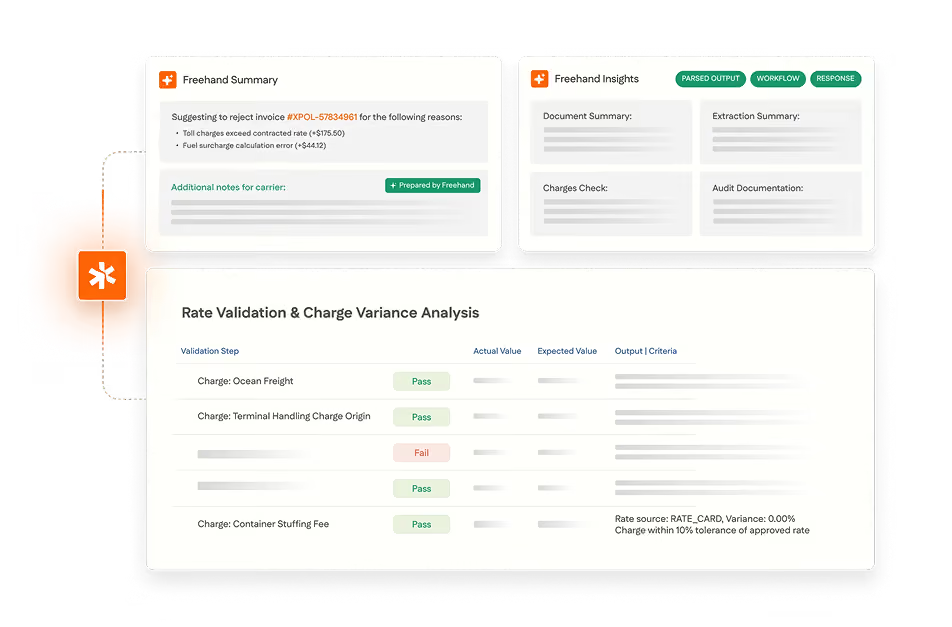
Every warehouse. Every provider. Every mile.
Gartner's 2026 outlook on logistics outsourcing, and how AI Teams hold every contract to the terms you agreed.
- Where outsourced logistics quietly loses margin
- Why billed charges drift from the contract
- How AI Teams close the gap
.png)