
Only 21% Have Mature AI Governance. Most Aren't Ready.
Deloitte surveyed 3,235 enterprise leaders. Only 21% have mature agentic AI governance. See why visible, plain-language rules close that gap.
.webp)
September 9, 2026
•
8
mins
Deloitte surveyed 3,235 enterprise leaders across 24 countries. Only 21% said their organization has a mature governance model for agentic AI, while adoption is expected to reach 74% of respondents within two years.
That gap, governance maturity lagging far behind deployment speed, is the real risk in rolling out agentic AI, not the technology itself.
Key Takeaways
- AI governance maturity means having clear decision boundaries, real-time behavior monitoring, and audit trails for what an autonomous system is doing, not just having deployed the system.
- Only 21% of enterprises have a mature governance model in place for agentic AI, per Deloitte's 2026 survey of 3,235 global enterprise leaders.
- Roughly 80% of organizations surveyed lack mature governance capabilities: no clear boundary for what an agent can decide alone versus escalate, no real-time monitoring of agent behavior, no audit trail of agent actions.
- Adoption isn't waiting for governance to catch up. Deloitte expects 74% of respondents to be using AI agents "at least moderately" within two years.
- A governance model built on plain-language, visible rules closes exactly the gaps Deloitte names, decision boundaries and audit trails, without requiring a separate compliance buildout.
What does "mature AI governance" actually mean?
It means an organization can answer three questions about its AI system at any moment: what can it decide alone, what is it actually doing right now, and what did it do yesterday.
Deloitte's survey names these directly as the gaps most enterprises have:
- No clear boundary between agent-decided and human-escalated actions
- No real-time monitoring of agent behavior
- No audit trail capturing the full chain of what an agent did
Having deployed an AI agent isn't the same as having governed one.
Most of Deloitte's 79% governance gap is a missing-answers gap: no clear decision boundary, no real-time behavior monitoring, no audit trail, not a shortfall in how many companies have deployed AI in the first place.
This isn't a Freehand-specific standard.
The NIST AI Risk Management Framework, the primary U.S. framework for this, organizes the same expectations into four functions: govern, map, measure, and manage AI risk.
{{blue-cta}}
Why is governance lagging so far behind adoption?
Because governance was built as an afterthought bolted onto systems designed to run autonomously first and explain themselves later, if at all.
Only 21% report mature governance while adoption keeps accelerating. The two aren't moving at the same speed because most vendors treat them as separate problems: ship the autonomous system, add a compliance layer around it later.
Shipping an autonomous system first and adding governance afterward is exactly backward for anything making decisions on live financial data.
Why does this matter more specifically for supply chain?
Because regulation is catching up to exactly the kind of AI supply chains are deploying, and because supply chains inherit governance risk from vendors nobody directly assessed.
Under the EU AI Act, high-risk AI systems (the category most autonomous logistics and freight decisioning falls under) face new obligations starting December 2, 2027.
Four requirements apply, and they read close to a checklist for what "mature governance" actually means in practice, not an abstract standard:
- Human oversight built into the system's design
- Automatic logging of risk-relevant events throughout the system's lifecycle
- A documented risk management process
- Governance over the data the system was trained and validated on
Supply chain adds a second layer most governance programs don't check: a company's AI vendor may itself depend on a foundation-model provider nobody in the chain directly assessed.
The same multi-tier structure that makes supply chain risk hard to see in physical goods, a tier-1 supplier's own tier-2 and tier-3 suppliers, applies just as directly to the AI systems running inside that supply chain.
What does this look like when governance is built in from the start?
Freehand Studio is where your own team sets the tolerance thresholds and approval rules an AI Team runs on, in plain language, not through a separate compliance layer added afterward. Every rule is visible and adjustable by the person who owns the decision, not locked inside a script only a developer can read.
Deloitte's three governance gaps each map to a specific mechanism, not a general promise:
- Decision boundaries: set directly in Freehand Studio, in plain language, by the person who owns the rule.
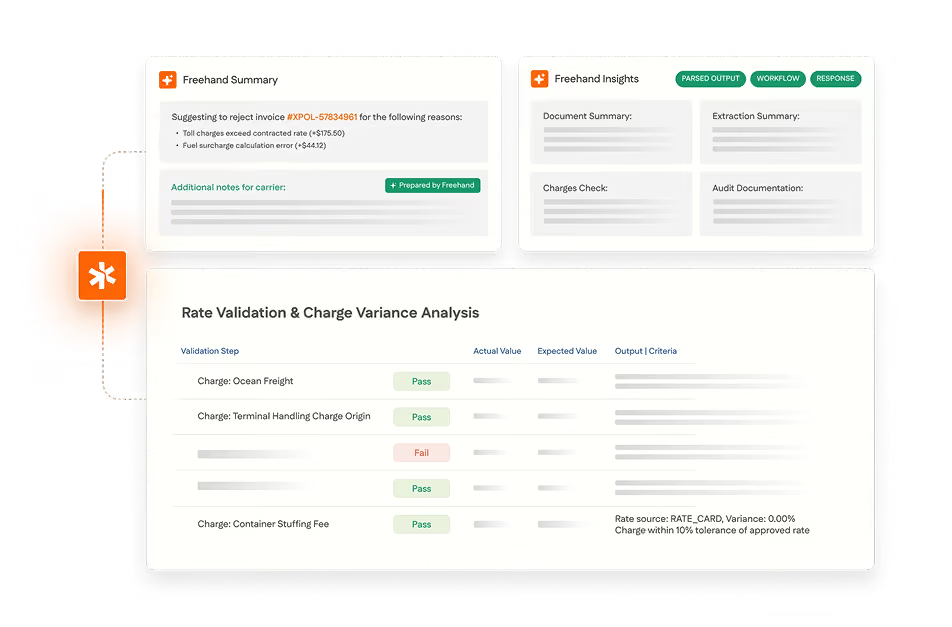
- Real-time monitoring: the Anomaly Detection Agent monitors freight spend continuously across carriers, modes, and charge types, flagging a billing pattern break the moment it appears rather than in a monthly report two months later.
- Audit trail: every decision traces back to a verified fact in the Context Graph, not a reconstruction assembled after the fact.
{{brown-cta}}
Does closing the governance gap require slowing down adoption?
No. It requires building governance into the configuration layer instead of adding it after deployment.
The adoption Deloitte projects isn't going to wait for governance maturity to catch up on its own.
The realistic path is a system where the rule-setting itself is the governance, visible, plain-language, owned by the business user, not a parallel compliance function racing to keep pace with a system already in production.
Frequently Asked Questions
What percentage of companies have mature AI governance?
Only 21%, according to Deloitte's 2026 survey of 3,235 global enterprise leaders across 24 countries, the 7th edition of its annual State of AI in the Enterprise report.
What does Deloitte's survey say enterprises are missing in AI governance?
Three specific gaps: clear boundaries for what an agent can decide independently versus escalate to a human, real-time monitoring of agent behavior, and audit trails capturing the full chain of agent actions.
Is agentic AI adoption slowing down while governance catches up?
No. Deloitte expects 74% of respondents to be using AI agents at least moderately within two years, accelerating well ahead of governance maturity.
How does Freehand address the governance gaps Deloitte identified?
Each gap maps to a specific mechanism: Freehand Studio sets decision boundaries in plain language, the Anomaly Detection Agent monitors freight spend continuously in real time, and every decision traces to a verified fact in the Context Graph instead of a reconstructed audit trail.
What does the EU AI Act require for high-risk AI systems in supply chain?
Starting December 2, 2027, high-risk AI systems must allow human oversight, automatically log risk-relevant events, run a documented risk management process, and govern the data the system was trained and validated on.
Sources
- Deloitte, Agentic AI Is Scaling Faster Than Guardrails
- NIST, AI Risk Management Framework
- EU Artificial Intelligence Act, Implementation Timeline
- EU Artificial Intelligence Act, High-Level Summary
- Freehand, What Is Freehand Studio? Configuring AI Teams Without Code
- Freehand, Anomaly Detection Agent
- Freehand, Context Graph
Every AI Decision, Traced to a Verified Fact.
Freehand's Context Graph grounds every agent to your real contracts and shipment data. Freehand Studio lets your team set the rules it runs on. No black box, no code.
An AI That Can't Show Its Work Isn't Ready to Act on Your Invoices.
Most AI agents give you an answer, not a reason. When the answer's wrong, you find out after you've already paid.
Every warehouse. Every provider. Every mile.
Gartner's 2026 outlook on logistics outsourcing, and how AI Teams hold every contract to the terms you agreed.
- Where outsourced logistics quietly loses margin
- Why billed charges drift from the contract
- How AI Teams close the gap