
68% Outsource Freight Payment. That Number Should Fall.
Roughly two-thirds of enterprises now outsource freight payment to cut cost. See why that growth is a symptom of the real problem, not a fix for it.
.webp)
September 9, 2026
•
7
mins
Roughly two-thirds of enterprises now outsource freight payment, and the market keeps growing. That growth looks like progress. It's actually a symptom: the same labor-cost problem that made in-house audit unaffordable at scale, moved to someone else's payroll instead of solved.
Key Takeaways
- Freight payment outsourcing has grown to roughly 60-68% of enterprises, according to Global Growth Insights and a corroborating figure from Shipware, both citing cost reduction as the primary driver.
- Outsourcing moves the labor-cost problem to a provider's payroll. It doesn't remove the constraint that created it: coverage still scales with headcount, just headcount you don't manage directly.
- A BPO auditing its own invoices, or a provider with no dedicated audit function on part of a shipper's volume, is a structural risk that outsourcing alone doesn't fix.
- A company running its LTL freight through the same carrier that audited it recovered $495K to $825K a year once it moved to independent, full-coverage auditing, money the outsourced relationship had never been positioned to catch.
- Growth in outsourcing is evidence the underlying labor-cost math still hasn't changed for most companies, not evidence the problem is solved.
What does it actually mean that 68% of enterprises outsource freight payment?
It means the majority of the market has already concluded that running freight audit fully in-house doesn't scale.
Roughly 60-68% of enterprises now outsource freight payment or audit functions, up from a market where in-house was still the default a decade ago.
That's a real, rational response to a real cost problem. It's also not evidence the problem got solved. It's evidence of where the cost went.
That trend isn't leveling off, either. Technavio projects the freight audit and payment market to grow by $651.2 million between 2025 and 2030, an 11.2% CAGR. More companies are moving the same unsolved constraint onto someone else's payroll every year, not fewer.
{{blue-cta}}
Why doesn't outsourcing actually fix the underlying constraint?
Because a BPO still prices its service around headcount, just headcount on its own payroll instead of yours.
The labor-cost math that made 100% in-house auditing unaffordable doesn't disappear when a provider takes it over.
It gets absorbed into their pricing, and their coverage still runs into the same wall: checking more invoices requires more of their people, not fewer.
For the specific cost numbers behind that shift, see our guide to accounts payable outsourcing.
What does that constraint actually cost, in dollars, at scale?
Take a company processing 5,000 freight invoices a month.
In-house, at $12-$22 per invoice, that's $720,000 to $1,320,000 a year in processing cost alone. Move it to a BPO at $1.50-$5.00 per invoice, and the bill drops to $90,000-$300,000, real savings, but the coverage question doesn't go away.
The BPO column is cheaper. It isn't more complete. Whatever percentage of that $720,000-$1,320,000 problem was going unchecked in-house is still going unchecked at the lower price, just billed differently.
What risk does outsourcing growth actually hide?
A provider auditing its own invoices, or covering only part of a shipper's freight, is a structural problem that a bigger outsourcing market doesn't fix on its own.
A mid-market consumer products company ran its LTL freight through a carrier that also performed the LTL audit, auditing its own billing. Its FTL side had zero review at all.
After moving to independent, full-coverage auditing across both modes, that company recovered $495K to $825K annually and compressed its invoice cycle from over 30 days to under three. That money had been sitting inside an outsourced relationship the entire time, not because the provider was dishonest, but because the structure was never built to catch it.
So why should that 68% number be falling instead of growing?
Because the constraint outsourcing was built to solve, headcount cost scaling with invoice volume, no longer requires a headcount answer at all.
An AI Team that resolves the exception itself doesn't need a bigger staff on anyone's payroll to check more invoices.
Coverage stops being rationed the moment it stops being a headcount problem, whether that headcount sits inside your company or inside a provider's.
Growth in outsourcing is the market solving yesterday's constraint more efficiently. It isn't evidence the constraint itself is gone.
{{brown-cta}}
Frequently Asked Questions
What percentage of companies outsource freight payment?
Roughly 60-68% of enterprises, according to industry market research, with cost reduction cited as the primary driver.
Does outsourcing freight payment actually reduce overcharges?
It reduces processing cost. Coverage often stays sampled, since a BPO's audit capacity still scales with its own headcount, the same constraint that made in-house full coverage unaffordable in the first place.
What's the risk of a carrier or broker auditing its own invoices?
It's a structural conflict of interest. A provider auditing its own billing, or a shipper's other transportation mode, has limited incentive or capacity to catch every error, independent of how well-intentioned the relationship is.
Why would outsourcing growth be a bad sign rather than a good one?
Growth in outsourcing reflects how many companies still face a labor-cost constraint serious enough to move it off their own payroll. It's evidence the constraint persists, not that it's resolved.
Sources
Buy the Finished Work, Not the Headcount.
Freehand delivers completed AP as software: invoices processed, charges audited, exceptions resolved. You scale volume without scaling a team.
You're Auditing a Sample. The Errors Live in the Rest.
Most teams spot-check 15 to 30% of freight invoices. Overcharges hide in the 70% no one opens.
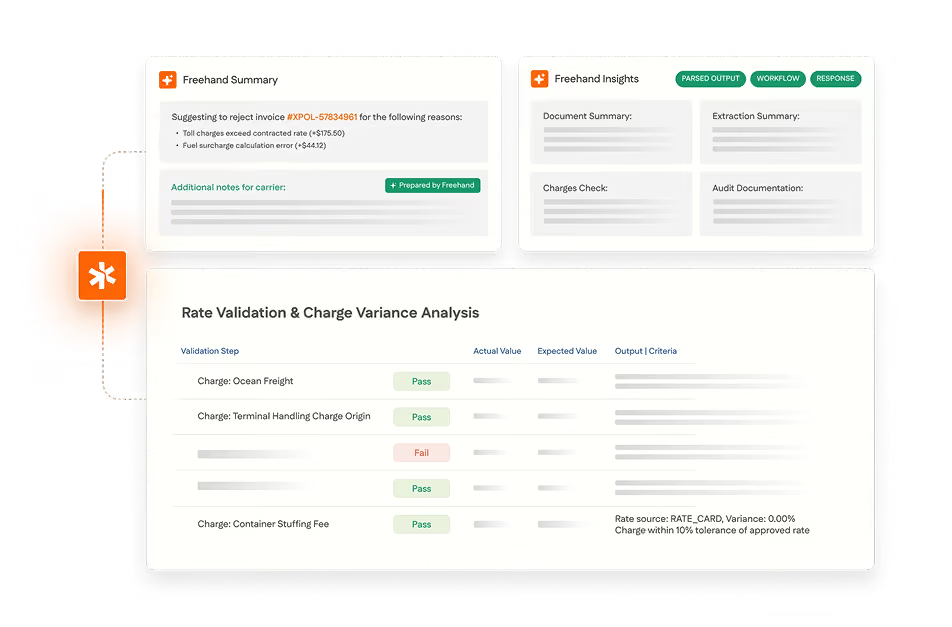
Every warehouse. Every provider. Every mile.
Gartner's 2026 outlook on logistics outsourcing, and how AI Teams hold every contract to the terms you agreed.
- Where outsourced logistics quietly loses margin
- Why billed charges drift from the contract
- How AI Teams close the gap