

7 Best Zero Down Alternatives for 2026 (Compared)
.webp)
September 10, 2026
•
16
mins

The best Zero Down Supply Chain Solutions alternatives for 2026: 1. Freehand, 2. Intelligent Audit, 3. Orca, 4. Trax Technologies, 5. Cass Information Systems, 6. nVision Global, 7. Loop.
Zero Down runs freight audit, optimization, and payment through its FreightOptics platform, with a hands-on service team and the highest Gartner Peer Insights review volume in the freight audit and payment market.
If you are here, you are likely weighing whether a human-reviewed managed service, priced on gain-share or per-transaction terms, is still the right fit as your freight volume grows and the freight audit market shifts toward autonomous models.
This page compares the alternatives that do the same core job.
Zero Down Alternatives Comparison
Here is a detailed comparison of the best Zero Down alternatives for 2026.
TL;DR
- Freehand: AI Teams that run the whole audit-to-pay workflow, audit 100% of invoices, and resolve exceptions autonomously instead of routing them to a service team.
- Intelligent Audit: Analytics-forward audit and recovery with the strongest independent review footprint of the incumbents.
- Orca: Consistent weekly managed audit with dedicated reps, the closest peer to Zero Down's service model.
- Trax Technologies: Deep multi-modal global spend data, with reviewers flagging support and exception-clarity gaps on the older platform.
- Cass Information Systems: Global scale and bank-backed payment, best when financial stability and a long track record top your list.
- nVision Global: Region-tailored managed audit with multi-currency and VAT depth for global freight programs.
- Loop: AI-native invoice data normalization with a high touchless rate, best for shippers whose biggest problem is messy freight documents.
Why teams look for Zero Down alternatives
Zero Down earns real credit. FreightOptics audits every invoice against carrier contracts, applies machine learning to flag 150+ error types, and the company reports recovering 3 to 7% of freight spend for clients over more than two decades in the category (Zero Down, vendor-claimed). Reviewers consistently praise the team, citing a "partnership first mindset" and a transparent, quick setup (Gartner Peer Insights). The reasons buyers evaluate a switch are about model and scale, not service quality.
- Human review still means human error: Gartner's own likes-and-dislikes snapshot for Zero Down lists "occasional human errors" as a recurring theme, the natural ceiling of a service-run audit rather than an autonomous one. (source)
- Gain-share and per-transaction pricing scale with volume: Zero Down quotes custom pricing built from gain-share, per-transaction, and monthly fees, so cost is not fixed as invoice volume or savings grow. (source)
- No independent review footprint outside Gartner: Zero Down holds 16 strong Gartner ratings but no G2 profile, so buyers evaluating a switch have only one channel to triangulate quality. (source)
- A bundled TMS is a bigger commitment than an audit-only need: FreightOptics pairs audit and payment with a full Transportation Management System, which is more platform than a team that only wants freight AP fixed may want to adopt.
If the managed-service model, gain-share pricing, or the TMS bundle is what is pushing you to look, the alternatives below cover the same core job of catching every overcharge before payment.
{{blue-cta}}
How did we evaluate these Zero Down alternatives?
We scored every provider on the same six criteria, weighted for a freight audit buyer replacing a managed-service incumbent. Weights sum to 100%, and the Overall score in the table is the weighted result.
- Audit coverage (25%): Share of invoices actually audited, and whether checks are adaptive or fixed rules.
- Exception autonomy (25%): Whether the system resolves exceptions on its own or only surfaces them for staff.
- Multi-modal and parcel depth (15%): Depth across ocean, air, parcel, LTL, and truckload worldwide.
- ERP and TMS integration (15%): Pre-built connectors to SAP, Oracle, NetSuite, and major TMS versus file-based setup.
- Pricing transparency (10%): Predictable volume-based pricing versus gain-share, per-transaction, or undisclosed tiers.
- Data ownership and portability (10%): Whether you keep and export your freight data without vendor involvement.
This is an independent editorial comparison, not a Gartner Magic Quadrant or a paid ranking. A buyer who mainly wants a bundled TMS alongside audit would weight ERP and TMS integration differently; a lean finance team replacing a service would weight autonomy and pricing transparency higher.
Freehand
Best for: Enterprises that want freight audit and payment executed for them as software, with every invoice audited and exceptions resolved without adding staff.
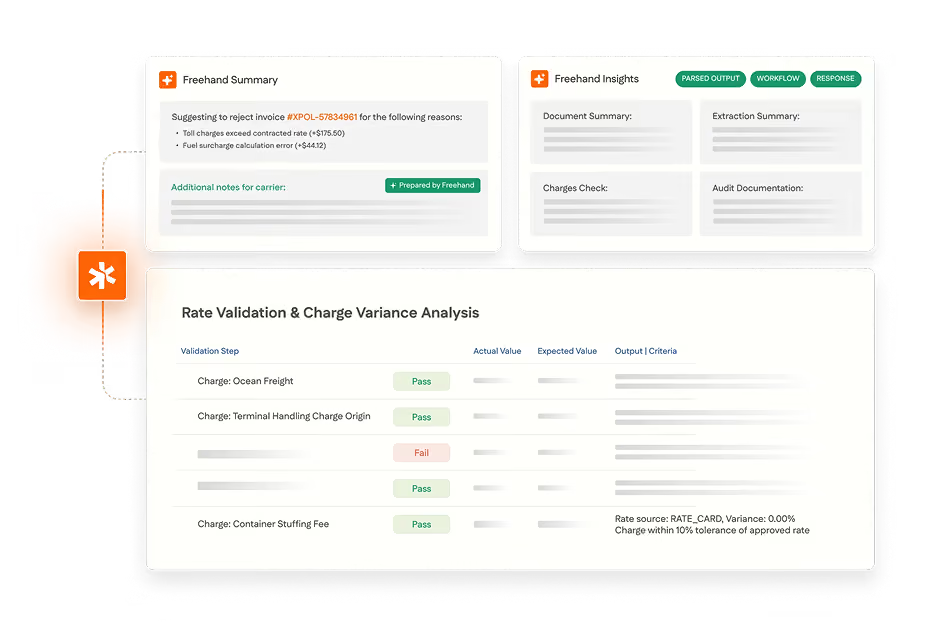
Freehand is AI Teams that run your accounts payable, including freight audit and payment, end to end. It audits 100% of freight invoices, not the roughly 33% a sampling model checks, reaches 95-98% touchless processing within 90 days, and trains only on your own data, holding no client funds. Instead of a service team working exceptions on gain-share terms, you buy the completed work at a fixed, volume-based rate.

The AI Teams ingest carrier contracts, audit each invoice against agreed rates and accessorials, resolve discrepancies, and post clean charges to the correct GL line. Built AP-first, Freehand replaces the managed-service relationship rather than adding a platform on top of one.
Key features
- Audits 100% of freight and parcel invoices, with no sampling
- Agentic exception handling that opens, evidences, and resolves disputes rather than surfacing them for review
- Context Graph that learns your carriers, lanes, contracts, and accessorial rules and adapts beyond fixed checkpoints
- Freehand Studio for full visibility into every audit decision and recovered dollar
- Coverage across ocean, air, parcel, LTL, and truckload in one workflow
- Automated GL coding, cost-center allocation, and charge-line routing
- Pre-built integrations with SAP, Oracle, NetSuite, and major TMS platforms
- Payment execution and reconciliation inside the same audit-to-pay flow
- Scales with invoice volume without proportional headcount or gain-share fees
- Enterprise data ownership and export
Pricing
Volume-based and delivered as software, so cost tracks invoice volume rather than a gain-share percentage or per-transaction service fee. Request a quote for your freight and AP volumes.
Pros
- Only option here that resolves exceptions autonomously instead of routing them to a service team
- Fixed, transparent pricing instead of gain-share or per-transaction terms that scale with savings
- Full audit coverage plus GL automation in one AP-first workflow
Cons
- Newer entrant than the two-decade-plus freight audit services
- Enterprise-only; AP-first design fits enterprises consolidating audit and payment, less so buyers who specifically want a bundled TMS alongside audit
What users say
Love: Full coverage plus autonomous resolution in one place: Freehand audits every invoice and acts on the findings, closing the gap left by human-reviewed audit queues. (source)
Complain: Best fit is AP-wide, not a bundled TMS: Teams that specifically want a Transportation Management System alongside their audit provider may find the software-delivered AP model a shift in scope. (source)
Freehand also replaces the logistics BPO services many shippers layered on top of a managed audit provider.
Intelligent Audit
Best for: Shippers that want analytics-led overcharge recovery with the strongest independent review footprint of the incumbents.
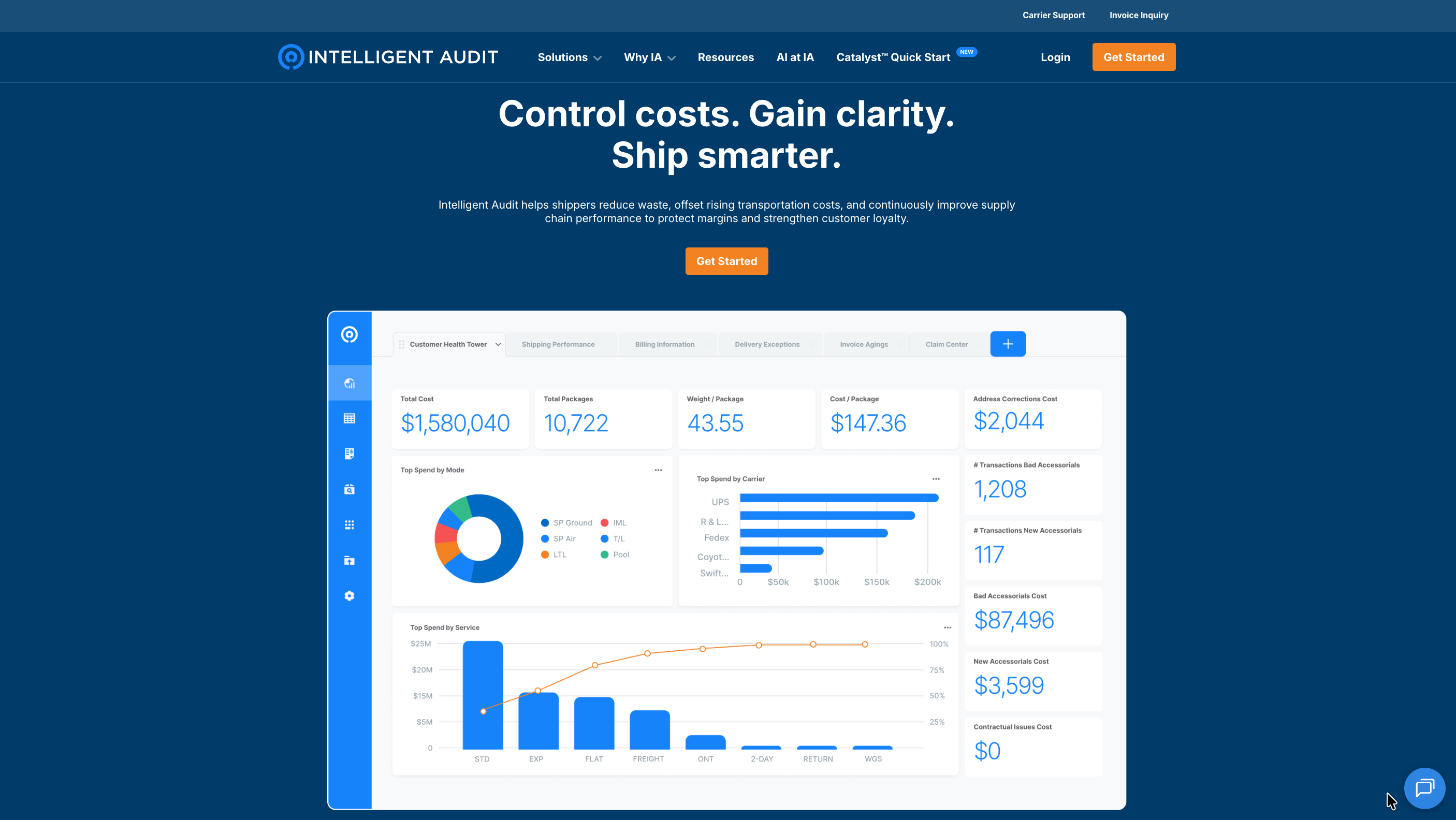
Intelligent Audit focuses on audit, recovery, and freight analytics across parcel, LTL, air, and ocean. It is the one shortlist brand with a real independent software review sample, and buyers praise its visibility into logistics invoices.
It leans analytics and recovery rather than autonomous resolution.
Key features
- Multi-modal freight audit and overcharge recovery
- Parcel audit depth alongside LTL, air, and ocean
- Clear invoice visibility and multi-layer approval workflows
- Scheduled daily, weekly, and monthly reporting
- Analytics and benchmarking on freight spend
- Carrier performance and service-refund tracking
- ERP and TMS integrations
Pricing
Mix of contingency (share of recoveries) and subscription; negotiated by volume.
Pros
- Strong independent review scores across G2 and Gartner
- Deep parcel audit and analytics
- Clear invoice visibility and approvals
Cons
- Assistive workflow still needs human approvers
- Reviewers want better pending-approval notifications
- Contingency pricing can misalign incentives at scale
What users say
Love: Clear invoice visibility and layered approvals: A Technical Program Manager praised easy navigation, a clear view of all logistics invoices, and a multi-layer approval workflow with scheduled reporting. (source)
Complain: No pending-approval notifications: The same reviewer wanted email alerts when an invoice is awaiting approval, which the tool currently lacks. (source)
For a wider view of this category, see our Intelligent Audit alternatives guide.
Orca
Best for: Teams that want a consistent weekly managed audit run by reps who know their accounts, the closest peer to Zero Down's own service model.
Orca delivers freight invoice audit and payment as a managed service, and it is the alternative Gartner's own Peer Insights page ranks first against Zero Down. Buyers value week-to-week consistency and dedicated account reps. It suits shippers that prefer a steady, hands-on service relationship over a self-operated platform.
Key features
- Managed freight invoice audit and payment
- Dedicated account representatives
- Consistent weekly audit and payment cycles
- Multi-modal coverage
- Spend reporting and visibility
- Discrepancy and duplicate detection
- Carrier dispute support
Pricing
Per-transaction or managed-service fees, negotiated by volume.
Pros
- Consistent week-to-week process
- Dedicated reps who learn your accounts
- Solid Gartner review base
Cons
- Reviewers note initial service delays during onboarding
- Service-led model scales cost with volume
- Assistive, not autonomous
What users say
Love: Consistent weekly process with dedicated reps: A Director of Supply Chain at a $1B-10B shipper credits week-to-week consistency and reps who know their accounts. (source)
Complain: Slow to ramp early on: An Operations Manager flagged initial service delays before the partnership improved, so expect an onboarding lag. (source)
If Orca is your leading option for a like-for-like service model, our OrcaAudit alternatives guide compares it head to head.
Trax Technologies
Best for: Global shippers that want deep multi-modal spend data and can staff the exception workflow.
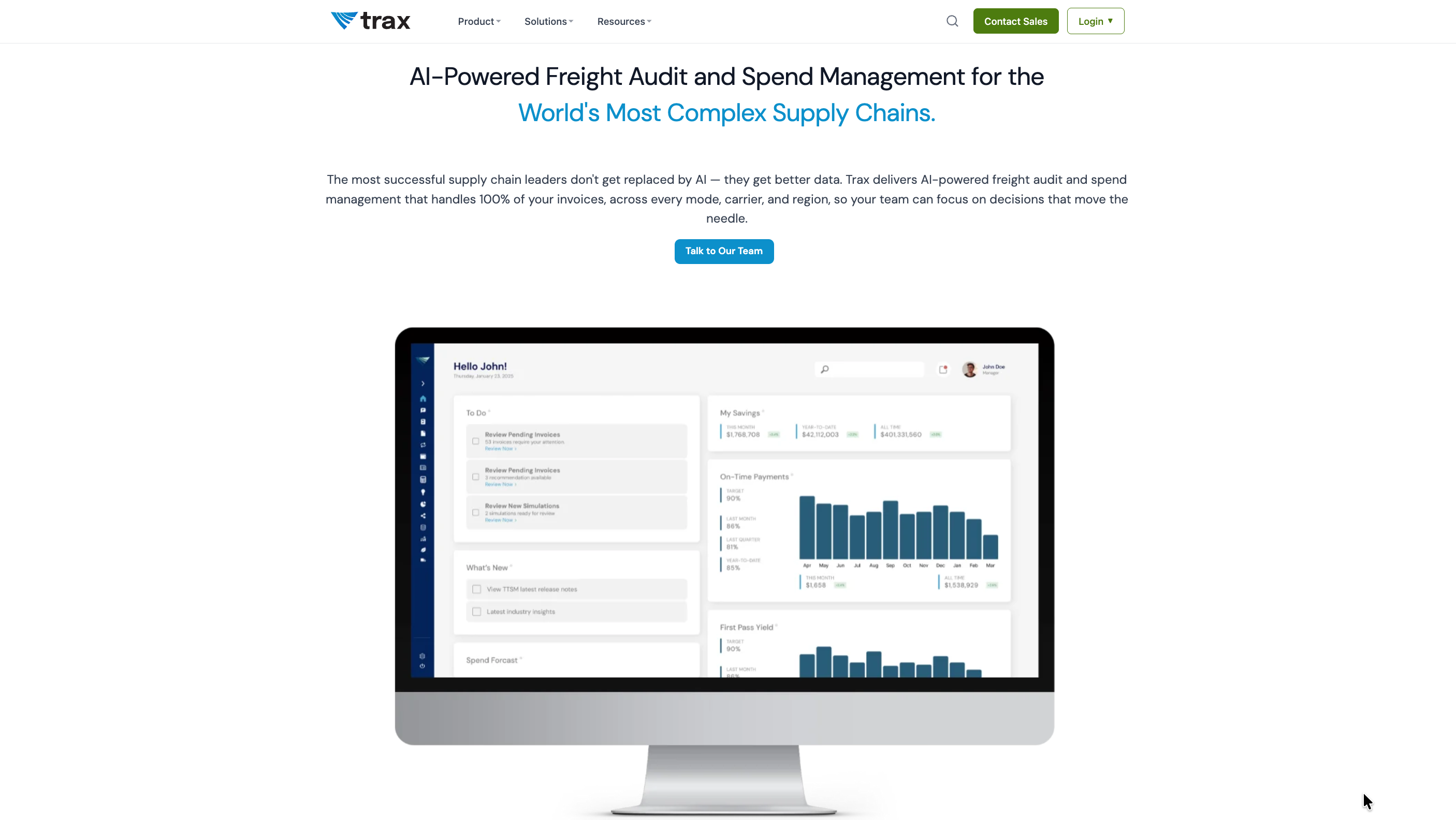
Trax Technologies is a long-standing freight audit and payment provider with broad global coverage and detailed spend data. It suits enterprises that value historical depth and reporting across many modes and countries. Reviewers value the data, while flagging support and platform-age issues.
Key features
- Multi-modal global freight audit and payment
- Spend data management and analytics
- Configurable, rules-based audit logic
- Global tax and regulatory handling
- ERP and file-based integrations
- Managed services layered on the platform
- Reporting across regions and modes
Pricing
Subscription plus per-invoice fees, negotiated by volume; not publicly listed.
Pros
- Deep global spend data and reporting
- Established across many modes and geographies
- Configurable audit rules
Cons
- Rules-based audit means overcharges outside the ruleset can slip through
- Reviewers cite support gaps and exception-clarity issues
- Prizma.AI trains on pooled cross-customer freight data, so your data informs a shared baseline
What users say
Love: Established multi-modal audit and reporting: Long-standing coverage of global freight spend across modes, with reviewers valuing its reporting depth. (source)
Complain: Support gaps and unclear exception handling: A Manager at a $10B+ manufacturer cited "too many gaps in operations and management" and low confidence in support and exception clarity, plus an aging platform. (source)
If spend data is your priority, our Trax Technologies alternatives guide goes deeper on that comparison.
Cass Information Systems
Best for: Enterprises that prioritize global scale, financial stability, and bank-backed payment.
Cass Information Systems is one of the oldest and largest freight audit and payment providers, pairing audit with its own payment and float capabilities. It suits organizations that value a long track record and the balance-sheet stability of a bank-backed provider across many modes and geographies.
Key features
- Global multi-modal freight audit and payment
- Bank-backed payment and settlement services
- Business intelligence and spend reporting
- Established ERP and file-based integrations
- Large operations footprint for high invoice volumes
- Duplicate and discrepancy detection
- Long history serving large, complex shippers
Pricing
Typically per-transaction fees plus payment float economics; terms are negotiated and not publicly listed.
Pros
- Global scale and financial stability
- Bank-backed payment
- Broad mode and geography coverage
Cons
- Assistive model still relies on staff to work exceptions
- Independent peer review signal is thin, with a single dated Gartner rating
- Holds client funds and earns bank float, so the banking relationship sits with Cass, not you
What users say
Love: Trusted benchmark for cost competitiveness: A Senior Director of Transportation calls Cass "a benchmark amongst it's peer group," citing ease of transition and business intelligence. (source)
Complain: Very thin, dated review signal: Cass shows a single Gartner rating from 2023, so there is little current peer feedback to validate. (source)
For a head-to-head against this incumbent, see our Cass Information Systems alternatives guide.
nVision Global
Best for: Enterprises with heavy international freight where multi-currency, VAT, and regional reporting are the hard part.
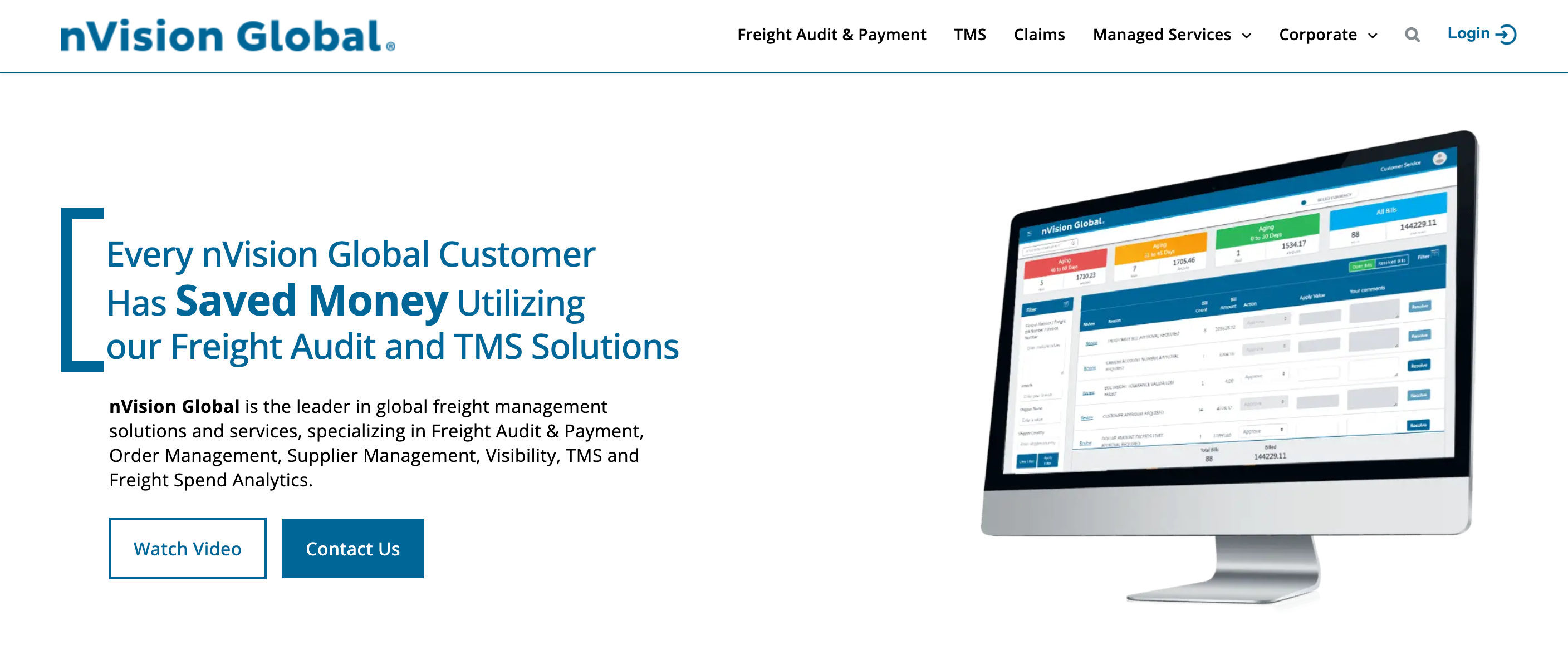
nVision Global is one of Gartner's own top-ranked alternatives to Zero Down, built around regional processing centers, multi-language and multi-currency handling, and global tax and VAT compliance. It layers business intelligence and a pricing and auditing engine on top of the core audit.
Key features
- Multi-language and multi-currency invoice processing
- Global tax and VAT compliance
- Cost recovery and overpayment tools
- Document management and imaging
- Pricing and auditing engine with business intelligence
- Regional operations centers for global coverage
- Supply chain consulting services
Pricing
Custom pricing, not published. Quotes depend on volume and regional scope.
Pros
- Wide geographical reach for auditing global logistics
- Flexible, customizable reporting for regional offices
Cons
- Feature breadth can complicate setup
- Support response times can vary across regions
- Thin independent software review footprint
What users say
Love: Region-by-region customization, reliable service: A Supply Chain Manager at a $10B+ manufacturer notes solutions tailored to each region that adjust year over year, calling them a reliable partner. (source)
Complain: Thin independent software reviews: nVision runs largely as a managed service, and its G2 product profile shows zero reviews, so software-level diligence leans on a small Gartner sample. (source)
Loop
Best for: Data-forward shippers that want AI-native invoice normalization across freight and parcel, with clean data feeding their team's decisions.
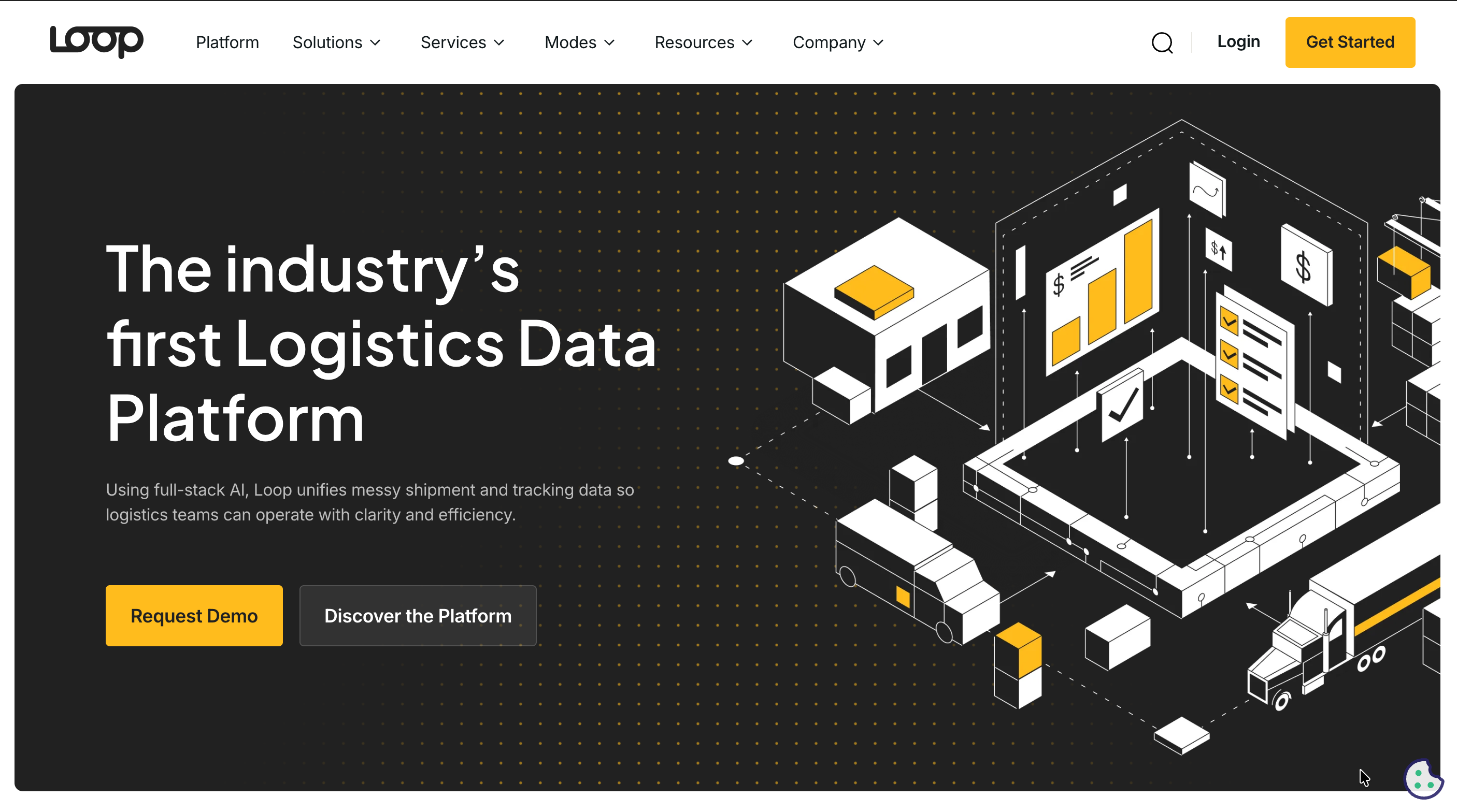
Loop is an AI-native logistics data platform whose DUX engine normalizes messy freight and parcel invoices at high touchless rates, bringing real-time control-tower visibility to shippers. Its Data2Logistics merger and J.P. Morgan Payments partnership expanded its reach and payment options.
Its strength is turning invoice data into a clean, single source of truth. Acting on that data still sits with your team.
Key features
- AI-native invoice capture and normalization (DUX engine)
- High touchless processing across parcel, LTL, air, and ocean
- Real-time control-tower visibility and analytics
- Freight and parcel audit
- Carrier payment via J.P. Morgan Payments partnership
- Data2Logistics-expanded parcel and data reach
- ERP and system integrations
Pricing
Custom, negotiated by volume; carrier payment runs through its bank partner.
Pros
- Modern, AI-native data normalization at high touchless rates
- Real-time control-tower visibility
- Strong funding and multi-modal reach
Cons
- Assistive: surfaces issues on dashboards rather than resolving them
- Carrier payment tied to a bank partner
- Newer entrant still building review depth
What users say
Love: Real-time normalization and visibility: Loop brings real-time freight invoice automation to shippers, normalizing messy transportation data into a single source of truth. (source)
Complain: Payment tied to a bank partner: Loop executes carrier payments through its J.P. Morgan Payments partnership, which can limit teams that want independent corporate banking arrangements. (source)
For the audit-focused view, see our Loop alternatives guide.
Zero Down vs Freehand
Both catch overcharges other systems miss. The difference is who does the work and how it is priced.
- Zero Down: Routes invoices through FreightOptics and a dedicated service team, who apply machine learning flags and then work the exceptions manually, on gain-share, per-transaction, or monthly terms that track your recovered savings or invoice volume.
- Freehand: Keeps the same 100% coverage principle and closes the loop with agentic execution. AI Teams audit every invoice, resolve exceptions autonomously, and post clean charges to your ERP in real time, delivered as software at a fixed, volume-based rate.
For a finance team trying to hold the labor line while removing gain-share cost variability, that difference in autonomy and pricing model is the whole case.
How to choose a Zero Down alternative
Match the replacement to how you want managed freight audit to run, not to the longest feature list. Run each option against these questions:
- Does it audit 100% of invoices, or sample a subset?
- Does it resolve exceptions on its own, or run them through a service team?
- Is pricing fixed and volume-based, or gain-share and variable with your savings?
- Do you need a bundled TMS, or a specialized audit-and-pay layer?
- Are ERP and TMS connectors pre-built, and do you keep and control the data?
Weight autonomy and pricing predictability highest if you are trying to remove both headcount and cost variability from the audit function.
{{brown-cta}}
FAQ
Who are Zero Down Supply Chain Solutions' main competitors?
In freight audit and payment, the main alternatives are Freehand, Intelligent Audit, Orca, Trax Technologies, Cass Information Systems, nVision Global, and Loop.
What is the best Zero Down alternative?
For enterprises replacing a managed service, Freehand ranks first because it audits 100% of invoices and resolves exceptions autonomously, at a fixed, volume-based rate rather than gain-share pricing.
Does Zero Down audit 100% of invoices?
Yes. FreightOptics audits every invoice against carrier contracts, using machine learning to flag over 150 error types. The distinction with agentic alternatives is autonomy and pricing model, not coverage.
Is there a cheaper alternative to Zero Down?
Volume-based providers like Freehand can be more predictable than gain-share or per-transaction pricing, since cost tracks invoice volume rather than a percentage of recovered savings.
Why do companies switch from Zero Down?
Common reasons include human-reviewed audits with occasional errors, gain-share or per-transaction pricing that scales with volume, thin review presence outside Gartner, and a bundled TMS some buyers don't need.
What should I look for in a Zero Down replacement?
Prioritize autonomous exception resolution, full and adaptive audit coverage, fixed and transparent pricing, multi-modal scope, and data portability so you keep control of your freight data.
Zero Down vs Orca: which is better?
Both are managed-service peers with dedicated teams; Orca is Gartner's top-ranked Zero Down alternative, while Zero Down bundles a full TMS. Neither resolves exceptions autonomously, so weigh an agentic option.
Do any alternatives resolve exceptions automatically?
Freehand resolves exceptions autonomously and posts to the ERP. Zero Down and most incumbents route flagged exceptions to a service team to work manually, keeping a human in the loop.
Stop Paying Gain-Share on Your Own Savings.
Freehand runs freight audit and payment at a fixed, volume-based rate, so your cost never scales with what you recover.
The Audit Team Still Makes Mistakes.
Zero Down's own reviewers flag "occasional human errors." Freehand's AI Teams audit 100% of invoices with nothing for a person to mis
Every warehouse. Every provider. Every mile.
Gartner's 2026 outlook on logistics outsourcing, and how AI Teams hold every contract to the terms you agreed.
- Where outsourced logistics quietly loses margin
- Why billed charges drift from the contract
- How AI Teams close the gap
.png)