

Spot vs. Contract Freight Rates: How to Choose
Spot vs. contract freight rates compared by market conditions, lane volume, and capacity risk, and why the cheaper rate isn't always the one you're billed.
.webp)
August 13, 2026
•
9
mins
Spot and contract freight rates are two ways to price the same lane, a fixed contract price against the spot market's real-time price, and choosing between them comes down to lane volume and how tight capacity is right now. Neither rate type is inherently cheaper. The spread flips with the market.
Getting the comparison right only matters if the rate you compared is the rate you actually get billed.
Key Takeaways
- A contract rate is a negotiated, fixed price locked in for a set period, usually 6 to 12 months, tied to a committed lane and volume. A spot rate is a one-time price quoted for a single shipment, set by real-time supply and demand.
- Spot runs above contract in a tight market, when capacity is scarce, and below contract in a soft market, when carriers are competing for volume. The direction flips with the cycle.
- Most enterprise shippers run the bulk of their volume on contract, with spot used for overflow, new lanes, and freight rejected under the routing guide, though the exact split varies too widely by fleet and industry to cite a single verified figure.
- The comparison that gets skipped: whether the contract rate you negotiated is the rate that actually clears accounts payable. A gap there costs more than picking the wrong rate type.
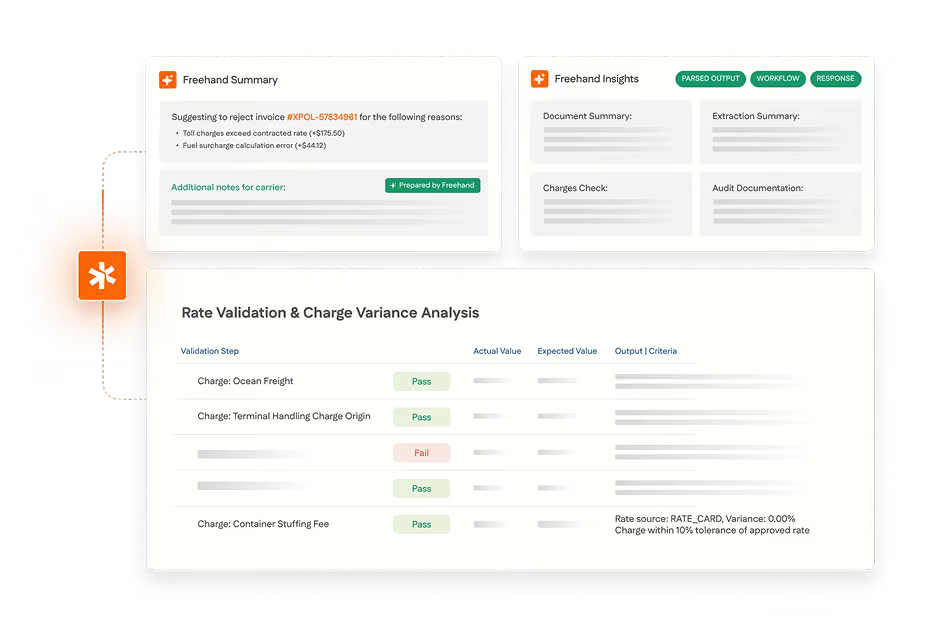
- Freehand's AI Teams audit every invoice against the contracted rate, so the rate you compared and locked in is the rate you're actually billed.
What's the difference between spot and contract freight rates?
A contract rate is fixed for months at a time and tied to a committed lane and volume; a spot rate is quoted fresh for each shipment based on current market conditions. Contract rates come out of a formal bid or RFP process, typically covering 6 to 12 months, and both sides commit: the shipper commits volume, the carrier commits capacity at that price.
Spot rates have no such commitment. A broker or carrier quotes a price for one shipment, often days or hours before pickup, based on the load-to-truck ratio in that lane right now. There's no guarantee that quote holds tomorrow, or that the same carrier will even have a truck available.
That structural difference, a commitment versus a one-time quote, is what drives everything else about when to use each one.
How do you decide between spot and contract rates?
You decide based on how predictable your volume is on a lane and how much capacity risk you're willing to carry. High-volume, consistent lanes favor contract. Irregular or low-volume lanes favor spot.
Most enterprise shippers don't pick one exclusively. Contract covers the core network, and spot fills the gaps: new lanes outside the bid cycle, volume spikes, and loads a contracted carrier rejects under the routing guide.
Does the spot rate premium always favor one side?
No. Spot runs above contract when capacity is tight and below contract when capacity is loose, and the direction reverses with the freight cycle. Treating the spread as fixed is where a lot of lane-level decisions go wrong.
Here's what that looks like on a lane with a $2,000 contracted rate. In a tight market, spot quotes on that lane might run $2,400 to $2,600, a real premium for capacity nobody has to spare.
In a soft market, the same lane's spot rate can fall to $1,700 or $1,800, since carriers are competing for volume and undercutting their own contract book to get it.
That's why a rate comparison done once, at contract signing, goes stale. The market that made contract the obvious choice in January can make spot cheaper by June.
What tools do shippers use to compare spot and contract rates?
Shippers benchmark the two using real-time rate data from DAT, Truckstop, or FreightWaves SONAR, rather than negotiating blind. DAT's RateView and DAT iQ products pull from the load-board transactions that make up the bulk of the spot market. Truckstop's Rate Insights estimates same-day spot pricing by lane. FreightWaves SONAR publishes the National Truckload Index for spot rates and has added contract rate benchmarking as well.
None of these tools tell you what a carrier actually billed you after the fact. They tell you what the market is charging right now, which is a different question from whether your last invoice matched what you agreed to pay.
What mistakes do shippers make comparing spot and contract rates?
Most mistakes come from treating the comparison as a one-time decision instead of an ongoing one.
- Locking in a long contract right before a soft market. A 12-month commitment signed at peak tightness can leave you paying above spot for months once capacity loosens.
- Chasing spot too aggressively in a tight market. Riding the spot market to save money when capacity is scarce risks paying more per load and still not securing a truck.
- Never revisiting the comparison after signing. A contract rate negotiated a year ago against last year's market isn't automatically still the better deal.
- Assuming the contracted rate is the billed rate. Winning the negotiation doesn't mean the invoice matches it. That gap is a billing problem, not a sourcing one, and it's the one most comparison frameworks skip entirely.
{{blue-cta}}
If you're building out your sourcing process further, our roundup of the best freight procurement software covers how the leading platforms handle bid management and rate benchmarking.
How do you make sure the rate you compared is the rate you pay?
You make sure by auditing every invoice against the contracted rate, since a won negotiation only holds value if it survives to the invoice. A contract rate that beats spot on paper still leaks money if the carrier bills fuel surcharges off an expired matrix or reclassifies the shipment after pickup.
That's a different problem than the spot-versus-contract decision, and it's the one that actually determines whether the rate you chose paid off. Our guide to the freight audit process covers how that verification runs, invoice by invoice.
Freehand's freight audit and payment platform validates every invoice against the contracted rate you negotiated, whichever rate type it is, and catches the drift before payment clears. If an overcharge does get through, recovering it runs on its own clock, separate from the sourcing decision entirely.
{{brown-cta}}
Frequently Asked Questions
What is a spot rate in logistics?
A spot rate is a one-time price quoted for a single shipment, based on current supply and demand in that lane. It carries no ongoing commitment from either the shipper or the carrier.
How is a spot rate calculated?
Spot rates are driven by the load-to-truck ratio in a specific lane at a specific time: how many loads need to move against how many trucks are available. Brokers and load boards quote based on that real-time balance, not a fixed formula.
When does contract freight make more sense than spot?
When your volume on a lane is high and predictable, and when you need guaranteed capacity more than you need the lowest possible price. Contract also makes sense heading into a tight market, before spot rates climb.
Can a shipper use both spot and contract rates on the same lane?
Yes, and most enterprise shippers do. Contract covers baseline volume, and spot fills overflow, rejected loads, or spikes above what the contracted carrier can cover.
Does a signed contract rate guarantee that's what you'll be billed?
A signed contract rate does not guarantee that's what you'll be billed. It sets the rate you agreed to. Whether the invoice actually matches it depends on whether fuel surcharges, accessorials, and freight class are audited against that contract before payment.
What percentage of enterprise freight runs on contract versus spot?
Most runs on contract, with spot used for overflow, but the exact split varies too widely by fleet size, industry, and lane mix to cite one verified figure. Treat any single percentage you see elsewhere with caution.
Hold Every Carrier to the Contract You Signed.
Freehand checks each invoice against your negotiated rates and catches the charges that slip past procurement. The savings you booked actually land.
The Rate You Negotiated Isn't the Rate You Get Billed.
Accessorials, fuel surcharges, and reclasses drift off contract the moment freight moves. Procurement wins erode at the invoice.
Every warehouse. Every provider. Every mile.
Gartner's 2026 outlook on logistics outsourcing, and how AI Teams hold every contract to the terms you agreed.
- Where outsourced logistics quietly loses margin
- Why billed charges drift from the contract
- How AI Teams close the gap