



Best Freight Billing Software in 2026: 6 Tools Compared
.webp)
July 15, 2026
•
13
mins

Comparing the top freight billing software options for 2026: 1. Freehand, 2. Loop, 3. Intelligent Audit, 4. Trax Technologies, 5. CTSI Global, 6. OpenEnvoy.
For enterprise shippers, freight billing software is the system that controls what you actually pay carriers: it validates each freight invoice against contracted rates and shipment data, codes it to the GL, resolves discrepancies, and executes payment. This guide ranks the tools on that shipper-side job, not carrier or broker invoice generation. If you are moving off a manual process, a freight audit BPO, or a legacy tool, the six below sort cleanly by how much of the work they actually do for you.
Some of these platforms also serve 3PL billing software use cases, where a third-party logistics provider bills its own customers rather than a shipper paying carriers directly. The audit logic is similar; the direction of the invoice is reversed.
TL;DR
- Freehand: The fully agentic option. AI Teams audit 100% of freight invoices, resolve exceptions, and post to your ERP without human review. Best fit for enterprises that want the billing work done, not flagged.
- Loop: AI-native logistics data platform that reads unstructured documents and automates up to 99% of freight and parcel audits. Strong on data quality; a person still confirms actions.
- Intelligent Audit: Deep, high-volume parcel and freight audit with ML detection and refund recovery, and the strongest independent review evidence in this list.
- Trax Technologies: The widest global carrier network and multinational spend visibility, delivered as a premium managed service on rule-based audit logic.
- CTSI Global: Freight audit, payment, and Honeybee TMS on one long-established platform (since 1957, across 50+ countries), with rules-based audit that standardizes and flags while staff resolve exceptions.
- OpenEnvoy: Real-time AP invoice matching that handles freight approvals, exceptions, and payments, strongest as a broad AP automation layer.
What is freight billing software?
Freight billing software automates the freight invoice lifecycle, matching carrier invoices to contracted rates and shipment data, calculating and validating charges, and moving them through to payment. For shippers, the job is controlling and paying inbound freight bills; for carriers and brokers, the same category also covers generating and sending invoices.
Core functions a shipper-side freight billing tool performs:
- Validate carrier invoices against contracted rates, shipment records, and accessorials
- Detect discrepancies: duplicate bills, fuel surcharge errors, dimensional weight, detention
- Code charges to the GL and allocate to the right cost center
- Resolve or route exceptions and execute carrier payment
- Report freight spend by mode, carrier, lane, and cost center
- Integrate with the TMS, WMS, and ERP through API or EDI
It works by pulling shipment, rate, and invoice data through API and EDI feeds, applying your contract terms, and clearing correct invoices while isolating the rest. Enterprises use freight payment software to replace manual reconciliation and cut billing disputes.
How we evaluated freight billing software
Every tool here handles the core job: validate carrier freight invoices, code them, resolve discrepancies, and pay. We weighted six criteria by how much each drives the buying decision for an enterprise shipper replacing a manual process, a BPO, or a legacy tool. Audit autonomy and coverage lead because they decide whether the software removes work or just reshuffles it.
- AI autonomy and agentic action (25%). Does the system resolve discrepancies and post them, or surface findings for a person to action?
- Audit coverage (20%). How much of invoice volume is actually audited, 100% versus a sample or rule set.
- Discrepancy detection depth (15%). How many billing error types it catches, and whether the check set is fixed or adaptive.
- Modal and billing-workflow breadth (15%). Coverage across modes plus rating, accruals, and GL coding, not audit alone.
- ERP and TMS integration (15%). Native connectors versus custom file or EDI setup.
- Time-to-value and pricing transparency (10%). How fast it goes live and whether pricing is disclosed.
This is an independent editorial comparison referencing Gartner and G2 alongside vendor documentation; it is not a certified third-party ranking. Every tool below is scored on these criteria, and Freehand reads strongest on autonomy and coverage because it is the only fully agentic, 100%-coverage option.
Comparison table: top freight billing software for 2026
| Tool | Best for | Audit coverage | AI autonomy | Implementation time | Pricing model |
|---|---|---|---|---|---|
| Freehand | Running freight AP autonomously, end to end | 100% of invoices | Fully agentic, resolves and posts | 12–14 weeks | Volume-based, disclosed |
| Loop | AI-native audit on messy freight documents | Up to 99% automated | Assistive, human confirms | Weeks, modern stack | Custom, undisclosed |
| Intelligent Audit | High-volume parcel and freight audit depth | High on parcel and freight | Partial, ML detection | Custom | Per-invoice SaaS |
| Trax Technologies | Global carrier network and multinational spend | Configurable | Rule-based, managed | Longer, enterprise | Custom, premium |
| Pando | Freight-native four-way match and accruals | 100% spend visibility (vendor-claimed) | AI-first, human review | Custom | Custom |
| OpenEnvoy | Automated AP invoice matching across spend | Full AP invoice match | Automated match, human approves | Weeks | Subscription, custom |
Here is a detailed comparison of the best freight billing software: 1. Freehand, 2. Loop, 3. Intelligent Audit, 4. Trax Technologies, 5. Pando, 6. OpenEnvoy.
Best freight billing platform: Freehand
Best for:
Enterprises that want freight billing run end to end without a human clearing each exception. Freehand is the only tool here that audits 100% of invoices and resolves discrepancies autonomously, posting results to your ERP.

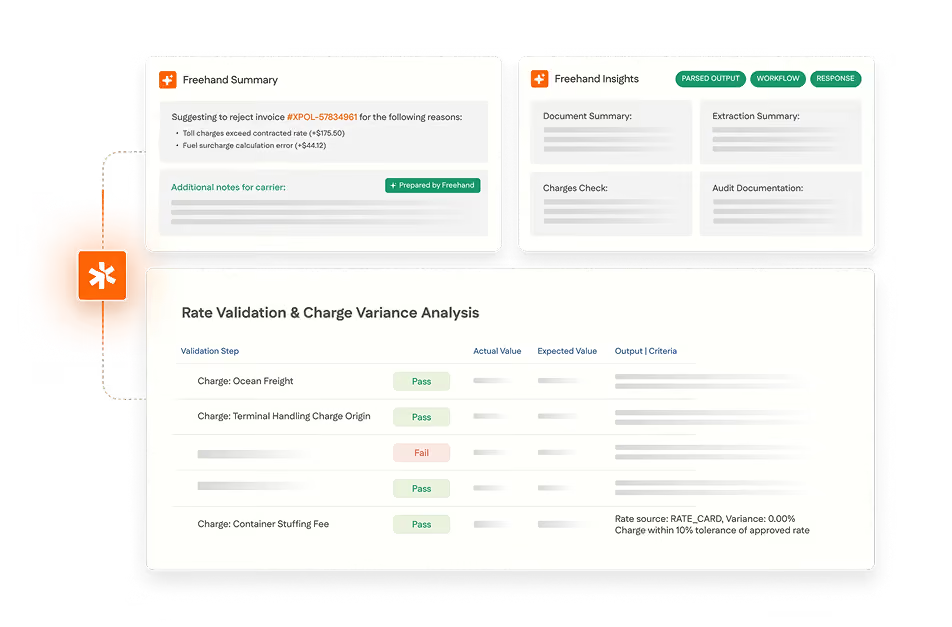
Freehand runs freight accounts payable as AI Teams that audit, code, resolve, and pay directly. It is built as services delivered as software: you buy completed billing work, not seats or a managed-service retainer. The comparison that matters is against the labor line (in-house ops, BPO, shared services), which is where a freight billing decision usually starts. It runs on top of your existing TMS and ERP through freight audit and payment software rather than replacing them at go-live.
Key Features
- AI Teams audit 100% of freight invoices, not a rule-bound sample
- Fully agentic exception resolution: the system senses, decides, and posts without waiting for human review on each exception
- Multi-way matching across invoice, contracted rate, shipment, and PO
- Detects 30+ freight billing error types, adaptive rather than a fixed rules ceiling
- Context Graph connects contracts, carrier history, shipment data, and GL rules so decisions are explainable
- Real-time GL coding and cost-center allocation with automatic posting
- Native connectors for SAP ECC, S/4HANA, Oracle Cloud, Oracle JDE, and NetSuite
- Multi-currency, multi-mode processing across truckload, LTL, parcel, rail, air, and ocean
- Duplicate invoice and freight invoice automation at scale
- Client-exclusive model in a dedicated environment; the enterprise owns and can export its own data
- Go-live in 12-14 weeks requiring 11-20 hours of client team time
Pricing
Volume-based and disclosed at scoping, quoted by freight volume and modules. No per-invoice format tiers, no percent-of-savings, and no managed-service retainer.
Pros
- 100% audit coverage closes the sampling gap that lets sub-threshold overcharges through
- Autonomous resolution removes the exception queue instead of moving it to your team
- Transparent volume pricing and enterprise-owned data reduce switching risk
Cons
- Newer entrant than decades-old incumbents
- Enterprise-focused; a small shipper with low freight volume is not the target fit
What Users Say
Love: Every invoice audited, exceptions executed. Freehand reports recovering 1.5-2.5% of freight spend annually (vendor-claimed); a Fortune 100 Consumer Electronics company moved from auditing 33% of invoices to 100% and captured more than $3M in annual savings. (source)
Complain: Newer name, enterprise-only fit. Freehand is a newer entrant than decades-old incumbents, and it targets enterprise freight volume, so a small, low-volume program is not the ideal fit.
Best AI freight billing tool: Loop
Best for:
Shippers whose core problem is dirty, unstructured invoice and document data before the audit even runs. Loop reads messy documents into clean data, then automates most of the audit.
Loop is an AI-native logistics data platform founded by former Uber Freight leaders. Its DUX model turns unstructured invoices, BOLs, and customs paperwork into clean, unified data, automating up to 99% of freight and parcel audits and explaining discrepancies. Its 2025 Data2Logistics merger added decades of audit domain depth and global payment execution. It covers freight, parcel, ocean, and air, with freight spend analysis built on the cleaned data.
Key Features
- DUX AI model for extracting data from unstructured documents
- Automated audit of rates, accessorials, and duplicate charges with explainability
- Real-time audit automation with granular cost allocation
- Self-serve analytics and dispute resolution
- Freight, parcel, ocean, and air coverage
- Global payment execution added via the Data2Logistics merger
- Modern interface with faster implementation than legacy providers
Pricing
Custom enterprise pricing, not published. Quotes depend on freight volume and modules and require a sales conversation.
Pros
- Strong data extraction on messy, multi-format documents
- High audit automation rate with a modern interface
Cons
- Assistive rather than fully agentic; a person still confirms actions
- Newer to market, with global coverage still expanding
What Users Say
Love: Logistics-trained document AI. Loop's DUX model turns messy invoices, BOLs, and customs paperwork into clean data, and its Data2Logistics merger added decades of enterprise audit depth. (source)
Complain: Undisclosed pricing, North America-weighted coverage. Loop does not publish pricing and its strongest coverage is North American, and the 2021-founded platform is still integrating its 2025 Data2Logistics merger. (source)
Not the right fit? See our Loop alternatives breakdown.
Best freight invoice audit platform: Intelligent Audit
Best for:
High-volume shippers where parcel and small-parcel spend dominates and refund recovery matters. Intelligent Audit brings nearly three decades of audit depth and the strongest independent review evidence in this list.
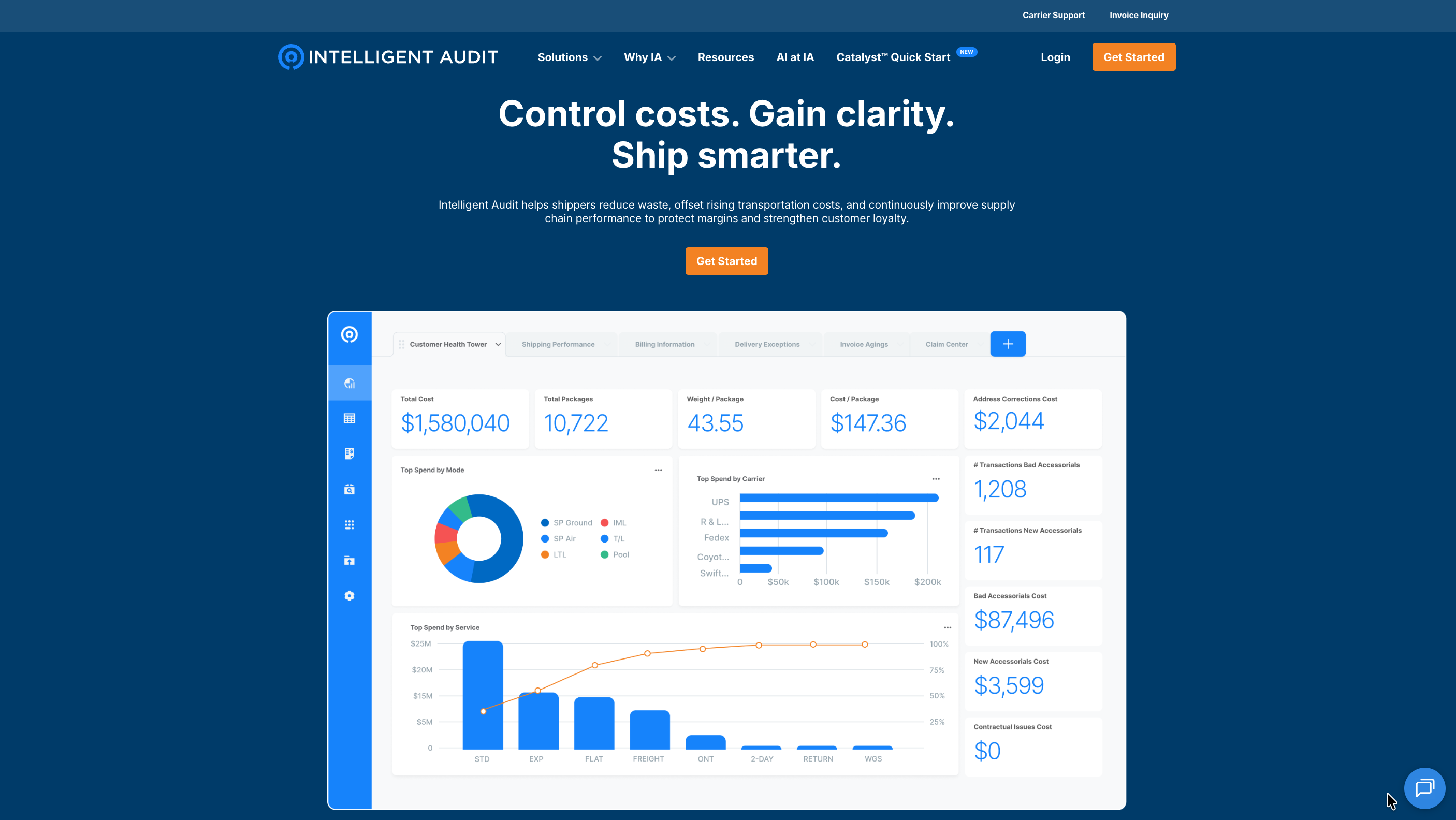
Intelligent Audit, founded in 1996, is a technology-first provider processing over 2 billion shipments annually and serving roughly 20% of the Fortune 50 (vendor-claimed). It runs more than 200 audit points per invoice (vendor-claimed) and specializes in high-volume parcel, LTL, and freight, with fast late-delivery refund identification. Its depth in parcel audit software is a standout, and it pairs with TriumphPay for carrier payment.
Key Features
- ML anomaly detection with 200+ audit points per invoice (vendor-claimed)
- High-volume parcel and small-parcel specialization
- Real-time cost-to-serve analytics
- Automated claim filing and late-delivery refund recovery
- Freight, parcel, and LTL coverage
- Per-invoice SaaS pricing model
- Carrier payment via the TriumphPay partnership
- GL coding and cost allocation on audited invoice data
Pricing
Per-invoice SaaS model for shippers and 3PLs. Companies typically cut shipping budgets by 2% to 5% (vendor-claimed).
Pros
- Nearly three decades of enterprise credibility and scale
- Strong for high-volume, small-parcel shippers
Cons
- Assistive detection rather than fully autonomous resolution
- Data-dense dashboards carry a learning curve
What Users Say
Love: Clear invoice visibility and layered approvals. A Technical Program Manager praised easy navigation, a clear view of all logistics invoices, and a multi-layer approval workflow with scheduled reporting (4.8/5 across 12 G2 reviews). (source)
Complain: No pending-approval alerts, dense dashboards. The same reviewer wanted email alerts when an invoice is awaiting approval, and its data-dense dashboards carry a learning curve. (source)
Not the right fit? See our Intelligent Audit alternatives breakdown.
Best enterprise freight billing system: Trax Technologies
Best for:
Multinationals that need the widest carrier network and spend visibility across many countries and modes. Trax is the scale option, delivered as a premium managed service.
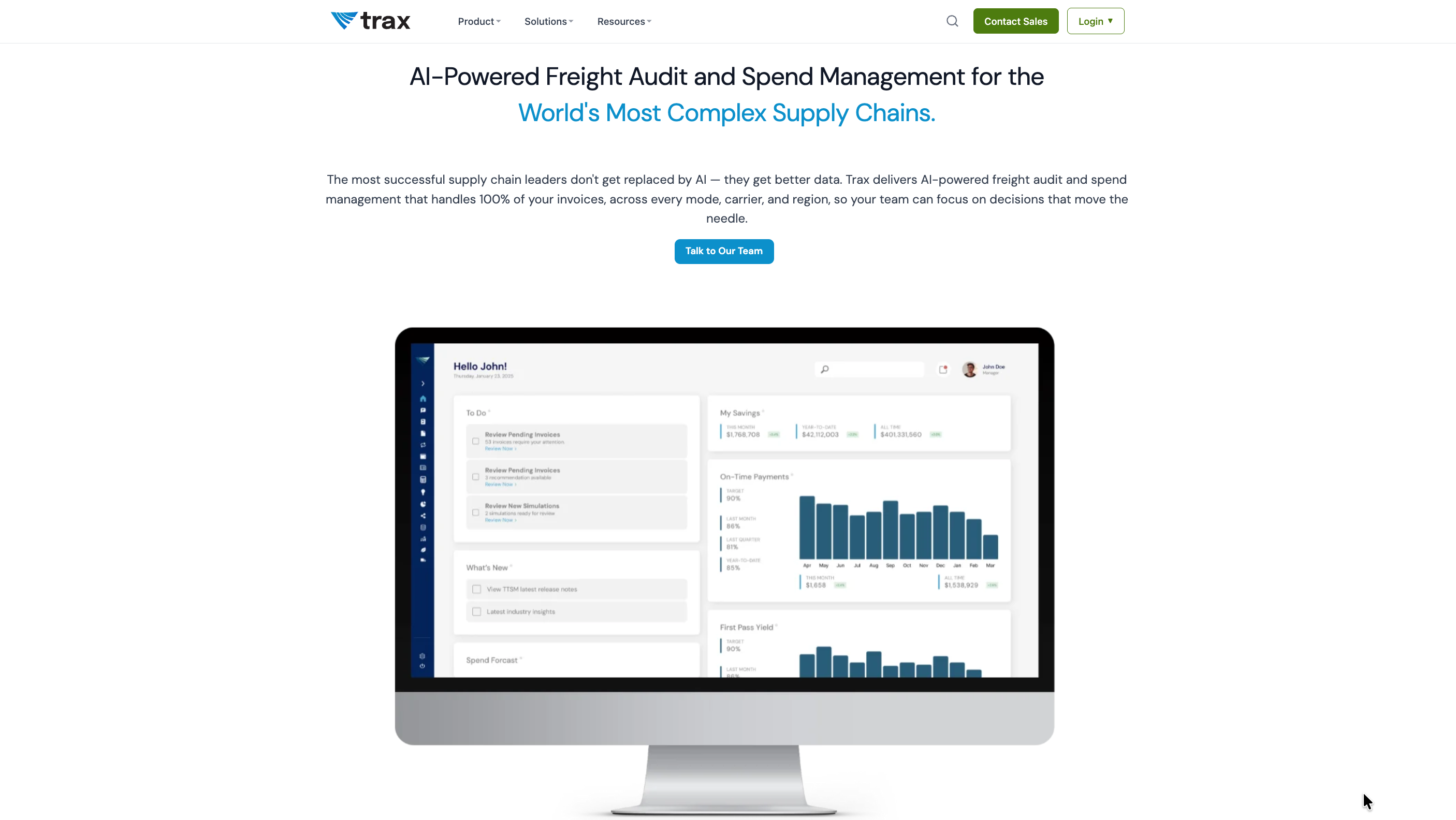
Trax delivers enterprise freight audit, payment, and transportation spend analytics as a managed service, processing more than $24B in annual transportation spend across 21,000+ carriers worldwide (vendor-claimed). Invoice validation is trained on more than two decades of normalized freight data. It is a strong fit where global carrier breadth is the deciding factor, backed by carrier-level freight rate benchmarking.
Key Features
- Broadest global carrier network at 21,000+ carriers (vendor-claimed)
- Enterprise data normalization across regions and modes
- Carrier performance benchmarking and scenario planning
- Multi-currency and multi-language support
- Rule-based invoice validation and exception handling
- More than $24B in annual transportation spend processed (vendor-claimed)
- GL coding support for complex global structures
Pricing
Custom, premium pricing for a managed service, not published. Quotes scale with spend and modules.
Pros
- Excellent visibility into complex, global freight costs
- Highly scalable for multinational corporations
Cons
- Rule-based and managed rather than autonomous resolution
- Premium pricing; some reviewers cite implementation on older platforms
What Users Say
Love: Broad global carrier coverage and reporting depth. Reviewers value Trax's multinational spend visibility and reporting across 21,000+ carriers. (source)
Complain: Support gaps and unclear exception handling. A Manager at a $10B+ manufacturer cited "too many gaps in operations and management" and low confidence in support structures and exception clarity, plus an aging TPS platform (3.5/5 on Gartner). (source)
Not the right fit? See our Trax Technologies alternatives breakdown.
Best freight audit and pay software: CTSI Global
Best for:
Global shippers that want freight audit, payment, and a TMS in one long-established lifecycle platform, and are comfortable with a rules-based audit that surfaces exceptions for staff to resolve. CTSI Global is freight-native and broad, with a lighter independent review footprint.
CTSI Global has run freight audit, payment, and Honeybee TMS on a single platform since 1957, processing billions in freight across 50+ countries. It targets enterprise shippers that want audit, payment, rate management, and logistics analytics on one freight-native system, with GL coding and cost allocation posted back to the ERP. The audit is rules-based: it standardizes and flags discrepancies, and configured rules plus staff work the exceptions.
Key Features
- Freight audit across modes against contracted rates (rules-based)
- Freight payment and global disbursement
- Honeybee TMS bundled in the same platform
- Business intelligence and logistics spend analytics
- Rate management and contract validation
- GL coding and cost allocation to the ERP
- Six decades of freight processing across 50+ countries (vendor-claimed)
Pricing
Custom enterprise pricing, not published. Typically per-transaction or managed-service, negotiated by volume, modes, and modules.
Pros
- Established freight audit, payment, and TMS in one lifecycle platform
- Broad global coverage with rate management, analytics, and payment
Cons
- Legacy, rules-based audit surfaces exceptions for staff to resolve rather than resolving them autonomously
- Limited third-party software reviews for enterprise diligence
What Users Say
Love: Established one-platform lifecycle. CTSI Global positions freight audit, payment, Honeybee TMS, and analytics on a single long-running system across 50+ countries (vendor-claimed capabilities). (source)
Complain: Limited independent review footprint. CTSI Global carries few third-party software reviews, so enterprise buyers get less outside validation than the larger platforms to diligence at scale. (source)
Best AP-first freight billing software: OpenEnvoy
Best for:
Finance teams that want real-time AP invoice matching across all spend, with freight as one category. OpenEnvoy is strongest as a broad AP automation layer rather than a freight-native tool.
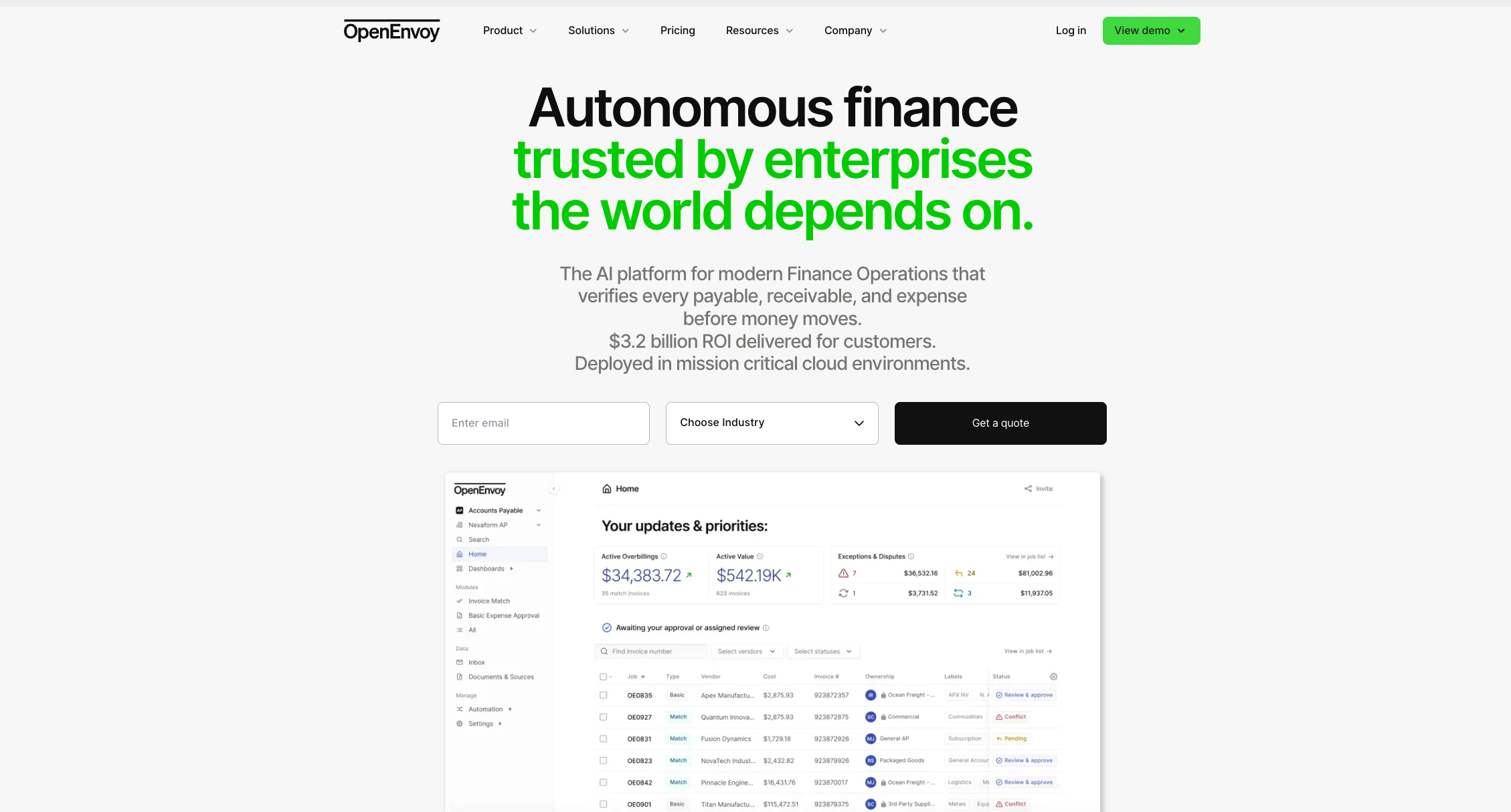
OpenEnvoy is an AI-based AP and invoice automation platform that matches invoices in real time with no templates, portals, or rules to maintain. For freight, it manages invoice approval, exceptions, and payment in one system and flags fuel surcharge errors, accessorials, and duplicate freight bills. It handles AI invoice processing across AP, with freight audit as one use case.
Key Features
- Real-time invoice matching with no templates or rules to maintain
- Four-way match across invoice, PO, receipt, and contract
- Freight invoice approval, exception, and payment workflow
- Detects fuel surcharge errors, accessorials, and duplicate bills
- Touchless email-to-ERP processing
- AP and AR automation across categories
- ERP integrations for posting
Pricing
Subscription and custom pricing, not fully published. Quotes depend on invoice volume and modules.
Pros
- Fast to deploy with no rule libraries to build
- Strong general AP automation with real-time matching
Cons
- General-purpose AP tool; freight-native depth is lighter than specialist platforms
- Human still approves matched invoices rather than autonomous resolution
What Users Say
Love: Touchless email-to-ERP automation. A reviewer said "Email to erp is fully touchless for majority of the cases" and credited steady feature rollouts (4.6/5 across 18 G2 reviews). (source)
Complain: Thin release-note detail, broad focus. The same reviewer wanted "more detailed release notes," and OpenEnvoy's Invoice Management roots mean freight is one category rather than its core. (source)
FAQ
What is freight billing software?
Software that automates the freight invoice lifecycle: matching carrier invoices to contracted rates and shipment data, validating charges, coding to the GL, and executing payment.
What is the best freight billing software?
For enterprise shippers that want billing run autonomously, Freehand ranks first: it audits 100% of invoices and resolves exceptions without human review. Best fit depends on your priorities.
How does freight billing software work?
It pulls shipment, rate, and invoice data through API and EDI feeds, applies your contract terms, clears correct invoices automatically, and isolates or resolves discrepancies before payment.
What is the difference between freight billing and freight audit software?
Freight audit software focuses on validating invoices against rates. Freight billing software covers the fuller lifecycle: validation, GL coding, exception handling, and payment, on either the shipper or carrier side.
How much does freight billing software cost?
Pricing varies by model: volume-based, per-invoice SaaS, percent of savings, or custom enterprise quotes. Most enterprise vendors quote by freight volume and modules rather than publishing rates.
Can freight billing software integrate with SAP or Oracle?
Yes. Freehand offers native connectors for SAP ECC, S/4HANA, Oracle Cloud, Oracle JDE, and NetSuite. Most enterprise tools integrate through APIs or EDI, though setup effort varies.
Is there free freight billing software?
Free options exist mainly for small carriers and brokers, such as entry TMS tiers. Enterprise shipper-side audit and payment platforms are paid and quoted by volume.
What do freight bill audit companies charge for their services?
Freight bill auditing services typically price per invoice, as a percentage of recovered savings, or through volume-based software subscriptions. Freight bill audit and payment companies bundling audit with disbursement often price on total freight spend under management rather than per invoice.
Every warehouse. Every provider. Every mile.
Gartner's 2026 outlook on logistics outsourcing, and how AI Teams hold every contract to the terms you agreed.
- Where outsourced logistics quietly loses margin
- Why billed charges drift from the contract
- How AI Teams close the gap


.png)