



8 Best AvidXchange Alternatives for AP (2026)
.webp)
July 28, 2026
•
16
mins
The best AvidXchange alternatives for 2026: 1. Freehand, 2. Stampli, 3. Medius, 4. Tipalti, 5. BILL, 6. MineralTree, 7. Ramp, 8. Vic.ai.
AvidXchange built its name on mid-market AP and a large supplier payment network, with real depth in real estate, construction, and HOA management. If you are here, you have likely hit its edges: slow payments, holds and delays that leave vendors calling, high fees, and support that struggles to keep up.
This page compares the best AvidXchange alternatives for accounts payable, ranked for finance teams that want faster, more autonomous processing and reliable payment. For the CFO signing off, the stakes are the cost of the AP labor line, payment reliability with vendors, and whether the tool scales with volume rather than headcount.
AvidXchange Alternatives Comparison
Here is a detailed comparison of the best AvidXchange alternatives for 2026.
{{blue-cta}}
TL;DR
AvidXchange is an established mid-market AP and payment network, but reviewers cite slow payments, high fees, and support gaps, and its workflow is assistive rather than autonomous. The seven alternatives, ranked for accounts payable automation:
- Freehand (4.7/5): Agentic AI Teams that run AP end to end, validating invoices, resolving exceptions autonomously, and executing payment, delivered as software.
- Stampli (4.0/5): Collaboration-first AP with an AI copilot and fast implementation, the best-reviewed alternative of the group.
- Medius (3.9/5): Agentic AP within guardrails, a Gartner-recognized platform with high straight-through rates.
- Tipalti (3.8/5): Global mass-payment infrastructure with deep tax and compliance handling for cross-border payables.
- BILL (3.6/5): Simple, widely adopted AP with transparent published pricing for SMB and mid-market teams.
- MineralTree (3.5/5): Secure mid-market AP payments and controls across multiple ERPs, a G2 Leader in the category.
- Ramp (3.4/5): Corporate cards and spend management with bill pay and a free tier, best for US-centric growth companies.
- Vic.ai (3.3/5): Autonomous invoice capture and coding, strong on data entry but light on payment.
- Pick by the job: agentic execution favors Freehand or Medius; global payment favors Tipalti; collaboration favors Stampli; secure mid-market payments favor MineralTree; transparent pricing favors BILL or Ramp.
Why teams look for AvidXchange alternatives
AvidXchange earns its place. It automates invoice approval and payment for mid-market finance teams, has a large supplier payment network, and fits check-heavy verticals like real estate and construction well. The reasons buyers look elsewhere are about payment reliability, cost, and autonomy, not whether the model works.
- Slow payments and holds. Reviewers report vendor payments taking weeks, with holds and delays that leave suppliers calling to check status. (source)
- Approval-to-paid lag. Users note invoices sit between approved and paid, slowing the cycle the platform is meant to speed up. (source)
- High fees. Transaction and payment fees draw consistent complaints, especially as volume grows. (source)
- Support gaps. Recurring reviewer feedback covers slow, sometimes unhelpful customer support and long waits to resolve issues. (source)
- Assistive, and dated at scale. The workflow still routes exceptions to staff, and buyers cite an aging interface and slower processing as they grow. (source)
If you want AP that resolves exceptions on its own and pays reliably, the alternatives below cover that wider scope, led by Freehand.
How did we evaluate these AvidXchange alternatives?
We scored every provider on the same six criteria, weighted for a finance team replacing a mid-market AP and payment tool with something more autonomous and reliable. Weights sum to 100%, and the Overall score is the weighted result. The clearest dividing line is whether a tool resolves and pays cleanly, or only captures and routes.
- Processing autonomy and straight-through (25%). How much of the invoice-to-pay flow runs without a human, not just capture.
- Exception and dispute resolution (20%). Whether the system resolves exceptions on its own or only surfaces them for staff.
- Invoice coverage and capture accuracy (15%). Share of invoices handled cleanly across PO, non-PO, and edge cases.
- ERP integration (15%). Pre-built connectors to SAP, Oracle, NetSuite, and mid-market ERPs versus custom setup.
- Payment execution and reach (15%). Reliable, timely payment inside the same flow, domestic and cross-border.
- Pricing transparency and governance (10%). Predictable, published pricing and clear controls versus opaque tiers and fees.
This is an independent editorial comparison, not a Gartner Magic Quadrant or a paid ranking. Autonomy and payment reliability lead the weighting because those are the gaps AvidXchange buyers most often cite; a team that mainly wants a supplier payment network would reweight toward reach.
Freehand
Best for: Finance teams that want accounts payable executed for them as software, with every invoice validated, exceptions resolved, and payment run reliably without adding headcount.
Freehand is AI Teams that run your accounts payable automation software end to end. Instead of a workflow your team operates and chases, you buy the completed work: invoices validated, exceptions resolved, charges coded, and payments made and reconciled.
The AI Teams ingest contracts and invoices, audit every line against agreed terms, resolve discrepancies on their own, and post clean charges to the right GL account. Built around the idea that AP is a labor problem before it is a software problem, Freehand runs the full spend-management lifecycle and closes the gap where approval-and-pay tools stall between approved and paid.
Key features
- Audits 100% of invoices, not a sample, with no approval-queue triage
- Agentic exception handling that opens, evidences, and resolves disputes rather than routing them
- Invoice validation against contracts, PO and non-PO, across formats
- Context Graph that learns your vendors, contracts, and coding rules
- Payment orchestration and reconciliation inside the same flow
- Automated GL coding, cost-center allocation, and charge-line routing
- Pre-built integrations with SAP, Oracle, and NetSuite
- Freehand Studio for full visibility into every decision
- Scales with invoice volume without proportional headcount
Pricing
Volume-based and delivered as software, so cost tracks invoice volume rather than seats, modules, or per-transaction fees. Request a quote for your AP volumes.
Pros
- Only option here that resolves exceptions and executes payment autonomously
- Full coverage plus GL automation in one audit-to-pay workflow
- Complements your ERP rather than forcing a rip-and-replace
Cons
- Newer entrant than the decades-old AP platforms
- Audit-to-pay strength fits enterprises consolidating audit, exceptions, and payment, less so buyers who only want a payment network
What users say
Love: AP finished, not just routed: Freehand validates every invoice, resolves the exception, and pays, so the queue shrinks instead of moving to another desk. (source)
Complain: Best fit is AP-wide, not a single stage: Teams that only want invoice capture or a standalone payment rail may find the full audit-to-pay scope broader than they need. (source)
Freehand also handles the AI invoice processing stage, then carries it through to paid and reconciled.
Stampli
Best for: AP teams that want collaboration and approvals built into the invoice itself, with fast implementation.
Stampli centers AP around communication, attaching every conversation, approval, and document to the invoice so the whole team works in one place. Its Billy the Bot AI assists coding and capture, and wide ERP coverage means value in weeks. It is the best-reviewed alternative in this group. Exception resolution still leans on the people in the thread.
Key features
- Invoice-centered collaboration with approvals and comments in one view
- Billy the Bot AI for capture and coding assistance
- 70+ pre-built ERP integrations
- Stampli Direct Pay for domestic payments
- Corporate cards and expense add-ons
- Fast implementation measured in weeks
- Audit trail on every invoice
Pricing
Custom, quote-based; positioned for mid-market and enterprise AP teams.
Pros
- Strong independent review footprint and satisfaction scores
- Fast to implement with wide ERP coverage
- Clear, collaborative approval workflow
Cons
- Assistive rather than autonomous, so people still work exceptions
- Analytics depth trails some competitors
- Quote-only pricing
What users say
Love: Clear, remote-friendly approvals: "The process for approving invoices is very clear and easy to do. With the fact that the actual invoice is attached allows me to review it for accuracy... we are 100% remote." (source)
Complain: Analytics could go deeper: "It's missing some of the analytics that other programs offer... being able to dig deeper into each spending category would go a long way." (source)
For a wider view, see our guide to the accounts payable workflow.
Medius
Best for: Enterprises that want agentic AP that acts within guardrails, backed by a Gartner-recognized platform.
Medius is horizontal invoice-to-pay software with strong capture and high auto-routing, and its agentic AI acts on invoices on its own inside defined guardrails. It is a step beyond assistive tools on autonomy, with a broad payment and controls layer. Configuration can be involved, and buyers often lean on its managed team.
Key features
- AI-driven capture with high accuracy
- Auto-routing of the large majority of invoices for approval
- Agentic AI that acts within guardrails
- Medius Pay for payment execution
- Fraud and anomaly detection
- Microsoft Dynamics 365 and broad ERP integration
- Spend and analytics reporting
Pricing
Tiered per-user pricing (Professional, Enterprise, Premium) with user caps; quote-based.
Pros
- Genuine agentic autonomy within guardrails
- Gartner-recognized in AP applications
- High straight-through processing rates
Cons
- Long, configuration-heavy implementation
- Reported strain at high payment volumes
- Per-user tiers can rise with team size
What users say
Love: Accurate capture and high auto-routing: "The accuracy of capturing invoice information, the ability to auto route 99% of the invoices for approval, and the ability to make immediate changes when required in the UI." (source)
Complain: Setup complexity: "The complexity of setting up things... When you don't do those things often, it's difficult to remember all the steps." (source)
If Medius is on your list, our Medius alternatives guide compares it head to head.
Tipalti
Best for: Finance teams paying many suppliers across borders that need tax and compliance handled at scale.
Tipalti is built around global mass payments, with supplier onboarding, tax form collection, and cross-border remittance across many currencies and countries. Its AP workflow covers intake through payment, and its payment reach is the strongest in this group. Capture and automation are more assistive, and implementations can run long.
Key features
- Global mass payments across currencies and methods
- Supplier onboarding and tax form collection (W-9, W-8)
- Invoice workflow from email intake to remittance
- Multi-entity and multi-currency support
- Regulatory and tax compliance handling
- ERP integrations
- Payment reconciliation
Pricing
Platform fee plus per-transaction payment costs; quote-based, positioned enterprise.
Pros
- Best-in-class global payment and compliance
- End-to-end AP workflow with remittance
- Strong multi-entity support
Cons
- Capture and automation need more manual intervention than autonomy-first tools
- Reporting and invoice-activity visibility have gaps
- Implementations often extend beyond initial timelines
What users say
Love: Complete AP workflow through remittance: "The AP Workflow is great. It covers everything from collecting invoices via email, to submitting an invoice and adjusting approvers, and finally providing remittance to the payee." (source)
Complain: Reporting and tax-form support: "One area where Tipalti could continue to improve is in reporting and visibility into invoice activity... some tax form updates require additional support." (source)
For cross-border spend, compare our view of procure-to-pay software.
BILL
Best for: SMB and lower-mid-market finance teams that want simple, widely adopted AP with transparent pricing.
BILL (formerly Bill.com) is one of the most widely used AP and AR platforms, pairing invoice capture and approval workflows with a large ePayments network. It suits smaller finance teams that value ease of use and published pricing over deep autonomy. Automation is approval-led, and heavy QuickBooks users sometimes hit sync friction.
Key features
- Invoice capture and approval workflows
- Large vendor ePayments network
- Strong vendor management
- AR and invoicing alongside AP
- QuickBooks, Xero, and NetSuite integrations
- Mobile approvals
- Document storage and audit trail
Pricing
Per-user monthly subscription with published tiers; among the more transparent of the group.
Pros
- Easy to adopt with a short learning curve
- Broad payment network and vendor management
- Transparent, published pricing
Cons
- Approval-led rather than autonomous
- Sync issues reported with QuickBooks Online
- Lighter fit for complex enterprise AP
What users say
Love: Easy navigation and strong vendor management: "The navigation and features are easy to use. Vendor management is strong... secure approval features... ability to set up vendors for ePayment... extensive integration capabilities." (source)
Complain: QuickBooks sync friction: "The sync between BILL and QuickBooks Online sometimes has issues, which can be frustrating at times." (source)
For the fundamentals, see our overview of the accounts payable process.
MineralTree
Best for: Mid-market finance teams that want secure AP payments and strong controls across multiple ERPs.
MineralTree TotalAP automates invoice-to-pay for mid-market companies, pairing capture and approval workflows with secure payment execution and fraud controls. A G2 Leader in AP automation and enterprise payments, it fits multi-ERP environments and higher payment volumes. Automation is assistive, and multi-approver workflows can slow things down.
Key features
- Invoice capture and coding
- Approval workflows with controls
- Secure payment execution (ACH, check, card, virtual card)
- Payment fraud protection and controls
- Multi-ERP integration (NetSuite, Sage Intacct, QuickBooks, Dynamics)
- Spend and payment reporting
- Supplier enablement
Pricing
Quote-based, positioned mid-market; combines platform and payment fees.
Pros
- Strong, secure payment execution and controls
- G2 Leader with solid review depth
- Broad multi-ERP fit
Cons
- Assistive workflow, not autonomous
- Multi-approver flows can slow payment
- Quote-only pricing
What users say
Love: Paperless and fewer errors: "I love that MineralTree has allowed us to become a paperless system which also allows us to cut back on errors and missing invoices." (source)
Complain: Slow with multiple approvers: "When there are multiple approvers or budget managers involved, the software can be slow to use, and really cause delays for paying invoices." (source)
For control at the payment step, see how the payment approval agent works.
Ramp
Best for: US-centric growth companies that want corporate cards and spend management with bill pay and a free tier.
Ramp leads with corporate cards and spend management, then adds AP and bill pay so finance teams control card spend and vendor payments in one place. Its AI-led matching and clean interface make close faster, and its free tier makes it accessible. AP is an extension of a card-first platform, and international coverage is limited.
Key features
- Corporate cards with automated matching
- Spend management and real-time visibility
- Bill pay and vendor payments
- AI-driven receipt and expense matching
- Procurement and approval flows
- ERP integrations (NetSuite, QuickBooks, Xero, Sage Intacct)
- Free tier plus paid plans
Pricing
Free core tier; paid Plus at $15/user/month and custom Enterprise.
Pros
- Fast setup and strong user experience
- Cards, spend, and AP in one platform
- Transparent, accessible pricing
Cons
- Spend-first, so AP is secondary to card management
- International operations are a weak spot
- Rules-based routing rather than agentic resolution
What users say
Love: Intuitive spend and expense management: "Ramp has been an excellent tool for managing both expenses and travel. The platform is highly intuitive and easy to use." (source)
Complain: International is not its strong suit: "Ramp charges a 3% currency conversion fee on foreign-currency purchases... international operations aren't its strong suit." (source)
If duplicate spend is your worry, see how duplicate invoice detection works at scale.
Vic.ai
Best for: Finance teams that want autonomous invoice capture and coding across general AP.
Vic.ai is an autonomous AP engine that captures and codes invoices at high accuracy, learning your chart of accounts so manual entry mostly disappears. It is strong at the front of the process, though exceptions still route to people and payment typically runs in a separate tool.
Key features
- Autonomous invoice capture and coding
- High capture accuracy across formats
- GL coding aligned to your chart of accounts
- Exception flagging
- ERP integrations
- Approval workflow
- Reporting on processed invoices
Pricing
Custom, quote-only; positioned for 500+ invoices per month.
Pros
- Strong autonomous capture and coding
- Learns coding preferences over time
- Reduces manual data entry sharply
Cons
- Exceptions still route to people
- No direct vendor payment inside the tool
- Custom pricing with a high volume floor
What users say
Love: Accurate capture and smooth ERP fit: "The AI accurately captures invoice data which significantly reduces manual entry. It's integrated smoothly with our ERP system, saving us both time and resources." (source)
Complain: No direct vendor payment: "There is no direct payment interface to vendor in vic.ai like other software... Some the customer supports team takes a little bit extra time." (source)
For autonomous coding at capture, see how the GL coding agent works.
AvidXchange vs Freehand
Both automate invoice approval and payment, and that is where the comparison gets useful. AvidXchange routes invoices through approval and pays them across its supplier network, with people working the exceptions and payment timing that draw the most complaints. Freehand is agentic AI Teams that run the whole flow, validating, resolving exceptions, and paying.
If your gap is a mid-market approval-and-pay workflow, AvidXchange covers it. If your gap is the work itself, the exceptions handled by people and the delay between approved and paid, that is what Freehand resolves.
Freehand audits every invoice, resolves exceptions on its own, and posts clean charges to your ERP in real time, then executes payment inside the same flow. Some teams keep a payment network and add Freehand for audit and resolution; others consolidate.
For the finance leader signing off, the difference shows up on the P&L and in vendor relationships. AvidXchange still needs people to work exceptions, so AP cost rises with volume, and payment delays strain suppliers. Freehand runs the work as software, so the labor line stays flat as volume grows, with a full audit trail on every decision and payment executed inside the same flow.
Fix the delay between approved and paid.
If AP is a real line of labor cost and the pain is exceptions worked by people plus slow payments, that is the job Freehand runs for you. It audits 100% of invoices, resolves exceptions autonomously, and pays, delivered as software that plugs into your ERP. Talk to Freehand about your AP volumes to see the flow run end to end.
{{brown-cta}}
How to choose an AvidXchange alternative
Run each option against these questions:
- Does it resolve exceptions, or only route them? Autonomous resolution points to Freehand or, within guardrails, Medius; assistive routing points to Stampli, Tipalti, or BILL.
- How reliable and fast is payment? Native audit-to-pay in one flow points to Freehand; global payment reach points to Tipalti; a broad domestic network points to BILL.
- How complex is your ERP and invoice mix? SAP, Oracle, or NetSuite with heavy non-PO volume favors Freehand or Medius; simpler QuickBooks or Xero stacks favor BILL or Ramp.
- What pricing model do you want? Published tiers favor BILL or Ramp; volume-based software favors Freehand; quote-only enterprise favors Tipalti or Stampli.
- Is your gap capture, or the whole process? Front-of-process capture favors Vic.ai; end-to-end audit-to-pay favors Freehand.
Weight autonomy and payment reliability highest if AP labor and vendor relationships are your real cost. A payment network moves the money; an agentic layer finishes the work and pays cleanly.
Fit by scenario
FAQ
Who are AvidXchange's main competitors?
AvidXchange's main competitors are Freehand, Stampli, Medius, Tipalti, BILL, MineralTree, Ramp, and Vic.ai, with Corpay and SAP Concur also common on mid-market shortlists.
What is the best AvidXchange alternative?
Freehand ranks first: it runs AP end to end, auditing 100% of invoices, resolving exceptions autonomously, and paying, where AvidXchange routes to staff and draws complaints on payment timing.
Is there a cheaper alternative to AvidXchange?
BILL and Ramp offer transparent published pricing, and Ramp has a free tier. For high volume, Freehand's volume-based model tracks invoices rather than per-transaction fees.
Why do companies switch from AvidXchange?
Buyers cite slow payments and holds, high fees, support gaps, and an assistive workflow that still routes exceptions to staff rather than resolving them.
Does Freehand replace AvidXchange?
Freehand can replace AvidXchange or sit alongside it. It audits every invoice, resolves exceptions, and pays inside one flow, closing the approval-to-paid delay AvidXchange users report.
Which AvidXchange alternative resolves exceptions automatically?
Freehand resolves exceptions autonomously as agentic AI Teams. Medius acts within guardrails. Stampli, Tipalti, BILL, MineralTree, Ramp, and Vic.ai surface or flag exceptions for staff to work.
How does replacing AvidXchange affect AP cost?
AvidXchange's assistive model scales AP labor with volume and adds per-transaction fees. Agentic tools like Freehand run the work as software, so cost tracks volume, not headcount.
What should I look for in an AvidXchange replacement?
Prioritize autonomous exception resolution, reliable and fast payment, full invoice coverage, ERP integration, transparent pricing, and responsive support.
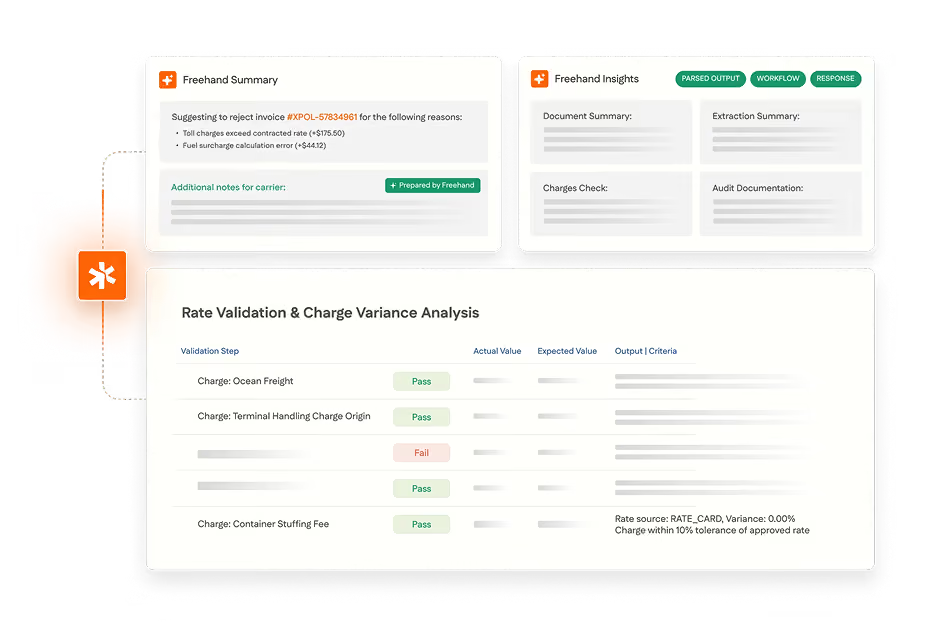
Freight Invoices Checked Against the Contract, Not Just the Coding.
Freehand audits every line against your carrier agreements before it ever reaches approval, so AP automation isn't just routing errors faster.
AvidXchange Routes the Invoice. It Doesn't Know If the Rate Is Right.
General AP automation approves what's coded correctly. It was never built to catch a freight accessorial that shouldn't have been billed.
Every warehouse. Every provider. Every mile.
Gartner's 2026 outlook on logistics outsourcing, and how AI Teams hold every contract to the terms you agreed.
- Where outsourced logistics quietly loses margin
- Why billed charges drift from the contract
- How AI Teams close the gap


.png)