
Best AI Freight Audit and Payment Software in 2026: 10 Platforms Compared
.webp)
July 8, 2026
•
11
mins
Comparing the best AI freight audit and payment software for 2026: 1. Loop, 2. Freehand, 3. Intelligent Audit, 4. TriumphPay, 5. Trax Technologies, 6. nVision Global, 7. Sifted, 8. Shipware, 9. Zero Down, and 10. Orca Freight.
U.S. freight billing errors run at 3 to 7% of total freight spend. On $500M a year, that is $15M to $35M in overcharges sitting inside invoices most enterprises have never fully audited. The platforms below close that gap in very different ways. Some resolve exceptions autonomously. Others route them to analysts.
This is a buyer's guide for enterprise shippers. If you carry serious freight spend and you sit in supply chain, finance, procurement, or IT leadership, the comparison below is built to help you shortlist and book the right demos.
Below, we are going to see a detailed comparison of the best freight audit and payment software for 2026, one line per platform, before the full breakdown.
TL;DR: The best freight audit and payment software at a glance
- Loop: AI-native platform with the strongest independently verified recovery evidence here, plus J.P. Morgan carrier payment.
- Freehand: the only fully agentic option, AI Teams resolve exceptions without human review, with a published 12 to 14 week go-live.
- Intelligent Audit: 29 years of domain depth and a managed-service layer for parcel-heavy shippers.
- TriumphPay: unified audit and payment built for broker and carrier networks.
- Trax Technologies: the broadest global carrier network at 21,000+ carriers, for multinational spend visibility.
- nVision Global: fixes invoice data quality upstream before the audit runs.
- Sifted: parcel spend intelligence with a subscription model where you keep 100% of recovery.
- Shipware: former carrier pricing analysts and contingency pricing for contract renewals.
- Zero Down: configurable workflows for non-standard billing structures.
- Orca Freight: peer-reviewed audit methodology for teams formalizing FAP for the first time.
Buyers researching this space search for it several ways: freight audit companies, freight audit services, freight audit and payment providers. The differences are mostly vendor model, whether you get software, a managed service, or both, not the underlying job.
Comparison table: top freight audit and payment software for 2026
| Platform | Best for | Audit Autonomy | Go-live | Cost Recovery / ROI | Pricing Model | Overall (/5) |
|---|---|---|---|---|---|---|
| Loop | Strongest verified recovery proof | AI-assisted, autonomous disputes | Not published | 2 to 7% recovered; ~9x ROI in 9 months | Custom enterprise | 4.7 |
| Freehand | Fully autonomous resolution, fastest go-live, lowest leakage | Fully agentic | 12 to 14 weeks | 1.5%+ recovered; 5 to 10x ROI | Custom, volume-based | 4.5 |
| Intelligent Audit | Parcel depth and institutional expertise | Human-in-loop | Not published | Not published | Custom, often savings-based | 4.2 |
| TriumphPay | Broker and carrier unified payment | AI-assisted | Not published | 98%+ discrepancy detection | Network and fee-based | 4.0 |
| Trax Technologies | Multinational spend visibility | AI-assisted | 3 to 6 months | 5 to 7% recovered | Custom, premium | 3.8 |
| nVision Global | Upstream invoice data quality | AI-assisted upstream | Not published | Not published | Custom, per-invoice | 3.6 |
| Sifted | Parcel spend intelligence, no savings fee | AI-assisted | Fast | Not published; you keep 100% of recovery | Subscription, no savings fee | 3.5 |
| Shipware | Contract renegotiation leverage | Advisory | Fast | Not published; contingency, earns on savings | Contingency-based | 2.6 |
| Zero Down | Non-standard billing structures | Partial AI | Quick | Not published | Tiered, transparent | 3.2 |
| Orca Freight | First-time FAP, peer-reviewed method | Human-in-loop | Mixed reviews | Not published | Custom, volume-based | 2.1 |
Overall is our weighted editorial score on the criteria below, not a third-party rating.
What is freight audit and payment software?
Freight audit and payment (FAP) software automatically checks transportation invoices for errors, manages carrier payments, and gives finance teams visibility into logistics spend. It typically:
- Runs multi-way matching across the invoice, rate or contract, shipment, and PO
- Catches incorrect rates, duplicate charges, and wrong accessorials
- Codes each cost to the right GL account
- Releases clean invoices to carrier payment
- Adds anomaly detection and autonomous exception handling on AI platforms
For a CFO it means accurate accruals and recovered spend; for a CIO, clean data and fewer manual queues without a custom integration; for a CSCO or VP of supply chain, freight billing becomes a source of decisions. See how this works on Freehand's platform page.
How We Evaluated AI Freight Audit and Payment Software
We scored every platform on six weighted criteria, sourced from vendor documentation, G2, Gartner Peer Insights, and the 2026 Gartner Market Guide. Autonomy and verified evidence carry the most weight, since they separate platforms that resolve exceptions from those that only flag them.
- AI autonomy and exception resolution (25%): resolves discrepancies without human review, or routes to an analyst.
- Verified recovery evidence (20%): independently confirmed savings and reviews vs. unconfirmed claims.
- Audit accuracy and coverage (15%): matching depth, error types caught, share of invoices audited.
- ERP and carrier integration (15%): native connectors, TMS compatibility, carrier network breadth.
- Go-live speed (15%): published implementation timelines and internal effort required.
- Pricing transparency (10%): disclosed pricing vs. custom quotes with hidden fees.
Independent editorial comparison referencing Gartner and G2 alongside vendor documentation, not a certified third-party ranking.
Best AI freight audit and payment software, ranked for 2026
The AI-native platforms lead on autonomous audit and verified recovery; the incumbents follow on scale and network reach.
Loop
Best for
Large enterprises that need the strongest documented recovery evidence to build an internal business case, want carrier payment alongside audit, and run freight and parcel across multiple modes.
Loop is an AI-native logistics data platform founded in 2021 by former Uber Freight leaders. Its DUX model reads unstructured documents and turns them into clean, unified data before the audit runs. The 2025 Data2Logistics merger added 60+ years of freight audit domain depth and global payment execution.
Key Features
- DUX 2.0 normalizes PDFs, EDIs, emails, spreadsheets, customs documents, and POs before audit
- Exception Agent initiates carrier disputes and resolves them without a human reviewing the queue
- Freight and parcel audit across ocean, air, LTL, and TL
- J.P. Morgan integration for carrier payment under one vendor relationship
- Spend analytics and visibility built on normalized data
- Anomaly and discrepancy detection across modes
- API-first ERP, TMS, and accounting integration
- Backing from Founders Fund, J.P. Morgan Asset Management, 8VC, and Index Ventures
Pricing
Custom enterprise pricing, not published. Quotes depend on freight volume and modules, so expect a sales conversation before you see numbers.
Pros
- Strongest independently sourced recovery proof in this comparison, including Fortune 100 names
- Data normalization layer most competitors expect you to solve yourself
- Audit and carrier payment under one roof
Cons
- No published standard go-live timeline or public pricing floor
- Parcel capability is newer, added through the Data2Logistics merger
What Users Say
- Love: Trusted, accurate, transparent audit. A reviewer says Loop is "a trusted partner with their deep knowledge of transportation that delivers accuracy, transparency and speed to our process." (source)
- Complain: Newer platform, thin review base. Loop's broader Logistics Data Platform launched in 2026, so independent review coverage of the newer features is still limited. (source)
Not the right fit? See our Loop alternatives breakdown.
Freehand
Best for
Enterprises where eliminating the manual exception queue entirely, not just shrinking it, is the goal, and where SAP or Oracle integration without EDI workarounds is non-negotiable. A strong fit for CFO, CIO, CSCO, and CPO buyers above $250M in freight spend.
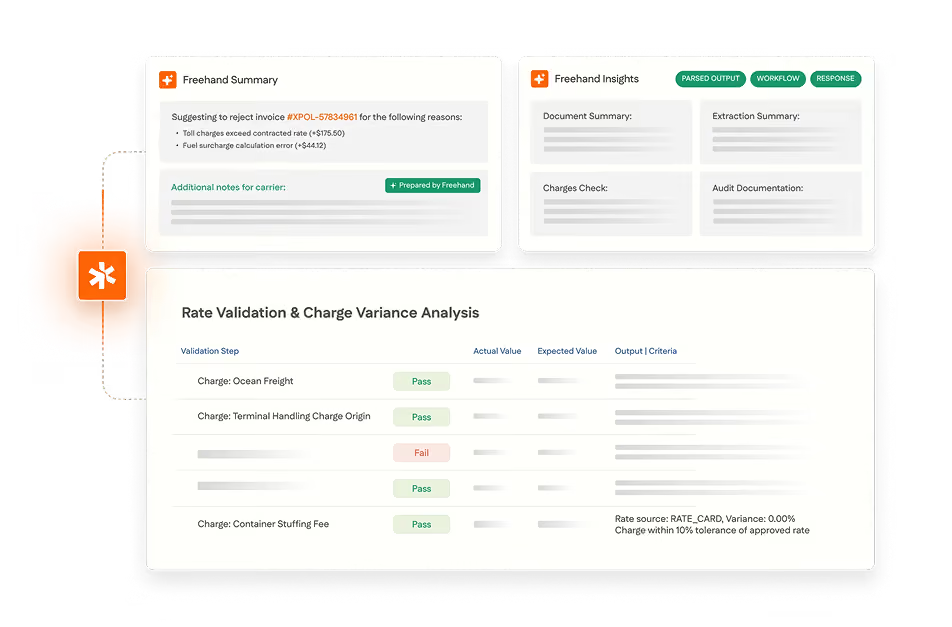
Freehand is a fully agentic freight audit and payment platform that came out of stealth at Manifest 2026. Its Autonomous AI Teams run the full invoice lifecycle: ingestion, matching, discrepancy detection, carrier dispute, resolution, and ERP posting, without a human reviewing the queue. It processes $50B+ in freight payments annually.
Those AI Teams are individually addressable. The anomaly detection agent flags charges that break historical patterns, the audit trends agent tracks how exceptions move over time, and the alerting agent routes the ones that need review. Once an overcharge is confirmed, the dispute management agent and dispute resolution agent carry the case to closure with the carrier, and the claims recovery agent pursues the money back.
Key Features
- AI Teams execute decisions directly in your ERP, not just surface exceptions
- 100% audit coverage instead of 15 to 30% sampling
- Multi-way matching across invoice, rate, shipment, and PO
- 30+ billing error types caught: accessorials, rate variance, surcharge mismatches
- Duplicate invoice detection at scale
- Real-time GL coding posts automatically after audit
- Native ERP connectors for SAP (ECC and S/4HANA), Oracle (Cloud ERP and JDE), NetSuite, and Dynamics, plus TMS-agnostic integration
- 12 to 14 week go-live built on a client-exclusive model with no pooled data
Pricing
Custom, volume-based. No percentage-of-savings fees and no data connection fees, so you get a quote after a scoping call.
Pros
- The only fully agentic platform here, exceptions resolve without analyst review
- Fastest published go-live and a client-exclusive data model
- One platform spanning freight audit, payment, AR, and trade compliance
Cons
- Launched in early 2026, so the named customer reference pool is still small
- Built for enterprise, not mid-market or single-carrier shippers
What Users Say
- Love: Full-lifecycle autonomy, not just detection. Freehand's AI Teams execute audit, dispute, and GL posting decisions directly in the ERP at 100% invoice coverage, positioning it as the only fully agentic platform in this comparison. (source)
- Complain: Newer entrant, small reference pool. Freehand launched in early 2026 and carries no Gartner Peer Insights or G2 presence yet, so buyers currently validate it through reference calls rather than aggregated ratings. (source)
{{blue-cta}}
Intelligent Audit
Best for
Parcel-heavy shippers and teams that want institutional depth and a managed-service layer, with optional strategic sourcing advisory for carrier negotiations.
Intelligent Audit, founded in 1996, has audited 2.1B+ shipments and represents 20% of the Fortune 50. It pairs freight and parcel audit software with DeepDetectAI for anomaly and fraud detection, plus optimization modeling that goes beyond simple error catching.
Key Features
- DeepDetectAI surfaces billing anomalies across all modes
- SKU-level freight cost visibility against forecast
- Contract renewal alerts catch carriers billing expired rates
- Strong parcel service-failure detection and recovery
- Payment processing through a TriumphPay integration
- ERP integration with GL coding and cost allocation
- Strategic sourcing advisory available as an add-on
- Catalyst program for $15M to $150M revenue businesses
Pricing
Custom enterprise, often with a savings-based or contingency component plus a SaaS fee. Not published, and it starts with a discovery call.
Pros
- Nearly three decades of domain data behind the audit
- Excellent parcel recovery and a usable interface
- Managed-service depth with optional carrier advisory
Cons
- Exceptions are resolved by human analysts, not autonomously
- Configuration requires ongoing consultant touchpoints
What Users Say
- Love: Clear invoice visibility and layered approvals. A Technical Program Manager praised easy navigation, a clear view of all logistics invoices, and a multi-layer approval workflow with scheduled reporting. (source)
- Complain: No pending-approval notifications. The same reviewer wanted email alerts when an invoice is awaiting approval, which the tool currently lacks. (source)
Not the right fit? See our Intelligent Audit alternatives breakdown.
TriumphPay
Best for
Freight brokers, carriers, and 3PLs that want audit and payment unified, with working capital and liquidity tools that pure FAP platforms do not offer.
TriumphPay is a digital freight payment network with built-in audit, quick pay, and carrier onboarding. It handles OCR invoice ingestion, automated auditing with AI exception management, and electronic payments across 50,000+ carriers. Its Triumph Intelligence data asset is one of the largest in the category.
Key Features
- Unified audit and carrier payment in one system
- NextGen Audit validates invoices against rate confirmations
- $70B+ freight data asset for anomaly detection
- Freight factoring and working capital alongside audit
- Quick pay options for faster carrier settlement
- McLeod, 3G, and TMW TMS integrations
- Useful for 3PL and 4PL audit software needs
- Ranked #4 on the FreightWaves FreightTech 25 2026
Pricing
Network and fee-based, including quick-pay and factoring fees. Varies by role and volume rather than a flat license.
Pros
- Audit, payment, and liquidity tools combined in one platform
- Large freight data asset improves carrier billing anomaly detection
Cons
- Broker-first architecture means shipper workflows need more configuration
- No published shipper-side recovery outcomes from independent sources
What Users Say
- Love: Unified audit, payment, and liquidity in one network. TriumphPay pairs invoice audit with quick pay and factoring, giving carriers and brokers working capital tools most pure audit platforms do not offer. (source)
- Complain: Broker-first architecture, thin shipper-side review signal. TriumphPay's network is built around brokers and carriers, and there is little independent shipper-side review data to benchmark outcomes against. (source)
Trax Technologies
Best for
Multinationals where freight runs across many regions and modes, and the priority is centralized spend visibility rather than autonomous resolution.
Trax processes more than $24 billion in annual transportation spend across 21,000+ carriers worldwide. Its Prizma.AI layer adds invoice validation trained on 25+ years of normalized freight data. It is a managed offering with the broadest global carrier coverage in this comparison.
Key Features
- 21,000+ carrier network, the widest coverage here
- Centralized spend visibility across all modes and regions
- SKU-level cost allocation to products and business units
- Prizma.AI validation on decades of freight data
- Contract compliance alerts before disputes compound
- SAP, Oracle, Blue Yonder, Microsoft Dynamics, and Workday integrations
- SOC 2, GDPR, and ISO 27001 for formal data governance
- Carrier and lane benchmarking
Pricing
Custom, premium pricing for a managed service. Not published, and quotes scale with spend and modules.
Pros
- Unmatched global carrier network for multinational freight
- Deep analytics that reduce spend over time
Cons
- 3 to 6 month implementation, the longest standard timeline here
- Pooled data model shared across customers, and a mixed FPS migration
What Users Say
- Love: Established multi-modal audit and reporting. Long-standing coverage of global freight spend across modes, with reviewers valuing its reporting depth. (source)
- Complain: Support gaps and unclear exception handling. A Manager at a $10B+ manufacturer cited "too many gaps in operations and management" and low confidence in support and exception clarity, plus an aging TPS platform. (source)
Not the right fit? See our Trax Technologies alternatives breakdown.
nVision Global
Best for
Operations where the audit keeps failing before it starts, because carrier invoice formats are inconsistent and documentation is missing, so exceptions are a data problem.
nVision Global provides freight audit and payment across more than 200 countries, and is the only platform here with a dedicated AI layer for pre-audit data validation. Its nSure AI Data Capture extracts, standardizes, and validates invoice data in real time before the audit engine sees it.
Key Features
- nSure AI validates and standardizes invoice data upstream
- Upstream validation reduces the exception volume downstream
- Global audit and payment across modes and currencies
- Regional service centers for local compliance and language
- Claims management and recovery
- Carrier rate management and contract compliance checks
- Logistics business intelligence and reporting
- Recognized in the 2026 Gartner Market Guide
Pricing
Custom enterprise, usually per-invoice or per-transaction. Not published.
Pros
- Solves the data quality problem Gartner ranks first in the category
- Strong global and multi-currency coverage
Cons
- Downstream audit is AI-assisted with human review, not autonomous
- No published dollar recovery benchmarks for independent comparison
What Users Say
- Love: Region-by-region customization, reliable service. A Supply Chain Manager at a $10B+ manufacturer notes solutions tailored to each region that adjust year over year, calling them a reliable partner. (source)
- Complain: Thin independent software reviews. nVision runs largely as a managed service, and its G2 product profile shows no reviews, limiting software-level diligence. (source)
Not the right fit? See our nVision Global alternatives breakdown.
Sifted
Best for
Parcel-heavy enterprise shippers that want logistics intelligence beyond audit, into carrier strategy and scenario modeling, with no percentage-of-savings fee.
Sifted is a parcel-focused spend intelligence platform and a G2 Leader in parcel audit. Unlike most parcel auditors, it does not charge a percentage of recovery, so high-volume shippers keep 100% of what is recovered. SiftedAI Copilot makes spend data usable for finance and procurement teams.
Key Features
- Subscription model, you keep 100% of recovered amounts
- SiftedAI Copilot opens audit findings to finance and procurement
- Scenario modeling for carrier network decisions
- Contract benchmarking for carrier renewals
- Automated parcel audit and discrepancy detection
- Accounting integrations included
- Starts with only API or carrier portal credentials
- All-modes expansion underway in 2026
Pricing
Subscription-based with no savings fee. A spend minimum and audit terms apply, so verify current pricing directly before shortlisting.
Pros
- No savings fee, which compounds for high-volume parcel shippers
- Strong analytics and scenario modeling beyond invoice recovery
Cons
- Parcel is the primary mode, all-modes coverage is still expanding
- No published per-customer recovery benchmarks
What Users Say
- Love: No savings fee compounds at volume. Sifted holds G2 Leader status in parcel audit and logistics intelligence, and its subscription model means shippers keep 100% of recovered amounts instead of paying a percentage. (source)
- Complain: Parcel-first, all-modes still maturing. Sifted's deepest strength is parcel, and its expansion into other modes was still underway as of 2026, so multi-mode shippers should confirm current coverage directly. (source)
Shipware
Best for
Shippers approaching a carrier contract renewal who want former carrier pricing insiders reviewing invoices and negotiating, with no out-of-pocket cost until savings appear.
Shipware pairs a 65-point audit engine with a team of former UPS, FedEx, and LTL pricing analysts. That carrier-insider knowledge shapes contract renegotiations and invoice reviews in a way pattern-trained models do not. The audit scope is publicly documented, which is rare in this market.
Key Features
- Former UPS, FedEx, and LTL pricing analysts on the team
- 65-point audit framework with publicly documented scope
- Contingency model, no upfront cost
- Contract renegotiation support for renewals
- Parcel and LTL invoice auditing
- Part of the SIB and SpendBrain platform
- Accounting integrations included
- Low entry point relative to enterprise platforms
Pricing
Contingency-based, so Shipware earns only on savings delivered. No upfront cost, with a modest spend minimum.
Pros
- Carrier-insider expertise for contract renegotiation
- No upfront cost and a clearly documented audit scope
Cons
- The 65-point ceiling is a hard limit on what is caught
- Consulting-first model means throughput scales with headcount
What Users Say
- Love: Carrier-insider expertise, no upfront cost. Shipware's team of former UPS, FedEx, and LTL pricing analysts and its contingency pricing model are its most cited strengths in independent comparisons. (source)
- Complain: Consulting-first, thin review footprint. Shipware's audit and negotiation work leans on analyst headcount rather than software autonomy, and it carries little independent G2 or Gartner review data. (source)
Not the right fit? See our Shipware alternatives breakdown.
Zero Down
Best for
Mid-market to enterprise shippers whose billing structures are too non-standard for rigid platforms: complex carrier mixes, unusual accessorials, and multi-tier cost allocation.
Zero Down configures the audit to your billing structure rather than asking you to fit a template. It supports multi-modal freight across LTL, TL, parcel, and intermodal, with weekly reporting set up for business unit teams to act on directly.
Key Features
- Configurable workflows built around your carrier mix
- Multi-modal coverage across LTL, TL, parcel, and intermodal
- Weekly reporting configured per business unit
- Invoice verification and compliance checking
- Accounting system integrations
- Tiered, transparent pricing
- Dedicated implementation support
- Data analysis for business decisions
Pricing
Tiered and transparent, which suits mid-market budgets. Quotes scale by volume, so contact the vendor directly.
Pros
- Handles non-standard billing that templates cannot
- Implementation quality and support are well reviewed
Cons
- Partial AI, not autonomous resolution
- Lower brand visibility slows procurement diligence
What Users Say
- Love: Fast, hands-on freight invoice auditing. Reviewers point to quick responsiveness and practical audit help, with a Director of Operations saying it has been "very helpful auditing our freight invoices." (source)
- Complain: No independent review footprint outside Gartner. Zero Down has strong Gartner rating volume but no G2 profile, so buyers cannot triangulate quality through a second channel. (source)
Orca Freight
Best for
Organizations formalizing their FAP function for the first time, who want consistent delivery, peer-reviewed audit methodology, and dedicated account management.
Orca Freight is the most emerging platform in this comparison. It earns a place through verified Gartner Peer Insights reviews and a peer-reviewed audit methodology, an independent validation layer that some compliance-driven buyers specifically require.
Key Features
- Peer-reviewed audit methodology for compliance sign-off
- Consistent weekly process delivery
- Dedicated account management
- Multi-modal invoice verification
- Compliance checking
- Accounting system integration for reconciliation
- Accessible implementation without enterprise complexity
- Verified Gartner Peer Insights presence
Pricing
Volume-based. Not published, so contact Orca Freight for a quote.
Pros
- Peer-reviewed methodology no other platform here offers
- Consistent delivery and dedicated support
Cons
- Least established on recovery evidence and AI autonomy
- Some implementation experiences are described as average
What Users Say
- Love: Consistent weekly process with dedicated reps. A Director of Supply Chain at a $1B to $10B shipper credits week-to-week consistency and reps who know their accounts. (source)
- Complain: Slow to ramp early on. An Operations Manager flagged initial service delays before the partnership improved, so expect an onboarding lag. (source)
How to choose the right AI freight audit and payment software
Match the platform to the need driving the purchase, then confirm it against your ERP, spend level, and evidence requirements.
- You need the manual exception queue closed, not just reduced: Freehand is the only fully agentic platform here, resolving discrepancies and posting to the GL without an analyst reviewing the queue.
- Your priority is reducing billing leakage specifically: Freehand's 100% invoice coverage and autonomous exception resolution close leakage that sampling-based, percentage-audited platforms miss by design.
- Your ERP is SAP or Oracle and custom integration work is the bottleneck: Freehand's native SAP ECC, S/4HANA, Oracle Cloud ERP, and Oracle JDE connectors remove the EDI workarounds most audit platforms require.
- You need proof for an internal business case built on named references: Loop has the strongest independently verified recovery evidence in this comparison.
- You need institutional depth or global carrier reach: Intelligent Audit brings nearly three decades of parcel expertise, and Trax Technologies covers 21,000+ carriers for multinational spend visibility.
Confirm go-live timeline and evidence depth against your own procurement standard before you commit.
Other freight audit and payment tools logistics teams consider
These providers come up in FAP evaluations but are not part of the ranking above.
- CTSI-Global: a freight audit and payment provider that pairs invoice auditing with logistics management and TMS capabilities.
- Green Mountain: a freight audit and payment company built around detailed invoice auditing and carrier contract management.
- ControlPay: a European-rooted freight audit platform with a self-service auditing tool for shippers who want to manage their own rules.
Our recommendation
If eliminating the manual exception queue, reducing billing leakage, or getting native SAP or Oracle integration is the mandate, start with Freehand. It's the only fully agentic platform in this comparison and has the fastest published go-live.
If your organization needs the strongest documented recovery evidence and named references to build an internal case first, Loop is currently ahead on independently verified evidence. Intelligent Audit and Trax remain credible where institutional depth or global carrier reach matters more than autonomous resolution.
Decide first whether your organization can evaluate on architecture or needs named references, since that answer points to a different platform.
{{brown-cta}}
Frequently asked questions
What is the best AI freight audit software in 2026?
Loop leads on verified recovery evidence and Freehand leads on AI autonomy. Which matters more depends on whether procurement needs named references or can evaluate on architecture.
How do I tell if a platform is AI-native or rules-based?
Ask for the exact percentage of invoices resolved without human review in live production. Answers given as ranges usually mean a rules-based engine with an AI label.
How much can freight audit software recover annually?
Billing errors run 3 to 7% of freight spend. On $500M a year, that is $15M to $35M recoverable. Loop customers typically recover 2 to 7%.
Is AI freight audit software better than a BPO?
For shippers above $250M in freight spend, usually yes. Software audits 100% of invoices at flat per-invoice cost, while BPO audits a sample and scales cost with volume.
How much does freight audit and payment software cost?
Most vendors use custom pricing: per-invoice fees, a percentage of savings, or a subscription. Public price lists are rare, so expect a quote after a demo.
What is a Freight audit and payment (FAP) provider?
A freight audit and payment provider collects, audits, and pays your transportation invoices, then reports on spend, billing accuracy, and carrier performance.
What is the best freight audit and payment product to reduce billing leakage?
Freehand closes leakage that sampling-based audits miss by auditing 100% of invoices and resolving accessorial, rate, and duplicate-billing exceptions autonomously, instead of routing them to an analyst queue.
What AI tools handle bill audit and freight cost recovery operations?
AI-native platforms like Freehand combine full-coverage invoice auditing with autonomous carrier dispute filing, so recovery happens as part of the audit itself rather than a separate manual claims process afterward.
How is Freehand different from Loop?
Both are AI-native. Loop excels at unifying logistics data, while Freehand's agents go further and resolve, code, and pay exceptions autonomously rather than just flagging them.
What do freight audit companies do?
Freight audit companies review carrier invoices against contracted rates, flag or resolve discrepancies, and route corrected invoices to payment. Some operate as managed services with staff working exceptions; others deliver it as software that runs the audit and resolution autonomously.
How do freight audit and payment providers price their services?
Pricing runs three ways: per-invoice or per-transaction fees, a percentage of savings recovered, or volume-based software pricing. Managed-service providers typically use the first two; software-delivered platforms like Freehand use volume-based pricing tied to invoices processed, not seats.
Conflict of interest disclosure:
This guide is published by Freehand, a freight audit and payment vendor included in this comparison. We applied the same criteria to ourselves as to every other platform, ranked Loop ahead of us on current verified evidence, and tied Freehand's numbers to its own case studies. Run the same criteria in your own RFP and score each vendor independently, including us.
You Compared 10 Platforms. Your Backlog Didn't Move Yet.
Freehand's AI Teams audit every invoice end to end, then escalate only the exceptions that need a human. Your backlog stops being yours to fix today.
A 15% Sample Misses 85% of Your Invoices.
Sampling audits check a slice of invoices and extrapolate the rest. Freehand audits every invoice instead.
Every warehouse. Every provider. Every mile.
Gartner's 2026 outlook on logistics outsourcing, and how AI Teams hold every contract to the terms you agreed.
- Where outsourced logistics quietly loses margin
- Why billed charges drift from the contract
- How AI Teams close the gap